
Amazon’s Q3 earnings beat expectations, with AWS growth rebounding to around 20%, retail and advertising remaining solid, and AI infrastructure investments exceeding $100 billion, boosting market confidence. Shares jumped over 10% post-market, driven by strong results and capital spending, while long-term returns will hinge on in-house chip development and order fulfillment.
After the U.S. market close on October 30 (early morning in Australia), Amazon delivered a strong Q3 report. Revenue and earnings per share (EPS) comfortably beat expectations, AWS growth rebounded, and profits improved. Retail and advertising remained steady, and the company raised its Q4 guidance. Beyond the “perfect scorecard,” the most exciting takeaway for investors is Amazon’s growing commitment to AI, with plans to invest over $100 billion in AI infrastructure.
The market reaction was immediate: the combination of better-than-expected results and aggressive AI capital spending fueled a surge in trading, with shares rising over 10% within an hour of the report. Traders clearly raised their expectations for Amazon’s future growth potential.
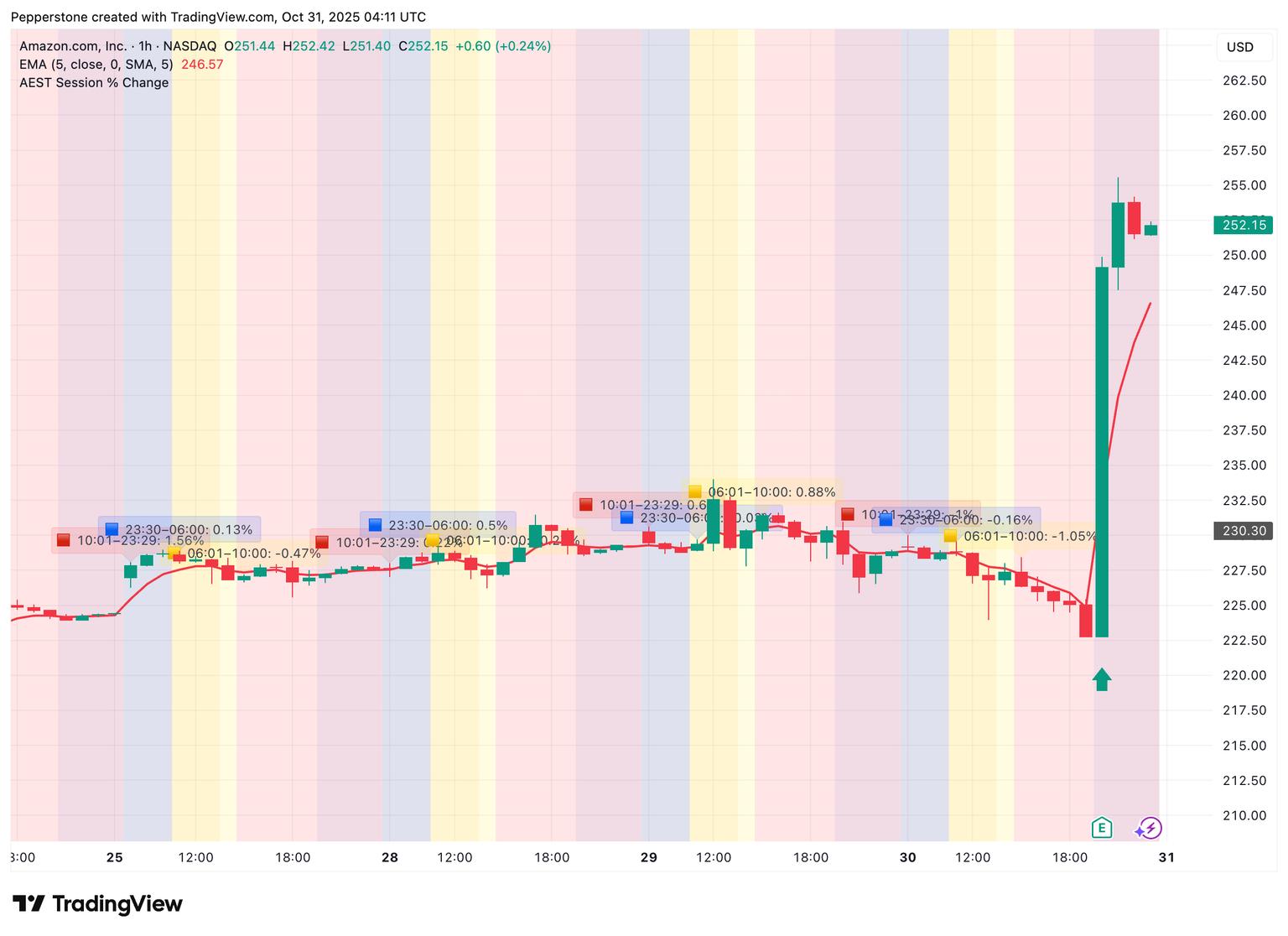
Yet, the report also carried some caution. While ramping up AI investments, Amazon simultaneously announced large-scale layoffs and recorded roughly $1.8 billion in severance costs, highlighting the cost and organizational pressures behind its expansion.
Overall, the earnings convey two main signals: first, Amazon has made cloud and AI its core growth engines for the next phase; second, the company is aligning aggressive capital spending with organizational restructuring to support these goals.
While the strategy is clear and logically sound, translating massive investments into sustainable long-term returns will depend on execution pace, customer retention, and successful deployment of in-house technology.
AWS Recovery: Amazon’s Growth Engine
AWS’s rebound is a standout of this quarter’s report. Its year-on-year growth returned to roughly 20%, with quarterly revenue surpassing $33 billion, significantly supporting Amazon’s overall profitability. Although cloud revenue doesn’t represent the largest share of total sales, it contributes most of the company’s operating profit, and growth recovery clearly boosts overall earnings quality.
Management emphasized that most new capacity was quickly absorbed by the market, reflecting ongoing demand for enterprise cloud services. Improved supply-demand balance reduces concerns over overinvestment or idle capacity, providing clear support for the stock.
In the near term, AWS’s steady growth gives Amazon time and flexibility to pursue its AI ambitions. In coming quarters, sustained AWS growth will depend on how quickly new capacity is absorbed, customer diversification, and maintaining margins amid rising competition—factors that will directly influence whether AWS continues to fuel Amazon’s long-term growth.
Retail and Advertising: AI Delivering Value
Beyond cloud and infrastructure, Amazon is integrating AI into retail and advertising. Growth in users and conversion rates for shopping assistants like Rufus, along with double-digit advertising growth, shows AI is not just “selling compute”—it’s enhancing front-end efficiency and conversions, expanding profit potential.
This front- and back-end monetization model is a unique advantage, amplifying the impact of technology investments on both cost and revenue.
Strong Foundations and Future Bets: Opportunities and Risks
Amazon shows a combination of “clear strategic direction” and “uncertain return timing.” With clear demand signals, the company is investing heavily in infrastructure—a logical strategy, yet one with notable risks.
First, high customer concentration may create pricing pressure—if major clients shift to other cloud providers for better deals, Amazon’s utilization and pricing power could be affected. Second, competition is intensifying, with Microsoft and Google also ramping AI infrastructure investments, making pricing and service innovation an ongoing battleground. Finally, regulatory and compliance costs, including one-off settlements, could affect short-term profits.
In the short term, AWS growth and AI applications in retail and advertising will continue to support results. For long-term sustainable returns, success depends on whether in-house chips and external procurement strategies complement each other, are accepted by customers, and whether organizational adjustments maintain efficient delivery and continuous innovation.
.png?format=pjpg&auto=webp&width=1536&quality=75&branch=main)