From Market Darling to Frustrating Trade
Meta was a market darling from April to August, with shares rallying almost 70% to touch $800. Since mid-August, however, it has become a frustrating trade, underperforming many other high-growth names.
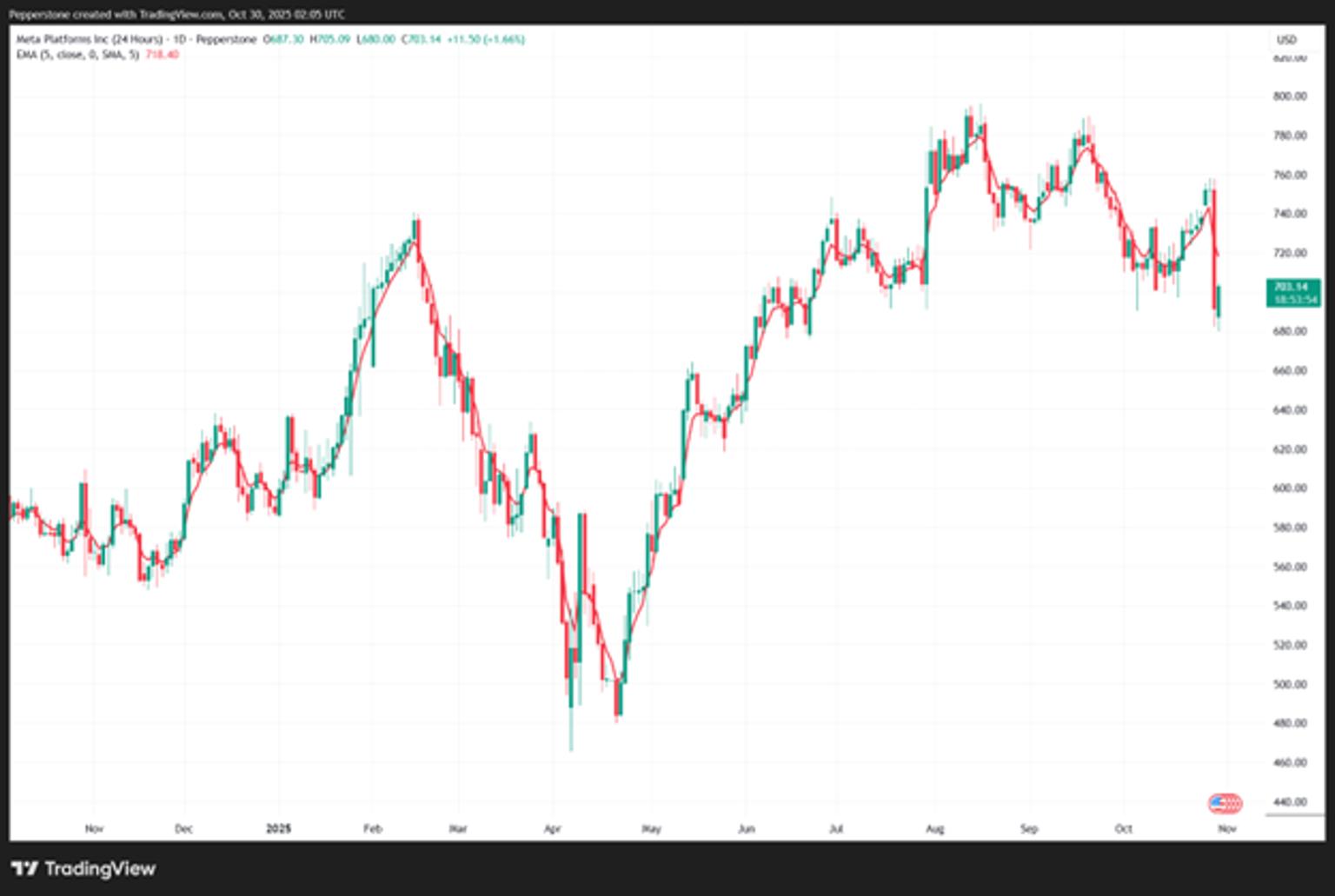
Investors had been hoping that Meta’s Q3 2025 earnings and guidance would reignite momentum and trigger a decisive break above $800. Instead, the initial reaction suggested disappointment — shares fell 8% in post-market trading.
Pepperstone’s Meta 24-Hour CFD price has since rallied off the $680 low, suggesting the gap lower in the main U.S. session may be less severe. Still, shares remain down 6.5% since the announcement — a larger move than implied by options pricing — which tells its own story.
What Concerned Investors?
The biggest concern was the company’s guidance on capex dollar growth — Meta said that capital expenditure in absolute U.S.-dollar terms would be “notably larger” in 2026 than in 2025.
In addition, Meta projected that expense growth would be “significantly faster” than in 2025, rising above 30%, well beyond historical trends and raising fears of margin compression. For context, Q3 operating margins rose 40% year-on-year, below the 43% expected by the Street.
Investors are questioning whether Meta’s strategy to accelerate massive investment in data centres and AI infrastructure — which management says will enhance ad-targeting effectiveness — will deliver sufficient returns.
CEO Mark Zuckerberg spent much of the post-earnings call clarifying the rationale for these AI investments, emphasising that the company is already seeing benefits and anticipates stronger returns ahead. However, the market remains unconvinced.
Solid Core Results Overshadowed
Fundamentally, the results were solid:
- Q3 advertising revenue +26% (y/y) vs market +22%
- Ad impressions +14% (y/y) vs Street +10.8%
- Operating income +18% (y/y)
- Q4 revenue guidance: $56–59 billion (+16–22%) vs +20% consensus
Despite the strength in headline numbers, sentiment turned negative as investors focused on spending growth rather than earnings growth.
Summary and Outlook
There’s a lot to like in Meta’s earnings report, but the outsized post-market sell-off clearly reflects investor unease about rising expenses and heavy AI-infrastructure investment.
Buyers may emerge into weakness once the dust settles, but if investors were expecting this result to spark a breakout above $800, that scenario hasn’t played out. Instead, the earnings have raised more questions about the return on investment than they’ve answered.