- English


Trading the 2026 US Midterm Elections: Where Could the Biggest Market Moves Come From?

Why should traders care about the US midterms?
Midterms don't determine the presidency, but they can materially change the administration's ability to govern.
A Democratic sweep could strengthen congressional oversight, constrain elements of Trump's legislative agenda and increase the potential for political gridlock. Continued Republican control would provide greater scope to advance administration priorities.
Importantly, the magnitude of any victory matters. A decisive majority offers more legislative leverage than a narrow one, although presidential veto powers and Senate procedural rules remain significant constraints.
For traders, the transmission runs through expectations for government spending, taxation, regulation, inflation and ultimately interest rates.
The biggest moves may emerge when the result differs materially from prediction-market pricing, particularly if investors are heavily positioned for one outcome.
What history tells us about trading US midterm elections
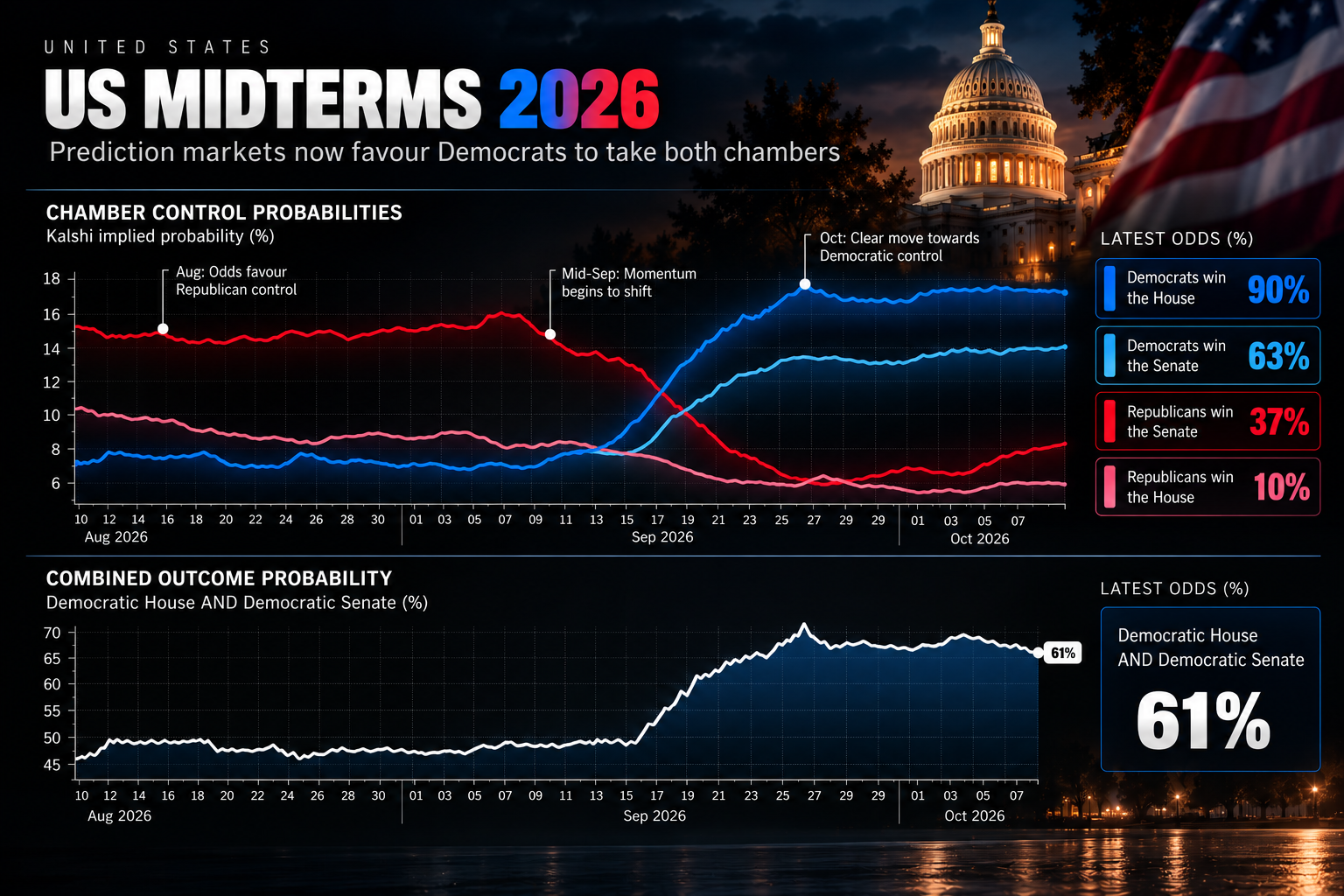
History offers some interesting clues, although the sample is small and the macro environment surrounding each election has been very different.
Across the five midterm elections between 2006 and 2022, the Nasdaq 100 and gold generally performed positively in the month leading into the vote, while the US Dollar Index tended to weaken.
Average returns across the 2006, 2010, 2014, 2018 and 2022 midterms, using the supplied historical dataset.
Three observations stand out:
- US dollar: The USD weakened in three of five pre-election months, but its average return one month after the vote was effectively flat. There is little evidence of a reliable post-election directional bias.
- Nasdaq 100: The index gained in four of five pre-election months and averaged a 1.94% advance in the following month. However, 2018 produced a 2.44% decline, highlighting the influence of monetary policy and broader risk sentiment.
- Gold: Perhaps the most interesting observation. Gold declined on the first trading day after all five elections, averaging -0.97%, before advancing over the following month in every instance, averaging +2.40%.
These patterns are worth monitoring, but five observations are insufficient to establish a dependable trading strategy.
The stronger lesson is that elections can trigger repositioning, while the sustainability of the move depends on the macroeconomic backdrop.
S&P 500 and Nasdaq 100: Could the election unlock another rally?
US equities have historically tended to perform well following midterm elections, as political uncertainty fades and attention returns to earnings, growth and monetary policy.
Since 1945, the S&P 500 has recorded an average fourth-quarter gain of approximately 4.2%, rising to around 6.4% during midterm election years, according to the historical seasonal figures used in this research.
Yet 2026 presents a different set of challenges.
The Nasdaq 100 remains heavily influenced by AI investment, mega-cap earnings and US Treasury real yields. Neither party is likely to immediately derail the structural AI investment cycle, although technology regulation, electricity policy and infrastructure investment could influence individual companies.
I would therefore focus less on whether the election is perceived as bullish or bearish and more on how Treasury yields respond.
Falling real yields could provide a powerful tailwind for growth equities. Conversely, another aggressive move higher in long-term borrowing costs could challenge valuations, particularly where earnings expectations are already elevated.
The critical signal will be whether an initial equity rally is supported by broader participation, improving liquidity and a constructive rates backdrop.
US dollar and gold: Where the macro reaction becomes critical
The US dollar and gold could provide particularly clean expressions of changing fiscal and monetary-policy expectations.
For the USD, the key transmission is through relative interest rates and Treasury yields.
An outcome that reduces expectations for fiscal expansion could support bonds and potentially weigh on the dollar. Conversely, renewed fiscal concerns or a repricing toward tighter Federal Reserve policy could provide support.
However, geopolitical risk and global demand for dollar liquidity can complicate that relationship.
Gold presents a different opportunity.
Its historical post-midterm performance is notable, but the more important variables remain real yields, the USD and demand for defensive assets.
A combination of falling Treasury real yields and a weaker dollar could support XAUUSD. Higher real yields and a stronger dollar would generally create headwinds, although safe-haven flows could offset those pressures.
For both markets, I would want the price action to confirm the underlying macro narrative rather than trade solely on the election result.
Which US equity sectors and stocks could see the biggest moves?
The more compelling opportunities may emerge through sector rotation rather than the headline S&P 500.
Several politically sensitive themes deserve attention:
- Healthcare: Medicaid funding, drug pricing and insurance regulation could influence UnitedHealth Group, Eli Lilly and Johnson & Johnson. The impact would vary considerably across hospitals, insurers and pharmaceutical businesses.
- Financials: JPMorgan Chase, Bank of America and regional banks could respond to changing expectations for capital requirements, regulatory oversight and the yield curve.
- Traditional and clean energy: Exxon Mobil, Chevron, NextEra Energy and First Solar offer different exposures to permitting, production, government incentives and electricity demand.
- AI infrastructure and industrials: NVIDIA, Broadcom, Vertiv, Eaton and Quanta Services could benefit from continued data-centre investment and grid expansion, although valuations remain sensitive to interest rates and capital-expenditure expectations.
- Defence: Lockheed Martin, RTX and GE Aerospace could react to changes in defence-spending priorities and procurement expectations
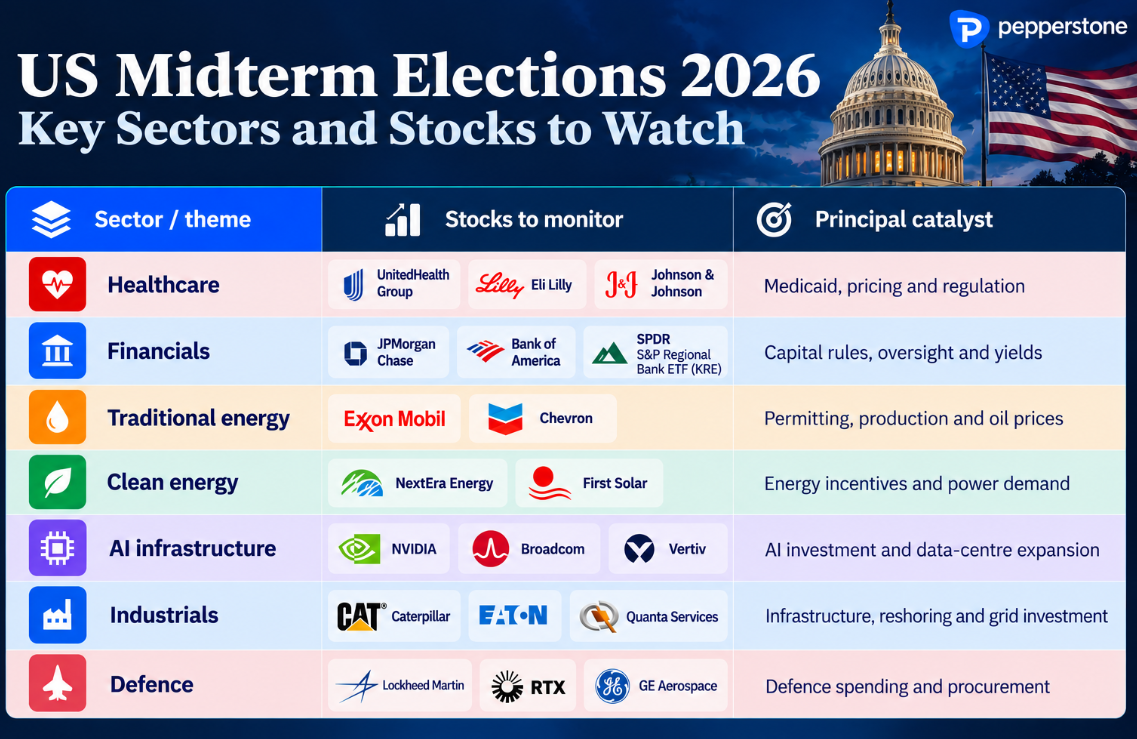
The key distinction is between businesses directly exposed to policy changes and those primarily driven by earnings, commodity prices or the broader economic cycle.
A favourable political outcome may already be priced into valuations. The larger opportunities could emerge where policy expectations change unexpectedly.
The hottest political themes for markets in 2026
Beyond congressional control, I see four themes with the potential to drive the most consequential market repricing.
1. Fiscal policy and Treasury supply
Persistent deficits, elevated debt-service costs and government borrowing requirements make the Treasury market central to the election trade.
A divided Congress could constrain new fiscal initiatives, but political gridlock does not automatically produce fiscal discipline.
The Treasury's quarterly refunding process around election week adds another potential catalyst.
2. AI investment and electricity demand
AI remains a powerful structural growth theme, but electricity availability, grid capacity and regulatory scrutiny are increasingly relevant.
The opportunity extends beyond semiconductors into utilities, power generation, electrical equipment and construction.
3. Energy affordability and geopolitics
Iran, Middle Eastern supply routes and domestic energy costs remain important sources of inflation risk.
Brent, WTI and refined products could react more directly to changes in foreign-policy expectations than to the congressional outcome itself.
4. Healthcare and financial regulation
Should Democrats secure both chambers, extending enhanced healthcare subsidies could become a priority, increasing projected federal deficits relative to their expiry, although Trump's veto remains an obstacle. Changes to bank capital requirements and regulatory oversight could also drive repricing across financial stocks.
Volatility: Could the biggest trade happen before election day?
Historically, equity volatility has often increased ahead of midterms before retreating as uncertainty clears.
Prediction-market probabilities, polling surprises and changing expectations for individual Senate races could all generate volatility before the vote.
Yet the election itself may not produce the largest move.
A result broadly consistent with market expectations could see implied volatility decline rapidly, while an unexpected or contested outcome could prolong uncertainty.
Traders need to distinguish between implied volatility, realised volatility and the cost of execution.
Wider spreads, slippage and rapid reversals can make election-night trading challenging, even when the directional view proves correct.
Trading the election night
Rather than entering the event with a fixed political prediction, I'd build a scenario-based watchlist and allow the market to reveal where the strongest opportunities are developing.
My priority screens would be:
- Treasury yields: Particularly the 10-year, 30-year and real-yield complex. These could provide the clearest signal for broader asset pricing.
- S&P 500 and Nasdaq 100 futures: Look for sustained directional moves, market breadth and confirmation from bond yields.
- US dollar: Monitor EURUSD, USDJPY and AUDUSD for changes in relative-rate expectations and risk sentiment.
- Gold: Focus on the interaction between real yields, the dollar and geopolitical risk.
- Oil and sector equities: Watch for changes in policy expectations and relative performance.
- Prediction markets and Senate results: Identify whether the outcome is challenging the consensus already embedded in asset prices.
A supposedly bullish result that fails to attract buyers can be just as informative as a decisive breakout.
Equally, a market that initially sells off but quickly attracts sustained buying may reveal that positioning, rather than the political outcome, is driving the move.
Liquidity, position sizing and execution discipline will be particularly important as results arrive.
The bottom line: Trade the repricing, not the politics
The 2026 US midterms could provide meaningful trading opportunities across equities, currencies, commodities and fixed income.
History suggests some interesting tendencies, particularly positive Nasdaq performance around previous midterms and gold's stronger average returns in the following month.
But the most important question isn't whether Democrats or Republicans win Congress.
It's whether the result changes expectations for fiscal policy, Treasury yields, inflation, corporate earnings and regulation.
For traders, the opportunity lies in identifying where those expectations are most vulnerable, monitoring how prices respond and recognising when the market is telling a different story from the political headlines.
The material provided here has not been prepared in accordance with legal requirements designed to promote the independence of investment research and as such is considered to be a marketing communication. Whilst it is not subject to any prohibition on dealing ahead of the dissemination of investment research we will not seek to take any advantage before providing it to our clients.
Pepperstone doesn’t represent that the material provided here is accurate, current or complete, and therefore shouldn’t be relied upon as such. The information, whether from a third party or not, isn’t to be considered as a recommendation; or an offer to buy or sell; or the solicitation of an offer to buy or sell any security, financial product or instrument; or to participate in any particular trading strategy. It does not take into account readers’ financial situation or investment objectives. We advise any readers of this content to seek their own advice. Without the approval of Pepperstone, reproduction or redistribution of this information isn’t permitted.