- English


Oil Price Outlook: Brent Eyes $100 as Iran Sanctions Put Weekend Gap Risk in Focus

Brent crude bulls in control
We roll into the meat of Friday's trading session with spot Brent firmly above $94 and spot WTI eyeing a push towards $88.
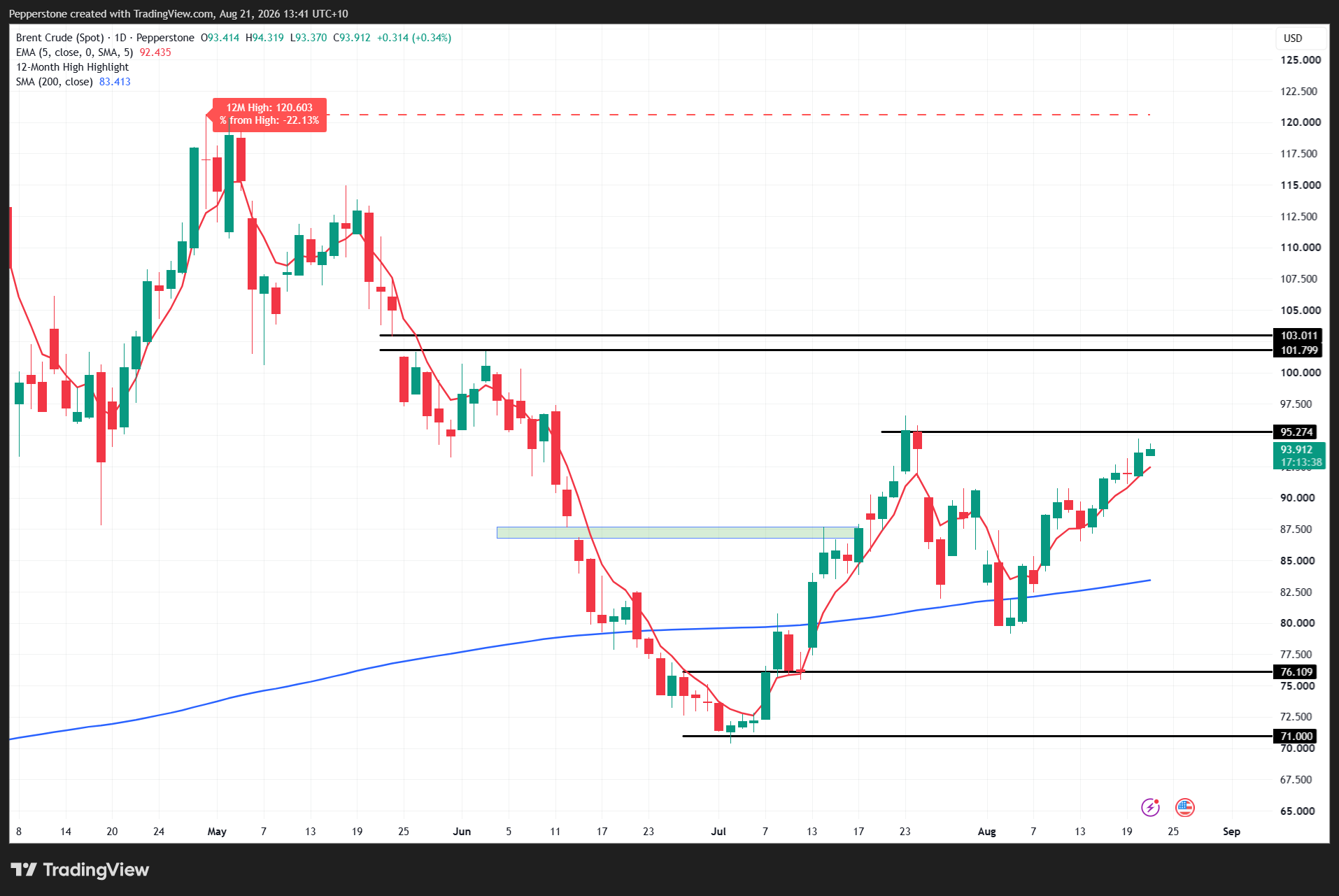
It's been a strong move, with Brent now looking towards the 23 July swing high around $96.59. A break through that level could put $100 firmly in play, with the bulls currently in control and the short-term trend clearly higher.
As we roll towards the weekend, traders will increasingly be asking about the potential for gap risk at Monday's reopen and reassessing exposures across energy, gold and other risk-sensitive markets.
History shows significant weekend gap risk
Since the US-Iran conflict began in late February, we've seen 24 weekends where oil traders have had to navigate the risk of significant headlines while traditional markets are closed.
Looking at Friday's close to Monday's reopen, the average absolute percentage move in spot Brent has been 3.1%, or $2.84 on a net change basis.
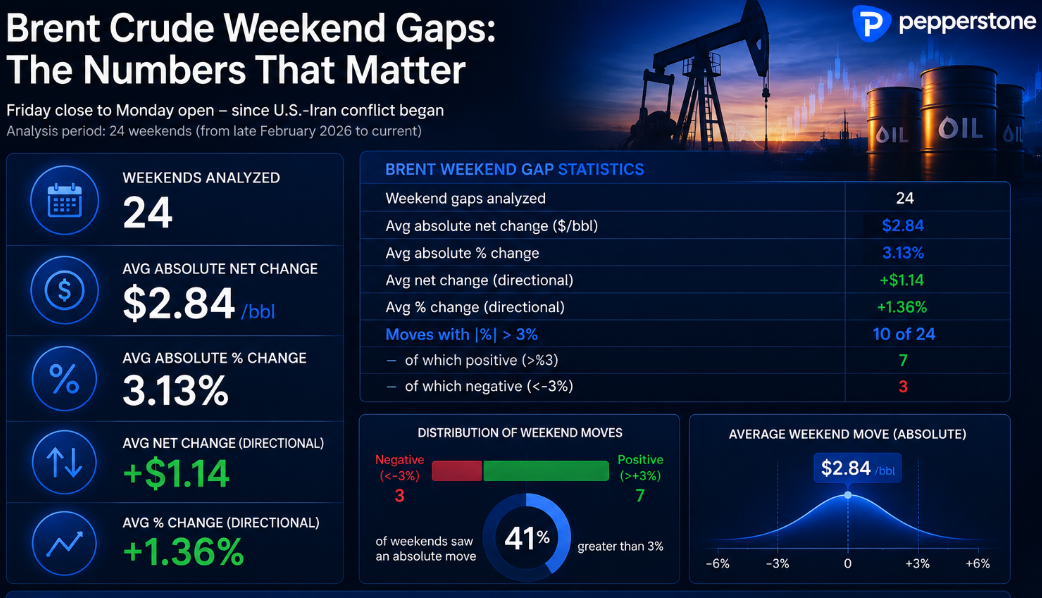
Some 41% of those occurrences have resulted in an absolute move greater than 3%, with the distribution skewed towards gaps higher rather than lower.
That makes weekend gap risk a clear consideration for energy traders, as it is for anyone holding positions in markets that close through the weekend.
Perp CFDs provide price discovery through the weekend
This puts additional focus on Pepperstone's crude Perp CFDs, alongside gold and other Perp CFDs, which continue trading through the weekend.
Should we see significant headline risk suggesting that another large Monday gap is becoming increasingly likely, Perp CFDs can dynamically reprice to that information, allowing traders to express a directional view and continue their strategy while the underlying market is closed.
Bessent's Iran sanctions take centre stage
The market's focus will fall squarely on US Treasury Secretary Scott Bessent's press conference on Monday, where he is expected to detail what the administration has described as the “toughest sanctions in history” against Iran.
While the press conference itself comes after traditional markets have reopened, traders will be conscious that headlines, media reports and speculation around the measures could emerge through the weekend, potentially increasing the prospect of gap risk.
The prospect of adding sanctions designed to cripple Iran's economy carries a clear risk that crude wears a higher geopolitical risk premium. It certainly doesn't look like a straightforward exercise.
Targeting Iranian oil creates a difficult equation
Going directly after Iran's economy by removing barrels available for export could simply mean a Brent price closer to $100.
If demand for Iranian crude from its key trading partners isn't a core component of the US strategy, Iran could potentially benefit from the higher global crude price while retaining willing customers prepared to buy its oil.
That suggests the administration may ultimately have to target the source of demand for Iranian crude, potentially threatening sanctions or economic consequences against key trading partners that continue buying Iranian barrels.
China is central to that equation, given it accounts for more than 80% of Iran's shipped oil. Bessent has already urged Beijing to cooperate, while acknowledging that discussions around potential measures against China are better conducted privately.
Secondary sanctions bring another layer of risk
Going after Iran's trading partners carries significant risk of its own.
Major economies are unlikely to take kindly to Washington dictating where they can source energy, raising the potential for economic retaliation. There is then the additional question of how Iran itself responds to an attempt to further isolate its economy.
This creates a complicated feedback loop:
US targets Iran's economy → Iranian barrels become harder to sell → available global supply falls → crude prices rise → pressure increases on Iran's customers → retaliation risk rises → geopolitical risk premium increases.
Executing that strategy without ultimately generating a higher crude price requires a lot of things to fall neatly into place.
Is $100 Brent coming into play?
For now, volatility markets and skew remain relatively sanguine, suggesting traders aren't positioned for an explosive move higher.
However, the steady grind higher in crude tells us that the market is increasingly long, momentum is building and the bulls remain firmly in control.
With Brent already above $94, the $96.59 July high becomes the immediate technical level to watch. A clean break would naturally bring $100 into the conversation.
For traders heading into the weekend, however, the bigger consideration is what happens while traditional markets are closed. With Bessent preparing to reveal the details of Washington's next economic offensive against Iran, the potential for headlines to reshape the oil outlook before Monday's reopen makes weekend gap risk increasingly difficult to ignore.
The material provided here has not been prepared in accordance with legal requirements designed to promote the independence of investment research and as such is considered to be a marketing communication. Whilst it is not subject to any prohibition on dealing ahead of the dissemination of investment research we will not seek to take any advantage before providing it to our clients.
Pepperstone doesn’t represent that the material provided here is accurate, current or complete, and therefore shouldn’t be relied upon as such. The information, whether from a third party or not, isn’t to be considered as a recommendation; or an offer to buy or sell; or the solicitation of an offer to buy or sell any security, financial product or instrument; or to participate in any particular trading strategy. It does not take into account readers’ financial situation or investment objectives. We advise any readers of this content to seek their own advice. Without the approval of Pepperstone, reproduction or redistribution of this information isn’t permitted.