- English
- 简体中文
- 繁体中文
- ไทย
- Tiếng Việt
- Español
- Português
- لغة عربية
- Монгол хэл


Trading Gold: Technical levels and an outlook for the week ahead

With this in mind, and to consider the probability in where price could be headed, and for risk management purposes, we consider the technical set-up, price action, correlation effects and the near-term catalysts.
Right now, the battle between the bulls and the bears remains unresolved, and that means the focus turns to key macro inputs, namely:
- Crude oil prices
- US Treasury yields
- US inflation data
- Fed expectations
Here’s how I’m looking at the market and the levels that matter most.
The Big Picture: Gold Remains Locked in a Major Range
Starting with the weekly chart, and while few CFD traders make entry decisions from the weekly timeframe, it can provide an incredibly useful big picture overview of the broader flows and market balance.
Since late March, XAUUSD has effectively traded within a broad range between:
- Resistance: 4,890
- Support: 4,500
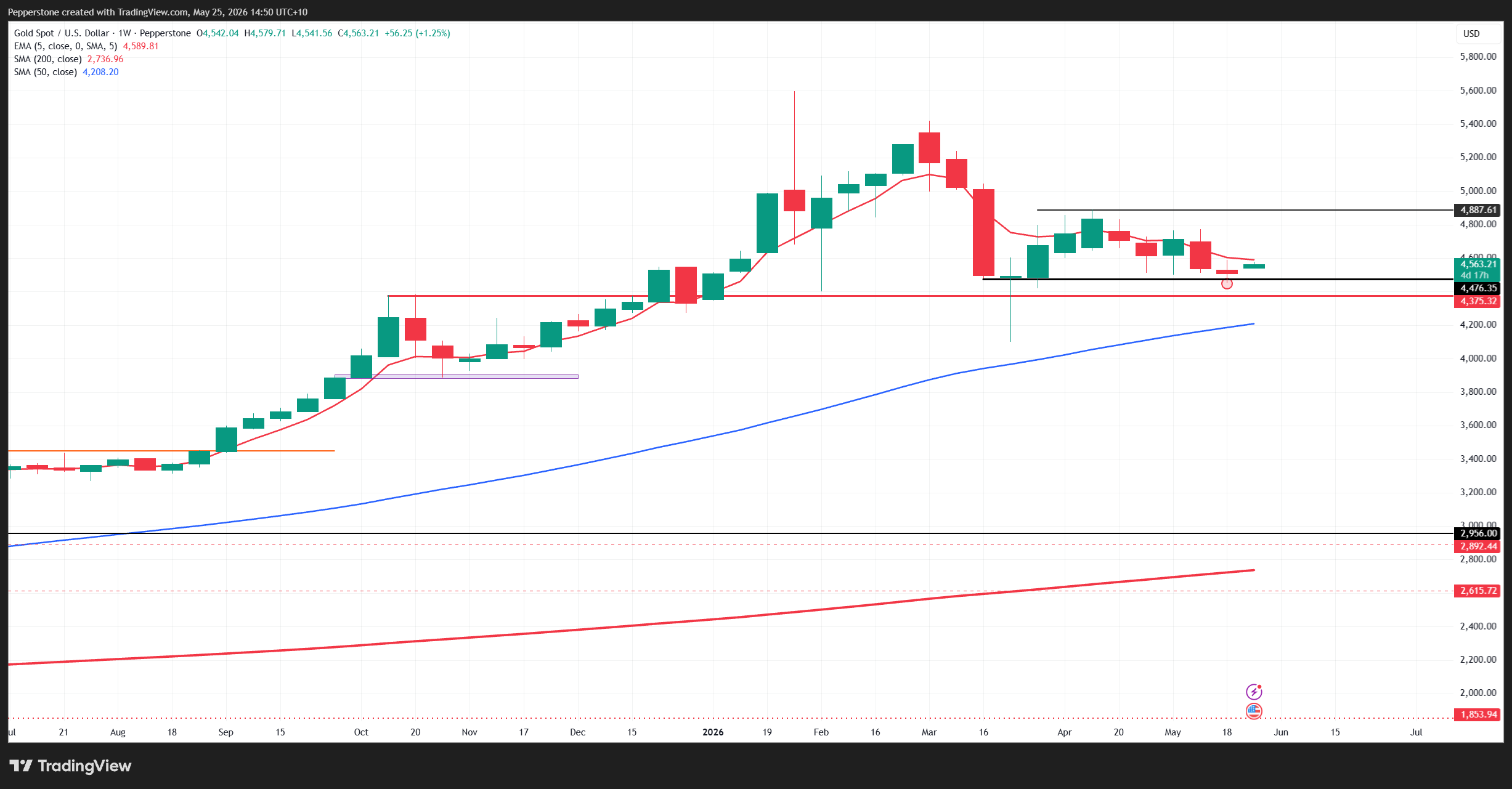
A weekly closing break outside of this range could prove extremely powerful and potentially signal the start of a more persistent trending move.
Right now, however, price remains trapped in balance.
The Key Technical Levels on the Daily Chart
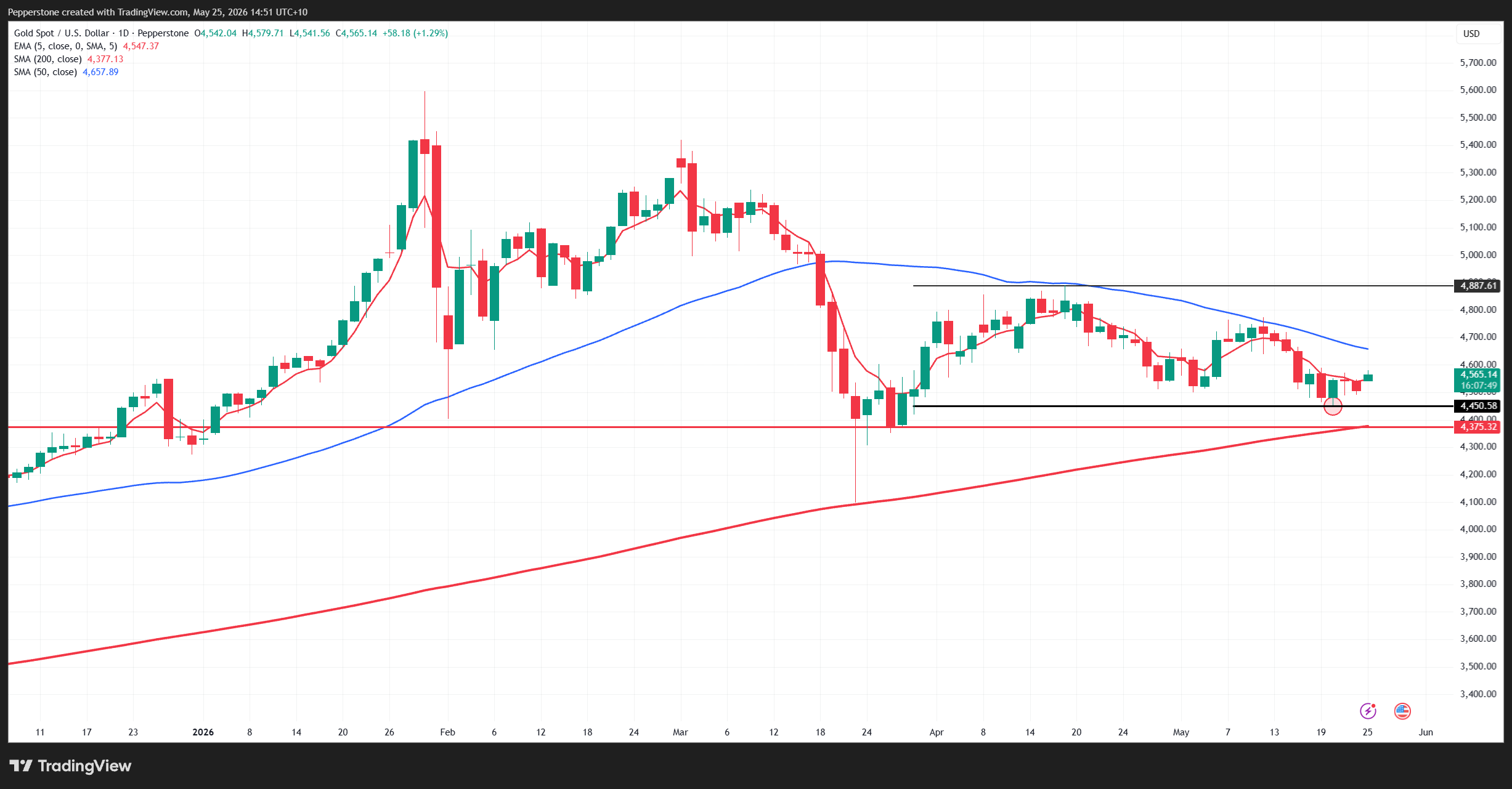
Moving down to the daily chart, we can see the range structure more clearly.
Downside Levels to Watch
The first major downside level sits at the 20 May low of $4,453.53.
Should gold close below that level, attention would quickly turn to $4377/75, representing:
- The 200-day moving average at $4,377
- Horizontal support that has held repeatedly since 20 October 2025
What Needs to Happen to Bring Out the Gold Bulls?
On the topside, bulls need to regain control, which needs a rally and close the 5-day high of $4,600.
A break and close above that level could open the door to:
- For a test of the 50-day moving average, which currently sits at $4,657.
- A retest of the 12 May high of $4773.53
At the same time:
- The 5-day EMA is tracking sideways, with the XAU price oscillating around this ST average.
- Momentum indicators remain neutral
In other words, the market still lacks clear directional conviction and unless trading long/short around the ranges, for those adopting a momentum approach, the tape needs work.
The Macro Drivers That Matter Most: Crude & US Treasury Yields
The biggest macro relationship driving gold right now is not necessarily the USD. It is US Treasury yields.
Specifically, the relationship between gold and the US 10-year Treasury yield has become extremely powerful.
The current 20-day rolling correlation between gold and the US 10-year yield sits around negative 0.80.
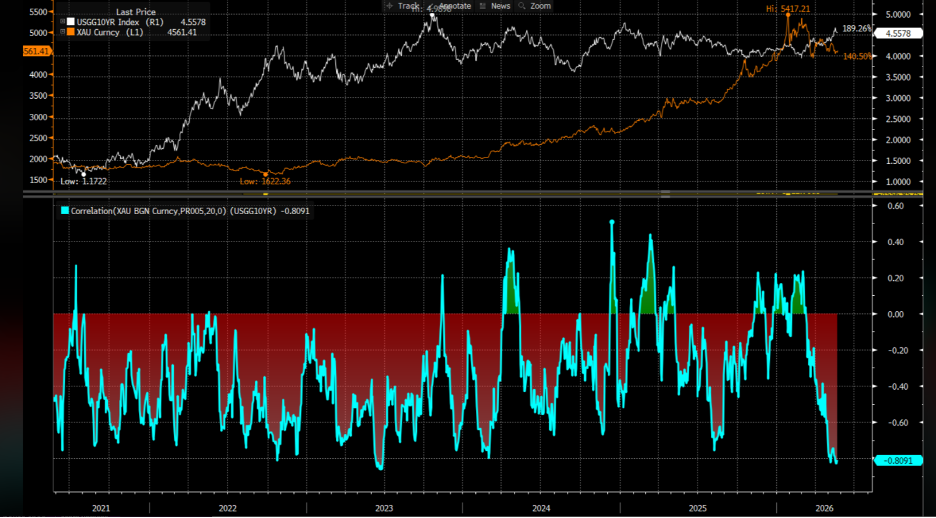
That is the strongest inverse relationship between the two since June 2023.
What that means in practice:
- Rising yields have pressured gold lower
- Falling yields have supported gold higher
If that relationship continues to hold, then gold bulls will ultimately want to see:
- Better buying in Treasuries
- Long-term yields falling from recent highs
Why Oil Prices Matter for Gold This Week
This is where crude oil becomes critically important.
If the sell-off in oil continues after Monday’s sharp decline, then:
- Inflation expectations could roll lower
- Bond yields could ease
- Rate hike expectations for 2027 could soften
- Gold could find renewed support
In that scenario, continued weakness in both WTI and Brent towards $90 could become a tailwind for gold prices.
The Key Economic Events for Gold Traders
From a macro perspective, two data points matter most this week:
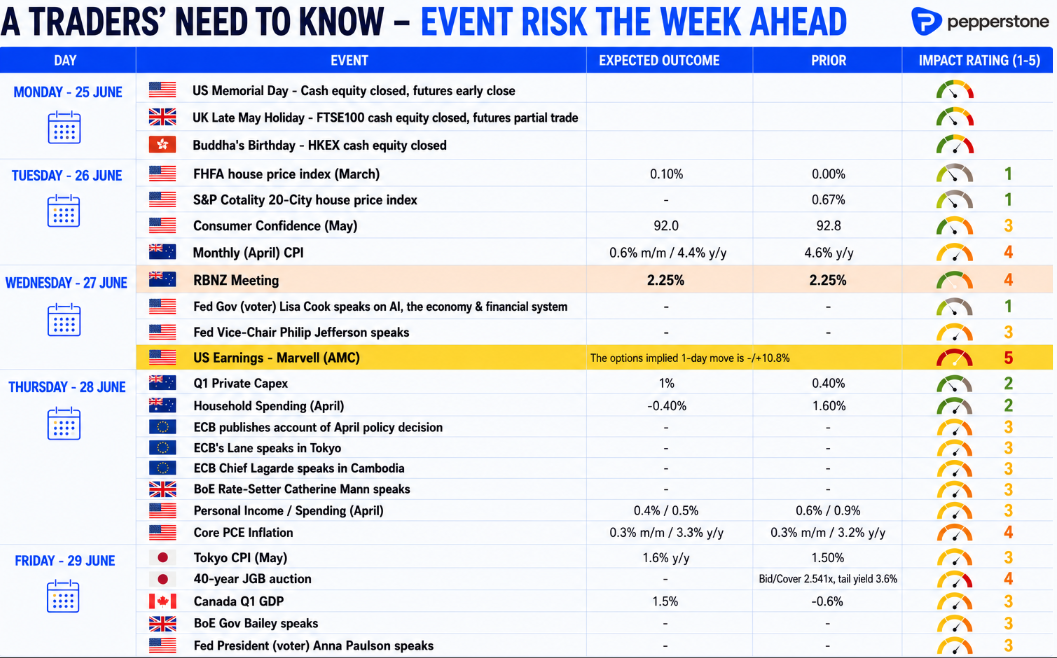
1. US Consumer Confidence
This could influence the market’s view on growth and future demand dynamics.
2. US Core PCE Inflation
This is likely the bigger event for gold traders.
While markets increasingly focus on future inflation expectations, the reality is that core PCE remains one of the Fed’s preferred inflation measures.
Gold bulls would likely want to see:
- A softer-than-expected core PCE inflation print
- Lower Treasury yields
- Reduced Fed tightening expectations
That combination could provide the fuel for a stronger upside move in gold.
What the Options Market Is Pricing In
With gold trading in balance, options markets are also reflecting reduced expectations for volatility.
XAU 1-week gold (options) implied volatility currently sits around 19.7%, not far from year-to-date lows.
That implies:
- Options dealers imply a move through the week of approximately -/+$124
From current spot pricing, that projects an approximate trading range of:
- Lower bound: $4,450
- Upper bound: $4,700
Those levels may become useful zones for traders looking to fade extreme moves during the week while the broader range remains intact.
My Trading Plan for Gold This Week
At this stage, gold remains a range-trading market until proven otherwise.
Bullish Setup
I would become more constructive on gold on:
- A closing break above $4,600
- Ideally accompanied by lower Treasury yields and weaker oil prices
That could open the path towards the 50-day MA and possibly $4773.
Bearish Setup
On the downside, I would look for short opportunities on:
- A closing break below $4,453.53
That would potentially bring:
- The 200-day moving average at $4,372 into focus
- A broader momentum shift lower
For now, the key inputs remain clear:
- Oil prices
- US Treasury yields
- Inflation expectations
- Core PCE inflation data
That is where the real directional signal for gold is likely to come from this week.
The material provided here has not been prepared in accordance with legal requirements designed to promote the independence of investment research and as such is considered to be a marketing communication. Whilst it is not subject to any prohibition on dealing ahead of the dissemination of investment research we will not seek to take any advantage before providing it to our clients.
Pepperstone doesn’t represent that the material provided here is accurate, current or complete, and therefore shouldn’t be relied upon as such. The information, whether from a third party or not, isn’t to be considered as a recommendation; or an offer to buy or sell; or the solicitation of an offer to buy or sell any security, financial product or instrument; or to participate in any particular trading strategy. It does not take into account readers’ financial situation or investment objectives. We advise any readers of this content to seek their own advice. Without the approval of Pepperstone, reproduction or redistribution of this information isn’t permitted.