- English
- 简体中文
- 繁体中文
- ไทย
- Tiếng Việt
- Español
- Português
- لغة عربية
- Монгол хэл


Silver Continues To Shine As Bulls Remain In Control

Summary
- Record Highs: Spot silver has continued its rocket-like ascent this year, breaking through $60/oz to new all-time highs
- Supply Squeeze: Tight supply amid tariff fears and chunky physical demand remains the main driver
- Further Upside On The cards: Momentum remains firmly with the bulls, leaving further upside on the cards into year-end
Silver has continued to tear higher in recent sessions, bringing its YTD gain to just over 90%, with spot trading to fresh all-time highs north of the $60/oz mark. Naturally, after such a stellar run, and with price now truly in uncharted territory, the key question is whether further upside could be on the cards, or whether the market is ripe for a pullback?
_D_2025-12-10_10-31-40.jpg)
Catalysts Driving Upside
Numerous catalysts continue to drive upside in silver, and the precious metals complex more broadly, as participants remain worried over the potential for inflation expectations to un-anchor under a more dovish Fed next year, as geopolitical risk continues to drive demand for hedges, and as fiscal spending remains on an unsustainable path across DM.
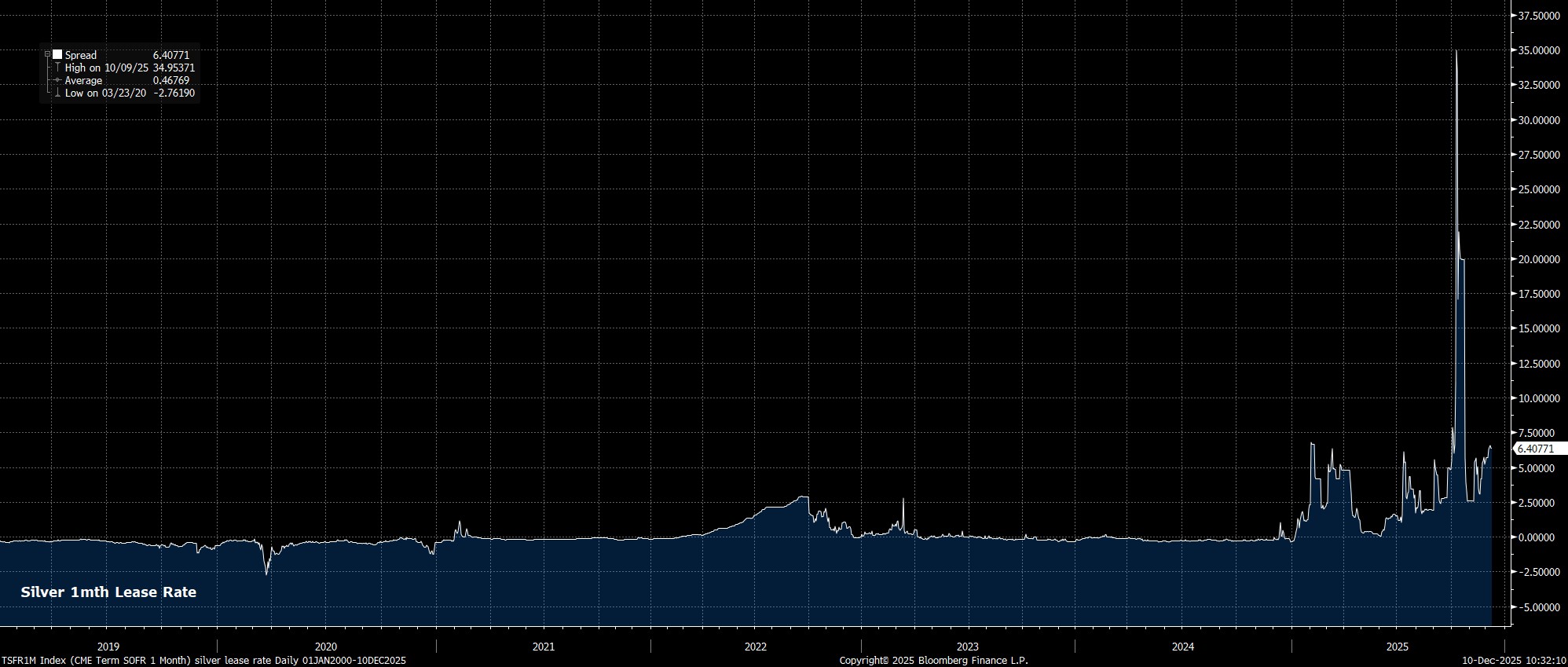
In addition, the silver market in particular continues to display notable signs of tightness, with the curve still heavily backwardated, and with lease rates remaining elevated, albeit off the highs seen in October.
Supply Squeeze Continues
This supply squeeze stems from a couple of distinct sources.
Firstly, while physical silver has increasingly flowed into London vaults over the last six weeks or so, there remains a degree of reluctance to move bars out of the US en masse, given the lingering risk that the Trump Administration could impose tariffs on silver, after listing the metal as a ‘critical mineral’ last month. Naturally, market participants are not especially keen on the idea of shifting silver to a vault across the Atlantic, only to then be forced to pay a tariff at some future date when shipping that same silver back into the US.
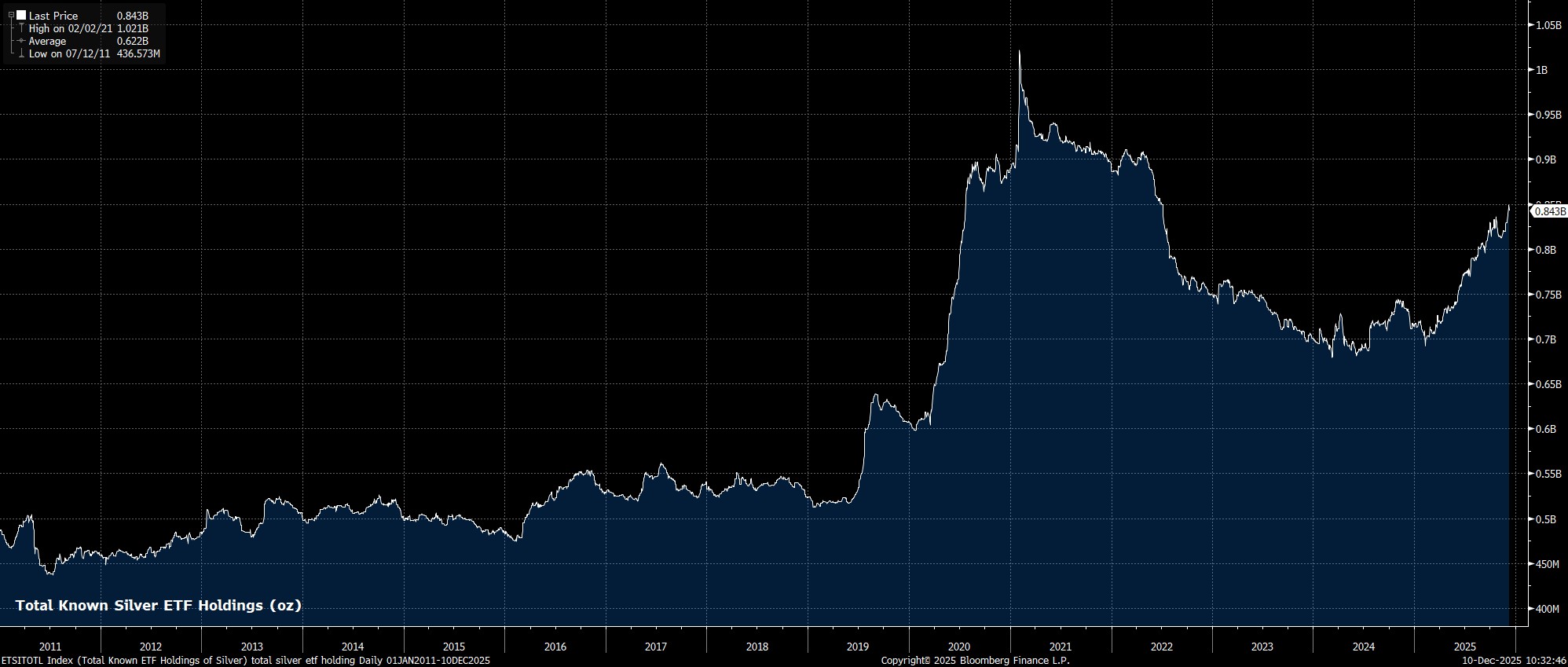
Meanwhile, retail demand has also continued to contribute to considerably tighter supply conditions, as traders seek to ride the recent wave of bullish momentum. Silver ETF holdings, a decent proxy for overall retail demand, have risen by 20% this year, and by 5% in the last month alone, with inflows into those ETFs having last week been at their highest level since July. This demand, in a market where supply is already constrained, compounds the impact of tighter supply on spot prices.
Silver Outlook Into Year-End
All this begs the question as to where we now head next.
While spot has rallied 25% in the last three weeks, since bouncing from the 50-day moving average in late-November, calling for an imminent pullback simply because we’ve rallied a long way is not a logical or justifiable projection to make. Nevertheless, such a rapid and significant rally does naturally raise the risk of the market at least suffering a bout of exhaustion, and taking a bit of a pause for breath.
That said, such a move would likely be more of a temporary interruption in the broader bullish trend, as opposed to signalling that trend having come to an end. Of course, with spot now in genuinely uncharted territory, calling potential resistance levels with any degree of conviction is at best an imperfect science.
However, purely from psychological perspective, round numbers are likely to be eyed by most market participants as potential turning points, especially the $65/oz mark. It’s also worth noting that, when attempting to corner the silver market in the 70s, ‘Bunker’ Hunt foresaw a tenfold rise in prices, which would put his upside target around the $75/oz mark.
To the downside, the bulls will clearly want to see spot remain north of the $60/oz mark, which now stands as key short-term support. Beneath that, MTD lows at $56/oz, followed by the Oct and Nov highs at $54.40/oz will be eyed.
The material provided here has not been prepared in accordance with legal requirements designed to promote the independence of investment research and as such is considered to be a marketing communication. Whilst it is not subject to any prohibition on dealing ahead of the dissemination of investment research we will not seek to take any advantage before providing it to our clients.
Pepperstone doesn’t represent that the material provided here is accurate, current or complete, and therefore shouldn’t be relied upon as such. The information, whether from a third party or not, isn’t to be considered as a recommendation; or an offer to buy or sell; or the solicitation of an offer to buy or sell any security, financial product or instrument; or to participate in any particular trading strategy. It does not take into account readers’ financial situation or investment objectives. We advise any readers of this content to seek their own advice. Without the approval of Pepperstone, reproduction or redistribution of this information isn’t permitted.