- English
- 简体中文
- 繁体中文
- ไทย
- Tiếng Việt
- Español
- Português
- لغة عربية
- Монгол хэл


Gold Outlook: Peace Deal Sparks Rebound — All Eyes on the Fed
.jpg?height=93&quality=100)
Gold saw sharp swings over the past week. A stronger-than-expected May nonfarm payrolls report and U.S. CPI hitting a three-year high prompted markets to significantly reprice the Fed's rate path, with rising real yields and a firmer dollar weighing heavily on gold.
The mood then shifted as geopolitical tensions eased. With the U.S. and Iran formally agreeing to a ceasefire memorandum of understanding, risk appetite recovered and gold staged a meaningful rebound from its lows.
Beyond Friday's scheduled signing ceremony, the week's focal point has fully shifted to the Fed meeting. In my view, gold's core pricing driver is transitioning from geopolitics to rate repricing — and Warsh's policy tone will be the key signal to watch.
Technical Observation: Gold Stabilizes — Watch the $4,300 Level
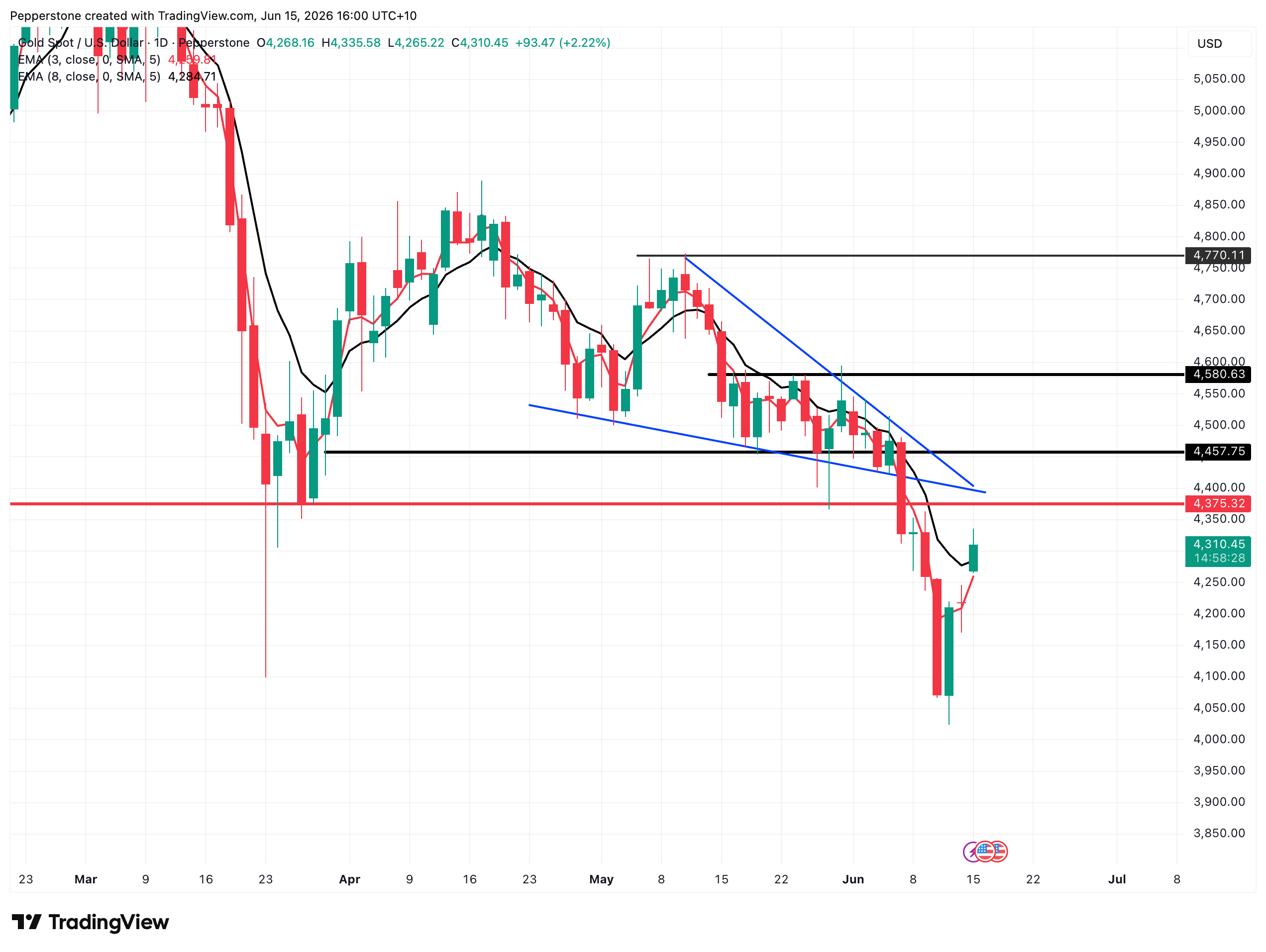
On the XAUUSD daily chart, gold has carved out a V-shaped recovery structure. Prices touched $4,024 last Thursday — the lowest level since November 2025 — before snapping back sharply.
Gold has now reclaimed the psychologically important $4,300 level, though overhead resistance remains thick. A sustained daily close above $4,300 would open the door for bulls to target $4,375, with $4,460 and $4,580 as further resistance zones beyond that.
That said, Monday's gap-higher open has left an unfilled upside gap, creating some near-term risk of a pullback to fill it. If gold stalls around $4,300, the gap's lower edge near $4,217 should offer initial support. A break below that would put the $4,024 low back in play.
U.S.-Iran Deal: A Tailwind for Gold — But Not a Trend Reversal
The U.S.-Iran peace agreement was the direct catalyst for this rebound. From Trump pausing military strike plans to both sides signing a ceasefire MOU and committing to reopen the Strait of Hormuz, geopolitical risk premiums are unwinding quickly.
This development has eased the transmission chain of higher oil prices feeding into inflation expectations and, in turn, tighter Fed pricing. Markets are currently pricing roughly a 60% chance of a Fed rate hike before December — down noticeably from earlier levels.
With the opportunity cost of holding gold declining, the case for higher prices has improved. At the same time, fading safe-haven demand and a recovery in risk appetite are simultaneously pulling capital away from gold.
This rally, then, looks more like a correction of excessive pessimism than the start of a new bull leg. Gold has moved past its most bearish phase — but a sustained uptrend still needs to be earned.
After the Bounce, Rates Remain the Real Constraint
Gold's recent selloff was driven by three forces: hawkish Fed repricing lifting real yields, profit-taking from the extended prior rally, and forced deleveraging amplifying the move lower.
The latter two have largely run their course, but real rates remain the key constraint. With May CPI at 4.2% and nonfarm payrolls printing 172,000 — both well above expectations — inflation and labor market resilience continue to limit the Fed's room to pivot.
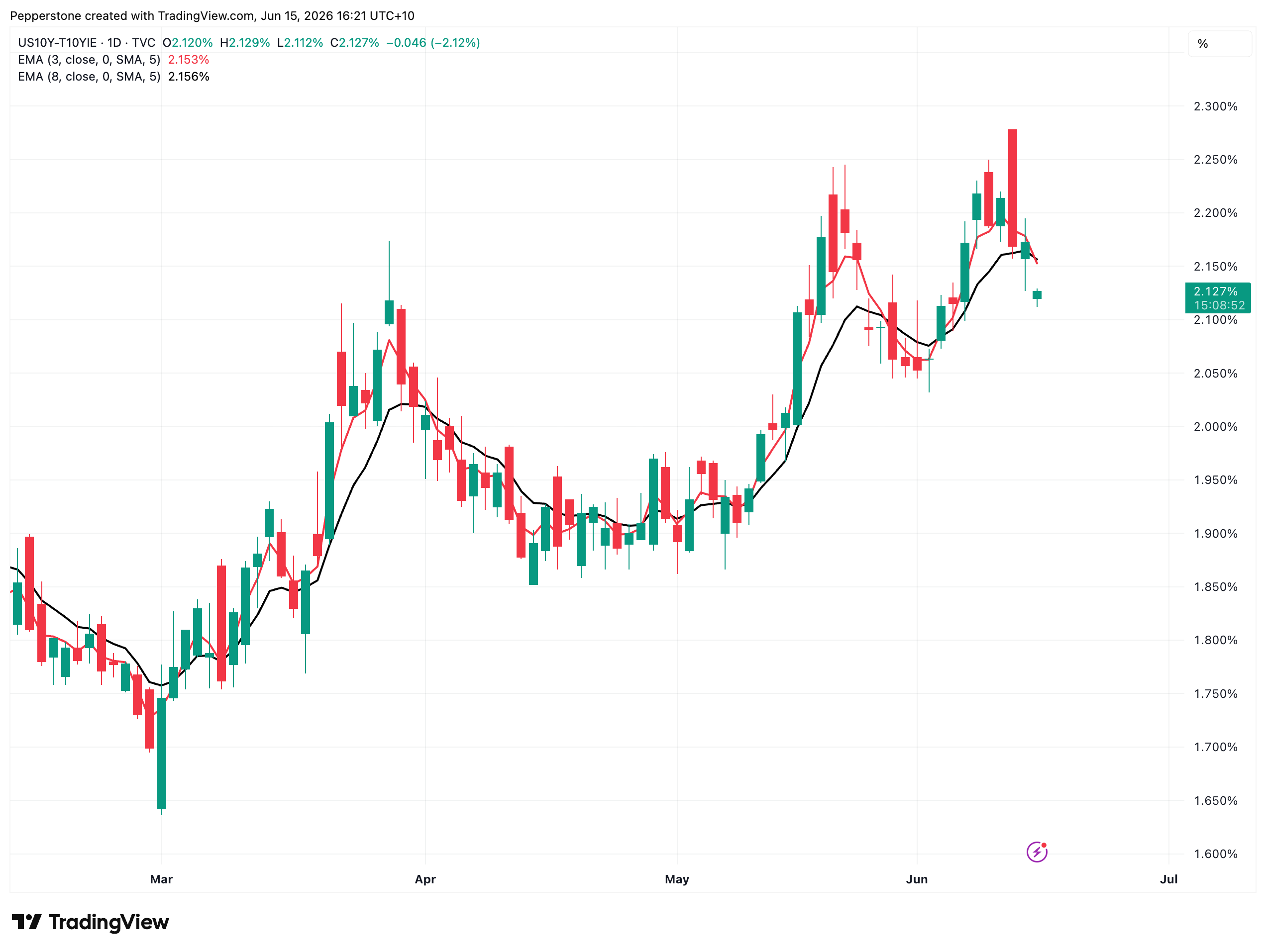
While the 10-year real yield has pulled back modestly, it remains above 2%. Until real rates have meaningful room to fall, gold's upside will stay capped.
This Week: Signing Ceremony and the FOMC
Stepping back, gold's turn from selloff to rebound reflects a sentiment reset after the geopolitical shock — not a trend reversal. Central bank buying continues to provide structural support from below, but a sustained directional move still requires a stronger macro catalyst.
This week, geopolitical developments and the Fed meeting form a clear dual narrative.
On the geopolitical front, Israel has expressed deep disappointment with the agreement, fighting in Lebanon continues, and the path through 60 days of follow-on nuclear talks remains far from clear. Any execution-level hiccup before Friday's signing could quickly reignite safe-haven demand and trigger sharp moves in gold — while a smooth signing would add further fuel to the bullish case.
On the Fed front, a rate hold is a near-certainty — what matters is the dot plot and Warsh's tone. The March dot plot still implied one rate cut this year; this update will likely shift toward a "higher for longer" baseline, and some officials may even pencil in a hike.
If the dot plot upgrades the rate path and Warsh emphasizes inflation stickiness, gold's rebound will face meaningful resistance. If the tone stays neutral and the guidance remains measured, the recovery has room to extend.
Taking a medium-term view, Warsh's preference for reducing forward guidance and communicating less publicly means the Fed's policy framework may become less predictable — and more discretionary. As that shift takes hold, markets will gradually move from trading the rate path to trading uncertainty itself. That environment structurally strengthens gold's safe-haven appeal, making it increasingly sensitive to expectation surprises rather than policy direction per se.
For traders, staying flexible and thinking in ranges — rather than committing to a directional view before the FOMC signal lands — is likely the more prudent approach this week.
The material provided here has not been prepared in accordance with legal requirements designed to promote the independence of investment research and as such is considered to be a marketing communication. Whilst it is not subject to any prohibition on dealing ahead of the dissemination of investment research we will not seek to take any advantage before providing it to our clients.
Pepperstone doesn’t represent that the material provided here is accurate, current or complete, and therefore shouldn’t be relied upon as such. The information, whether from a third party or not, isn’t to be considered as a recommendation; or an offer to buy or sell; or the solicitation of an offer to buy or sell any security, financial product or instrument; or to participate in any particular trading strategy. It does not take into account readers’ financial situation or investment objectives. We advise any readers of this content to seek their own advice. Without the approval of Pepperstone, reproduction or redistribution of this information isn’t permitted.