- English
- 简体中文
- 繁体中文
- ไทย
- Tiếng Việt
- Español
- Português
- لغة عربية
- Монгол хэл


Gold Outlook: Fed Holds, Hawks Speak Up — All Eyes on Payrolls
.jpg?height=93&quality=100)
Gold spent another week in the same $4,000–$4,200 range, waiting for a catalyst.
The week started on a positive note after reports of a U.S.-Iran ceasefire pause lifted sentiment. That didn't last — renewed flare-ups cooled the mood quickly and gold pulled back. Then the Fed held rates, the market breathed a collective sigh of relief, and a coordinated dollar intervention by Japan and the U.S. gave gold another push higher. Friday's data threw cold water on the rally, and gold ended the week roughly flat.
Heading into this week, a gradual easing in geopolitical tensions and the restart of U.S.-Iran negotiations could take some of the inflation pressure from oil off the table, offering modest support. But the real question — whether gold can actually break out of this range — likely comes down to Friday's July jobs report.
Technical Observation: Six Weeks in the Same Range — Waiting for a Breakout
Gold has been stuck in the $4,000–$4,200 range for six straight weeks. RSI is hovering near 50, which tells you pretty much everything — neither side has conviction. But the longer this drags on, the more positioning builds up on both sides, and the bigger the eventual move when something finally breaks the stalemate.
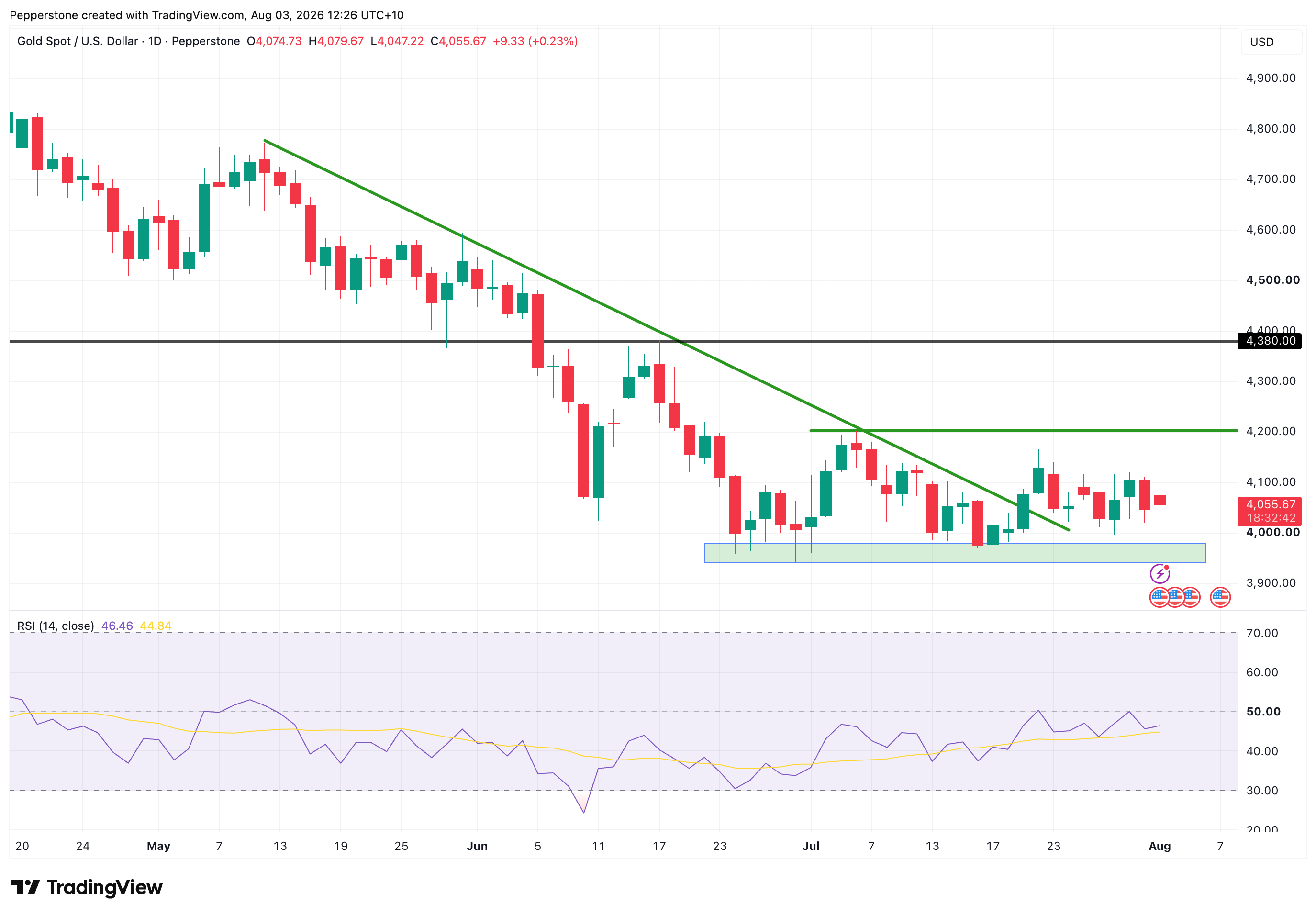
The two levels worth watching are straightforward. A convincing close above $4,200 puts $4,380 in play. A break below $4,000 opens up $3,940–$3,960.
The Fed Held — But the Division Inside Is the Real Story
The headline from July's FOMC meeting was a hold, but that's not what the market was talking about afterward.
The 9-3 vote was the most divided outcome since September 2016. Three regional Fed presidents — Hammack, Kashkari, and Logan — all pushed for an immediate hike, and they weren't subtle about it. That kind of unified hawkish dissent doesn't happen by accident. It tells you the committee's patience is wearing thin.
Warsh didn't make it easier to read. He reiterated the Fed's commitment to hitting 2% inflation, long-end Treasury yields shot higher, but he once again declined to submit his own dot plot projection and gave no forward guidance on what comes next. The message was essentially: the data decides.
For gold, that cuts both ways. Stronger data means hike expectations build, real yields stay high, and gold stays under pressure. But a murky policy outlook also means the market can't confidently short gold — uncertainty has a way of keeping a floor under prices.
One thing that stood out: even as long-end yields surged, the dollar didn't follow. That divergence suggests some traders are starting to question the "U.S. exceptionalism" trade, and the dollar pullback from the Japan intervention gave gold some cushion on the downside.
U.S.-Iran Talks Restart — But Getting a Deal Done Is Another Story
The ceasefire agreement has effectively collapsed, but both sides agreed over the weekend to sit back down on Tuesday and work through the Strait of Hormuz framework — specifically, Iran's demand for partial toll rights, a joint monitoring mechanism, and a phased reopening of commercial shipping.
Just the prospect of talks was enough to knock oil prices lower, and with that came some relief on the inflation front. The usual chain — oil up, inflation fears up, hike bets up, gold down — went into reverse, at least temporarily.
But there's a long way between "talks resuming" and "deal done." Iran still wants control over which ships enter its waters. The U.S. is skeptical of any toll arrangement. The core disagreements haven't moved. If negotiations stall again — which has happened every single time so far — expect volatility to pick back up quickly.
Central Banks Keep Buying — China's Demand Is Shifting
Q2 data from the World Gold Council shows global central banks added a net 289 tonnes of gold, up 62% year-on-year. That kind of steady institutional buying doesn't make headlines, but it keeps a floor under the market.
China is a more interesting story. Total Chinese gold demand fell 41% in Q2, as high prices cut into jewelry buying and gold ETFs saw outflows. But look at the other side of that: bar and coin investment demand is up sharply, and investment demand now accounts for 66% of China's total gold consumption.
The consumer is stepping back, but the investor is stepping in. It's a structural shift worth watching.
This Week: It's All About Payrolls
The big picture hasn't changed — gold is rangebound, pulled between Fed uncertainty, geopolitical noise, and steady central bank demand underneath.
Friday's July nonfarm payrolls report is the week's defining event, and arguably the most important data point before September's FOMC meeting. The consensus is sitting around 80,000 new jobs, up from June's 57,000, with unemployment holding at 4.2%.
A strong print — say, above 100,000, with unemployment staying at 4.2% or lower — and September hike bets will climb. That means higher yields, a firmer dollar, and gold back under pressure at $4,000.
A soft number that echoes June's weakness flips the script. Hike expectations cool, and with oil already pulling back, gold gets a decent shot at pushing back toward the top of the range.
The material provided here has not been prepared in accordance with legal requirements designed to promote the independence of investment research and as such is considered to be a marketing communication. Whilst it is not subject to any prohibition on dealing ahead of the dissemination of investment research we will not seek to take any advantage before providing it to our clients.
Pepperstone doesn’t represent that the material provided here is accurate, current or complete, and therefore shouldn’t be relied upon as such. The information, whether from a third party or not, isn’t to be considered as a recommendation; or an offer to buy or sell; or the solicitation of an offer to buy or sell any security, financial product or instrument; or to participate in any particular trading strategy. It does not take into account readers’ financial situation or investment objectives. We advise any readers of this content to seek their own advice. Without the approval of Pepperstone, reproduction or redistribution of this information isn’t permitted.