- English
- 简体中文
- 繁体中文
- ไทย
- Tiếng Việt
- Español
- Português
- لغة عربية


.jpg?height=93&quality=100)
Since the start of the year, buying momentum in the precious metals market has been exceptionally strong. In just three weeks, gold has risen over $500, approaching the $5,000 mark, while silver has pushed toward $100, repeatedly hitting record highs.
Amid the heat of momentum trading and concentrated long positions in gold and silver, the market is also seeking new potential opportunities. One of the questions traders have been asking most recently is whether other assets might see a delayed catch-up rally. This is where copper comes back into focus.
Supply Tightness: Structural Deficits Widening
Supply-demand balance has always been a core driver of commodity prices, and copper’s market is showing clear signs of structural tightness.
On the supply side, global copper mine output is still growing overall, but at a very limited pace. According to the International Copper Study Group (ICSG), global copper mine production in 2025 increased by only about 1.9%, far below the average growth seen in most previous years.
Meanwhile, output from some major mines has been volatile: Indonesia’s Grasberg mine saw a sharp drop due to an accident, and Chile’s state-owned Codelco is expected to produce only about 10,000 tons more in 2026 than in 2025—a very modest increase.
This limited production growth, combined with long development cycles—new mines typically require 10–15 years from exploration to commercial output—means supply increases are unlikely to be released quickly, and inventories may remain low for an extended period.
Compared with commodities like iron ore or energy, which experience pronounced cyclical fluctuations, copper’s supply-demand tightness is more sustained and structural, providing a solid foundation for prices and underpinning potential trend-driven opportunities.
Emerging Demand: Copper’s Strategic Value
Alongside rising supply pressures, another major factor supporting copper prices is the explosive growth in strategic demand.
Beyond traditional construction and electrical equipment, demand from electric vehicles (EVs), renewable energy, and AI data centers continues to rise. These demand drivers are generally less sensitive to short-term economic fluctuations and carry a long-term growth logic.
For example, a conventional internal combustion vehicle uses roughly 20–25 kg of copper on average, while an EV consumes about 3–4 times that amount. With global EV penetration rapidly increasing, copper demand from EVs is expected to rise significantly in the coming years.
AI data center construction is also pushing copper demand into a new dimension. Data centers require high-capacity power transmission, advanced cooling systems, and complex cabling, meaning copper demand per megawatt of AI computing power far exceeds that of traditional data centers.
According to BHP, global data centers currently consume around 500,000 tons of copper per year, potentially increasing nearly sixfold to around 3 million tons by 2050.
This long-term, strategic demand growth makes copper not only cyclical in opportunity but also structurally attractive, drawing sustained market attention.
Fundamentals in Place: Watching Copper’s Next Potential
Overall, copper is transitioning from a traditional cyclical industrial metal to a growth asset shaped by structural shortages and strategic demand. As the TACO moment emerges and market sentiment recovers, capital is starting to seek potential returns beyond pure safe-haven assets.
Copper sits at this intersection: reflecting shifts in risk appetite while underpinned by real demand from energy transition and digital infrastructure.
On the technical side, copper has staged a clear rebound since December 2025. According to Pepperstone CFD quotes, mid-January saw copper briefly surpass $6.18, reaching a record high. Although it subsequently pulled back slightly due to geopolitical tensions and profit-taking, it recently found support around $5.85.
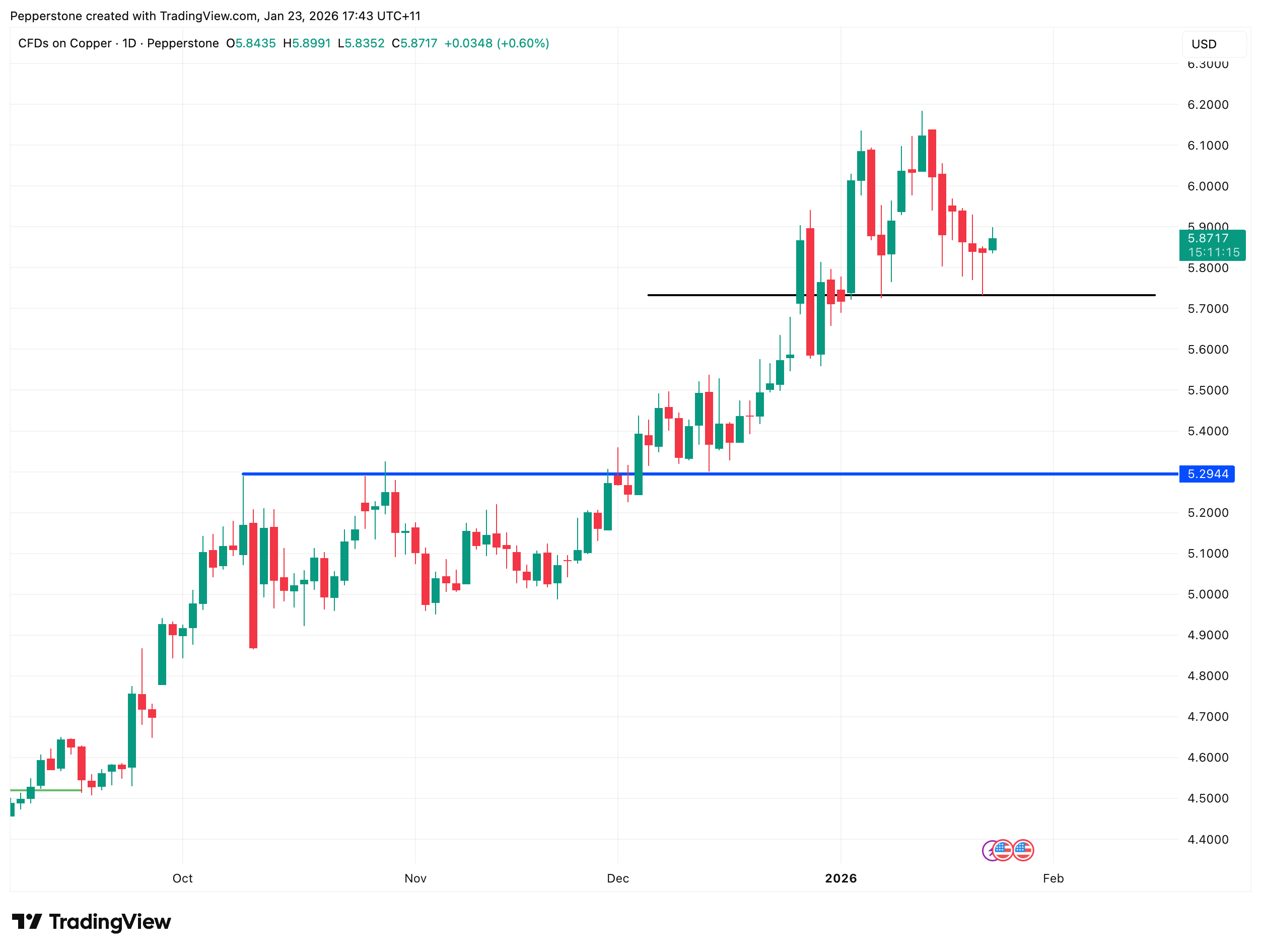
This suggests that copper may present a delayed catch-up opportunity, though volatility remains elevated. For traders, key factors to watch include:
- Supply:Mine output fluctuations, new mine approvals and production ramp-ups, potential supply shocks
- Inventories:Stock levels at major exchanges such as LME, COMEX, and SHFE
- Demand:Data from renewable energy, data center, and EV sectors
Tracking these core indicators helps to understand copper market dynamics, offering perspective beyond gold and silver.
The material provided here has not been prepared in accordance with legal requirements designed to promote the independence of investment research and as such is considered to be a marketing communication. Whilst it is not subject to any prohibition on dealing ahead of the dissemination of investment research we will not seek to take any advantage before providing it to our clients.
Pepperstone doesn’t represent that the material provided here is accurate, current or complete, and therefore shouldn’t be relied upon as such. The information, whether from a third party or not, isn’t to be considered as a recommendation; or an offer to buy or sell; or the solicitation of an offer to buy or sell any security, financial product or instrument; or to participate in any particular trading strategy. It does not take into account readers’ financial situation or investment objectives. We advise any readers of this content to seek their own advice. Without the approval of Pepperstone, reproduction or redistribution of this information isn’t permitted.