- English
- 简体中文
- 繁体中文
- ไทย
- Tiếng Việt
- Español
- Português
- لغة عربية
- Монгол хэл


AMZN Q2 2026 Earnings Preview: AI Capex in Focus

The essentials at a glance:
-Amazon reports on July 30 amid a cautious backdrop: consensus expects $197 billion in revenue (+17% YoY) and AWS acceleration toward 31% growth, following the capex shock that rattled Alphabet and Big Tech last week.
-The key fundamental question is whether Amazon raises its $200 billion capex guidance and how much operating margin compresses toward a 12.0% midpoint, alongside free cash flow that consensus sees turning negative in 2026 before recovering in 2027-2028.
-On the technical side, AMZN holds a bearish bias below $227.80: losing that level opens the door to targets at $220 and $214.70, while holding it or reclaiming $237-$247 would improve the near-term structure.
Will Amazon Repeat Alphabet's Capex Shock?
Amazon will report its second-quarter earnings on Thursday, July 30, after the U.S. market close, with the investor call scheduled for 5:00 pm Eastern Time. This AMZN Q2 2026 earnings preview lands at a particularly tense moment for the sector: the stock is trading near $228, down 1.16% year-to-date and roughly 17% below its May high, weighed down by concerns over AI infrastructure capital spending that intensified last week following Alphabet's earnings report.
That company raised its 2026 capex budget to around $205 billion, triggering a nearly 6% single-session stock decline and wiping out a combined roughly $890 billion in market capitalization across the seven major tech companies. That precedent places Amazon under special scrutiny, as the market wants to know whether the company still intends to spend $200 billion in capex this year or whether it ends up revising that figure upward due to rising costs for components like memory and semiconductors.
Market consensus projects revenue of approximately $197 billion, year-over-year growth of around 17%, within the company's own guidance range of $194 billion to $199 billion. Operating income is expected to come in around $23.7 billion, with earnings per share of $1.82 — figures that slightly exceed the midpoint of the guidance Amazon provided in April, indicating the market is already pricing in a result modestly better than what the company's senior executives had anticipated.
The options market is pricing in a stock move of around 6% the day after the report, above the recent average, a sign investors expect this quarter to be more pivotal than usual for the investment thesis.

AWS Accelerates, But Operating Margin Narrows
In this AMZN Q2 2026 earnings preview, the central focus will once again be Amazon Web Services (AWS). Consensus points to AWS revenue of around $40.5 billion, an acceleration to roughly 31% year-over-year from 28.4% in the first quarter, driven by stronger demand from Anthropic and from OpenAI-model-based services via Bedrock. AWS's project backlog reached $364 billion at the close of the first quarter, up from $244 billion three months earlier — not including an additional Anthropic commitment exceeding $100 billion announced afterward.
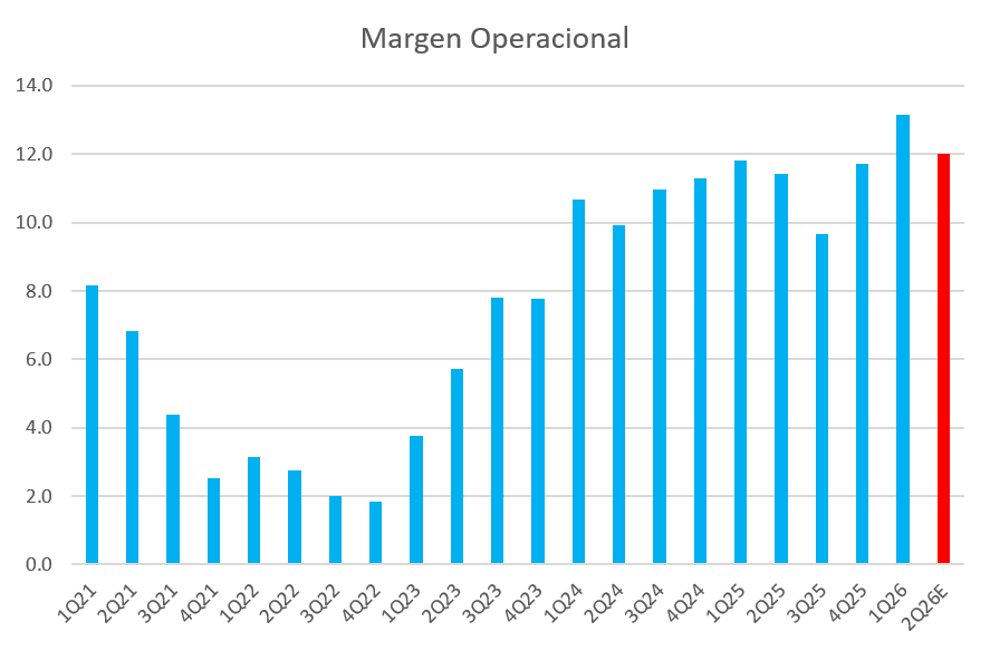
Operating margin will be the other point of friction in this report. After hitting a record 13.1% in the first quarter, the company's second-quarter guidance implies a pullback to a midpoint of 12.0%, reflecting roughly $1 billion in additional costs tied to the Amazon Leo satellite project, higher stock-based compensation, and promotional spending associated with Prime Day, which this year was moved to June and therefore falls within the quarter.
In the advertising segment, consensus expects revenue of close to $19.3 billion, up 23% year-over-year, with the Prime Day shift into the second quarter acting as an additional catalyst. The question hanging over the call is whether advertising strength and AWS's operating leverage can offset these headwinds and produce a result above the guided midpoint of $23.7 billion in operating income.
Free Cash Flow Remains the True Barometer
Free cash flow will remain the most delicate flank of this earnings story. With capex of $44.2 billion in the first quarter and a full-year expectation of $200 billion — a roughly 60% jump from 2025 — free cash flow already turned negative in the year's opening quarter, against a backdrop in which Moody's had revised the company's credit outlook from positive to stable back in February, precisely due to the scale of this investment plan.
Full-year 2026 consensus calls for negative free cash flow of around $12 billion, with a recovery to $4.5 billion in 2027 and $55.6 billion in 2028; for much of the analyst community, that recovery trajectory — rather than the quarter's specific result — is the true anchor of the long-term valuation. Any sign that Amazon is following Alphabet's path and raising its capex budget could amplify concerns over the pace of cash generation, even as the underlying narrative around AI compute demand remains solid.
Also under close watch will be the board's third-quarter guidance, with consensus at $204 billion; the shift of Prime Day into June could create a tougher comparison for that period, against a backdrop of somewhat softer consumer signals.
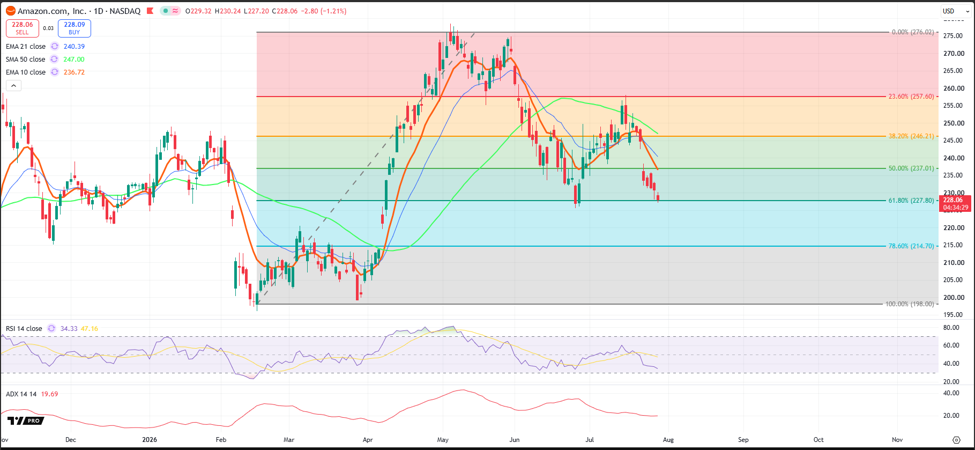
From a technical standpoint, AMZN maintains a bearish bias after breaking below the $237 support level and trading under the 10-day EMA ($236.72), 21-day EMA ($240.39), and 50-day SMA ($247), all in negative alignment. The RSI at 34.3 reflects weakness and proximity to oversold territory, while the ADX at 19.7 indicates the trend is not yet strong, raising the possibility of technical bounces.
The decisive level is $227.80: if it holds, it could support a speculative long entry with targets at $237 and $240, and a recovery above $247 would clearly improve the structure; conversely, a daily close below $227.80 would favor bearish entries, with targets at $220 and $214.70.
In short, this AMZN Q2 2026 earnings preview arrives with expectations already elevated and a market split between confidence in cloud services' reacceleration and fear that the AI infrastructure investment cycle will keep pressuring cash generation.
The stock's reaction will likely depend less on whether Amazon beats revenue consensus — something the market already treats as probable — and more on the message the company sends about the return on these investments and the pace at which it plans to keep spending on compute capacity through the rest of 2026 and into 2027.
The material provided here has not been prepared in accordance with legal requirements designed to promote the independence of investment research and as such is considered to be a marketing communication. Whilst it is not subject to any prohibition on dealing ahead of the dissemination of investment research we will not seek to take any advantage before providing it to our clients.
Pepperstone doesn’t represent that the material provided here is accurate, current or complete, and therefore shouldn’t be relied upon as such. The information, whether from a third party or not, isn’t to be considered as a recommendation; or an offer to buy or sell; or the solicitation of an offer to buy or sell any security, financial product or instrument; or to participate in any particular trading strategy. It does not take into account readers’ financial situation or investment objectives. We advise any readers of this content to seek their own advice. Without the approval of Pepperstone, reproduction or redistribution of this information isn’t permitted.