

How to trade earnings season
Earnings season is among the stock market's most lively and exciting periods. Navigating earnings season requires planning, dedication, and a thorough awareness of the factors that influence market movements. The 2026 earnings landscape is increasingly shaped by inflation data, central bank interest rate policy, rapid AI innovation, and ongoing geopolitical tensions, making expectations and forward guidance especially important.

For traders, earnings season represents a period of increased volatility. Companies present quarterly results, which provide insights into their financial performance and prospects. These disclosures can cause individual stocks – and even entire sectors – to rise or fall in moments.
This article will guide you on how to analyse earnings reports and use products like CFDs to capitalise on potential opportunities.
Understanding earnings season
Earnings season occurs four times per year in the US, usually beginning a few weeks after the end of a fiscal quarter. During this time, businesses report key performance indicators such as revenue, earnings, and forward projections. Earnings are normally released outside normal trading hours, but some trading providers offer extended hours to help you capitalise on related volatility.
Why earnings season matters
Earnings season impacts individual companies, entire sectors, and the overall financial landscape – creating both risk and opportunity.
- Sector trends: A strong report from a leading company like Tesla can positively impact the electric vehicle sector, for example.
- Forward guidance: Company outlooks can shape expectations and influence price movements beyond the initial release.
- Market sentiment: Earnings results help reveal whether overall market confidence is strengthening or weakening.
- Insights: Earnings reports offer macroeconomic data on consumer behaviour, company investment, and global trade trends.
What drives market reaction during earnings season
Earnings reactions are not always straightforward. Even when companies report strong results, share prices can fall if expectations were already high or if investors focus on future costs, margins, or guidance rather than headline numbers. This highlights that earnings season is driven as much by forward-looking sentiment as it is by actual performance.
Example:
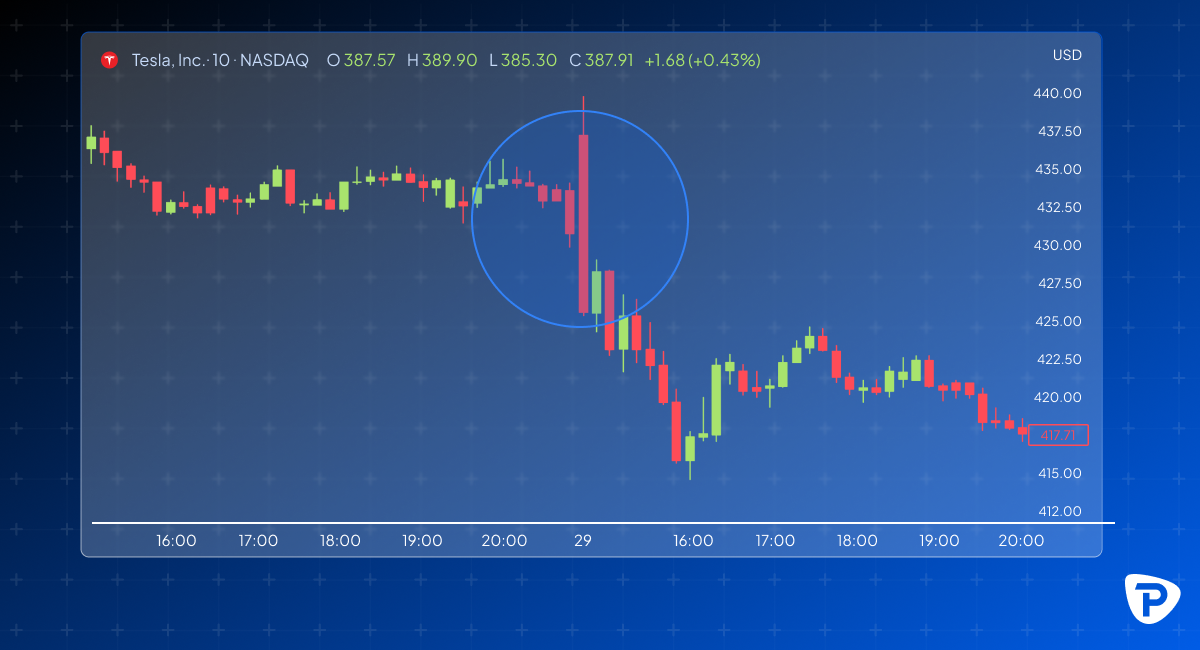
Tesla delivered its Q4 2025 earnings, beating market expectations, with stronger-than-expected profitability. However, despite the positive results, the share price moved lower after the announcement as investors focused on concerns around future margins, heavy investment in AI and robotics, and increased EV market competition. This reaction shows how markets often prioritise outlook and expectations over headline earnings figures.
Expectations around earnings season
The key driver of market movement around earnings announcements is not the announcement itself, but how the numbers measure up against expectations. For example, if Meta is widely expected to produce a positive set of data, this optimism would gradually be factored into the share price ahead of the announcement. If the announcement is then in line with expectations, it’s unlikely to cause much of a ripple. However, if Meta surprises the markets by releasing numbers that are lower – or higher – than expected, it’s far more likely to spur investors into action.
Ahead of an earnings announcement from a company you’re interested in trading, it’s worth getting familiar with EPS (earnings per share – how much profit a company made per share in a quarter) and revenue estimates provided by expert analysts and then examining historical patterns. For example, does the stock have a history of beating or missing expectations? By looking at previous quarterly EPS figures against their expectations, you can get a rough estimate of how the market responds and what to expect.
Similarly, observing how a share price reacts after an earnings report can reveal how strongly market sentiment is influenced by the announcement. If the stock experiences major movement, it indicates the results matter to traders; if it barely moves, other factors may be driving the price.
Trading before an announcement
Once you’ve done your research on a particular company, you might consider:
- Entering a long trade before the announcement, if you believe strong earnings will cause the stock price to rise.
- Entering a short trade before the announcement, if you anticipate disappointing earnings will cause the stock price to decline.
- Trading on post-earnings momentum
- Once earnings are announced, you can capitalise on the market’s initial reaction:
- Positive reaction: A stronger-than-expected earnings report can lead to multi-day rallies.
- Negative reaction: Earnings misses, or weak guidance can trigger significant selloffs as investors adjust their positions.
- The scale of these moves usually depends on how the results compare to expectations.
Example:
Microsoft’s FY25 earnings highlighted how strong results can still produce muted upside. Despite solid growth in cloud and AI-driven revenue, concerns around future guidance and higher AI investment costs weighed on the stock’s post-earnings performance.
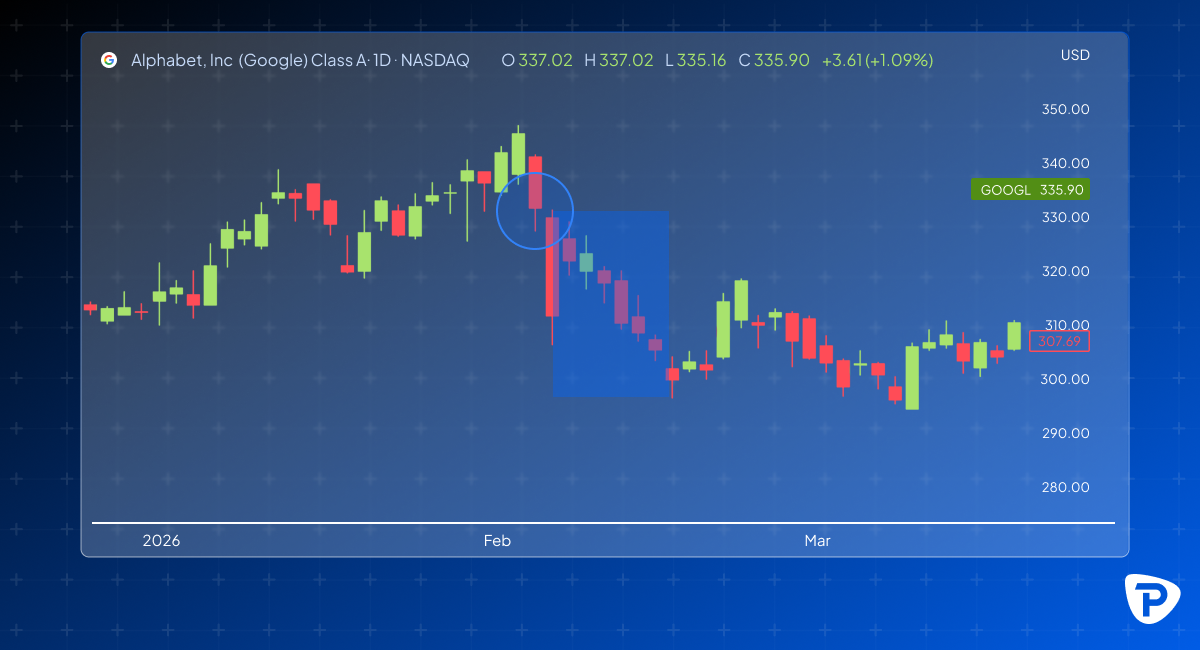
Alphabet’s Q4 2025 results also illustrate how expectations can drive a negative surprise reaction. Despite robust financial results and 18% YoY growth, the stock fell around 11% as the market weighed the sharp increase in planned 2026 capital expenditures against near‑term free cash flow.
How to analyse a company’s earnings report
An earnings report contains a wealth of data, but to make informed trades, you could focus on a few key areas
Core metrics: the top-line numbers highlighting overall performance:
- Revenue growth: Is the company increasing sales year-over-year (YoY)?
- Earnings per share (EPS): Did the company beat or miss EPS expectations?
Margins: provide insight into operational efficiency:
- Gross margin: Indicates how well the company controls costs.
- Net margin: Reflects overall profitability after expenses and taxes.
Forward guidance: a company’s prediction of future earnings, often carrying more weight than actual results:
- Positive guidance signals confidence in future growth.
- Weak guidance can lead to significant selloffs, even if the company beats EPS estimates.
Free cash flow (FCF)
Free cash flow reflects a company’s ability to generate cash after expenses. Positive FCF indicates financial flexibility. Company stocks with strong free cash flow growth may experience notable price movements after earnings, as traders respond to the news.
Conversely, weak free cash flow, even when revenue meets expectations, can carry significant implications for a company's share price. This is often due to underlying factors not visible in headline figures, such as one-off or irregular items (events or costs outside a company’s normal operations), which may raise concerns about the quality and sustainability of earnings.
Example:
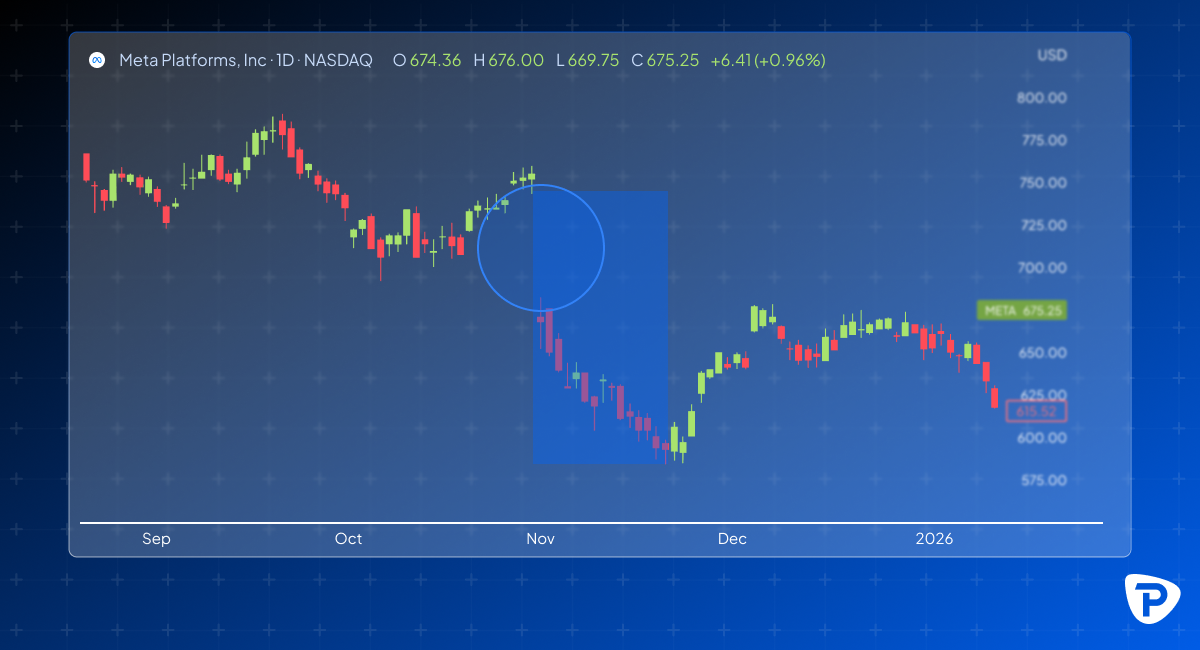
In Q3 2025, Meta Platforms reported revenues broadly in line with expectations. However, the company incurred a substantial $15.9 billion expense related to a disputed tax item. This resulted in an approximate 80% drop in net income for the quarter, directly impacting earnings per share and free cash flow.
The market reaction was strong. The stock declined by as much as 21% in the days following the release, reflecting a repricing as investors reassessed forward guidance, capital expenditure plans and the risk of similar non-recurring items.
Debt metrics
- Debt-to-equity ratio: High debt levels can signal risk in an environment of rising interest rates.
- Interest coverage ratio: This shows how easily a company can service its debt.
Seasonal trends and sector-specific patterns
Research your sector carefully to understand if there are broader factors likely to affect performance, and whether this may already be built into the price.
- Retail: Q4 earnings often show seasonal strength around major shopping periods, such as the holiday season.
- Energy: Q1 earnings align with winter demand peaks.
How to trade on an earnings announcement
There are various ways to react to price movements around earnings announcements.
Investing in the stock
If your research suggests a positive mid- to long-term outlook for the company, you may want to invest in its stock. This means you’ll own a portion of the company and can make capital gains if you later sell your shares for a higher price than you bought them for. There’s also the potential to receive dividend payments if the company issues them as well as voting rights in important company matters.
Options
These can offer a flexible way to trade if you’re expecting a market to move, but you’re not sure in which direction. For example, straddles and strangles provide the potential to profit from significant price movements in either direction, while iron condors essentially do the opposite, enabling you to benefit from reduced volatility after earnings. However, it's important to note that while these strategies can lead to profits, they also carry the risk of losses.
CFDs
Contracts for difference (CFDs) can be a great way to trade earnings announcements, because they allow you to speculate on price movements without owning the underlying asset. This means you can go both long and short, profiting from movements in either direction. As well as company shares, you can trade whole indices, commodities, forex and more from a single account.
CFDs are leveraged products, meaning you only have to put down a small portion of your overall exposure in order to trade. This can amplify your profits, but also your losses.
Trading CFDs with Pepperstone
Pepperstone offers round-the-clock trading and fast execution, enabling you to trade the moment markets move. Our suite of advanced trading tools and integrations means you’ll never need to miss an opportunity.
- 24/5trading on key US share CFDs¹: Get ahead of market movements by trading before, during and after an announcement.
- Razor-sharp spreads: Starting from 0.0 points on a Razor CFD account,² with low commission.
- 1350+ instruments: Think an earnings announcement might affect a whole index? Trade global indices, ETFs and more.
- Local, personalised support: Our dedicated, multilingual client service team is here to assist you 24 hours a day, Monday to Friday and 18 hours at the weekend.
- Smart tech integrations: Connect to MT4, MT5, cTrader, TradingView and more to gain access to the world’s most cutting-edge trading tools.
124-hour trading 5 days per week on select US share CFDs. For exact timings, please refer to the instrument specifications within the trading terminal.
2Other fees and charges may apply.
The material provided here has not been prepared in accordance with legal requirements designed to promote the independence of investment research and as such is considered to be a marketing communication. Whilst it is not subject to any prohibition on dealing ahead of the dissemination of investment research we will not seek to take any advantage before providing it to our clients.
Pepperstone doesn’t represent that the material provided here is accurate, current or complete, and therefore shouldn’t be relied upon as such. The information, whether from a third party or not, isn’t to be considered as a recommendation; or an offer to buy or sell; or the solicitation of an offer to buy or sell any security, financial product or instrument; or to participate in any particular trading strategy. It does not take into account readers’ financial situation or investment objectives. We advise any readers of this content to seek their own advice. Without the approval of Pepperstone, reproduction or redistribution of this information isn’t permitted.