- English


USDJPY Slides to 155: FX Intervention Lifts the Yen, but Rate Differentials Remain the Key Headwind
.jpg?height=93&quality=30)
On July 31, Japan's Ministry of Finance and the US Treasury carried out a joint yen-buying intervention — the first such coordinated action since the 2011 Great East Japan Earthquake.
Based on Bank of Japan money-market data, the combined size of the intervention is estimated at close to $87 billion. Japan's Ministry of Finance also said authorities stand "ready at any time" to take further coordinated action.
The large-scale intervention quickly moved the FX market. USDJPY pulled back from around 164, its highest level since 1986, falling to a Monday low of 155.23 — a fresh three-month low.
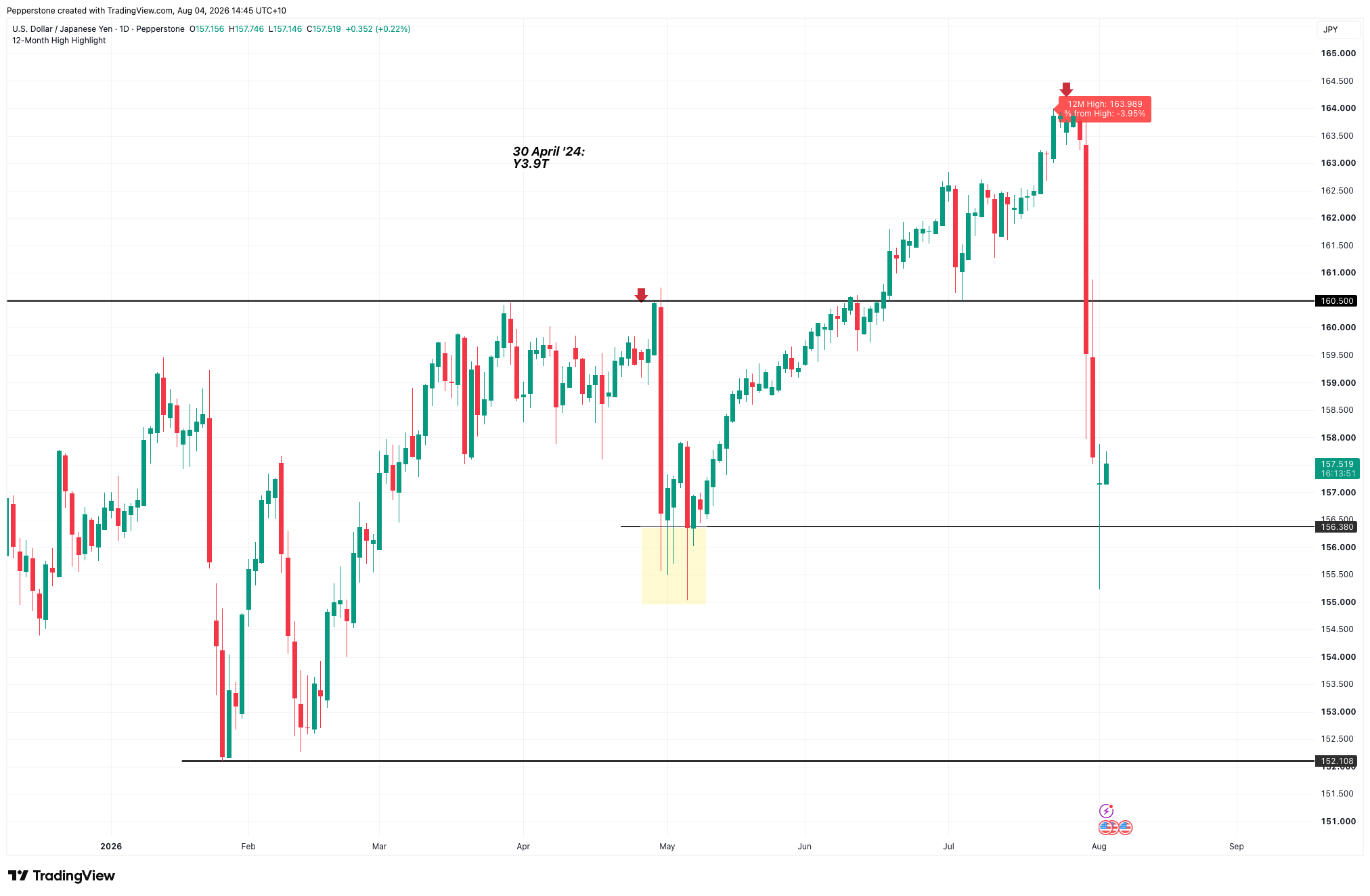
Short-term buyers are now re-entering the market. If the rebound extends, the pair could test resistance near 160.5; if it weakens again, support levels to watch include 156.3, 155.23, and around 152.
Against a backdrop of heightened intervention expectations and a marked rise in volatility, the key question for traders is whether this yen rally will turn into a genuine trend reversal. The answer depends largely on whether the policy intervention can be sustained, and on whether the forces driving yen weakness are likely to turn around.
US Joins the Intervention: Yen Volatility and Its Impact on the Treasury Market
What sets this intervention apart from other yen interventions this year is that it wasn't driven by Japan's Ministry of Finance alone — the US Treasury was also involved. This joint US-Japan action suggests the scale and duration of intervention could expand further, which is why it has quickly become a market focal point.
While Trump described the move as a "signal of friendship" toward Japan, the deeper logic behind it has more to do with the stability of the dollar system and US Treasury risk management.
This year, Japan's super-long government bond market has repeatedly shown signs of liquidity strain, while the US 30-year Treasury yield has also climbed above 5.28% at one point. The simultaneous rise in long-end yields globally reflects traders reassessing fiscal sustainability, long-term inflation, and government debt risk.
Japan is the largest foreign holder of US Treasuries, with holdings exceeding $1.2 trillion. As the Bank of Japan gradually raises rates, if domestic Japanese asset yields become more attractive, Japanese institutional and retail investors may have a stronger incentive to bring capital back home, which would weaken marginal demand for Treasuries and push up US borrowing costs.
Seen from this angle, helping Japan stabilize the yen and avoid greater turmoil in its bond market is also, in effect, helping preserve stability in the US Treasury market.
The Yen's Rapid Decline: US-Japan Rate Differentials, Structural Pressure, and Fiscal Expansion Combined
The yen's sharp depreciation since early May is the key backdrop to this intervention. On the surface it looks like ordinary currency-market volatility, but underneath it reflects the combined effect of the US-Japan rate differential, structural pressures in Japan's economy, and fiscal expansion.
The Fed's policy rate currently sits in the 3.50%-3.75% range, still on the high side among G10 nations. The Bank of Japan raised its rate to 1.0% in June, a 31-year high, but the two countries' rate differential still exceeds 250 basis points.
Against this backdrop, the carry trade — borrowing cheap yen to invest in higher-yielding dollar assets — remains highly attractive. Capital outflows have triggered yen selling, and USDJPY has naturally moved higher.
Structural problems within Japan are also weighing on the yen. An aging, shrinking population is suppressing domestic demand and lowering growth potential. Japan is heavily reliant on imported energy and food, so a weaker yen pushes up import prices; rising imported inflation in turn dampens consumption and business investment, ultimately forming a negative feedback loop of "yen depreciation — imported inflation — weak growth — capital outflows."
On top of that, Japan's government debt load is among the largest in the world and fiscal pressure has stayed elevated for years, making Japan even more reliant on a low-rate environment.
Add to this Takaichi's push for expansionary fiscal stimulus, and markets worry that loose fiscal policy will offset the currency support that rate hikes would otherwise provide — another reason the yen's depreciation expectations have proven hard to reverse.
Intervention Lifts the Yen Short-Term, but Fundamentals Still Need to Fall in Line Longer-Term
Now for the key question: can the yen settle into a steady uptrend?
In the short term, the policy intervention has clearly shifted market sentiment. Speculative funds had built up large short-yen positions, and the emergence of joint US-Japan intervention risk has raised the cost of shorting the yen — so the sharp rebound is hardly surprising.
Over a longer horizon, though, intervention on its own cannot change the rate differential or the direction of capital flows. Unless the Fed re-enters a rate-cutting cycle, or the Bank of Japan speeds up its hiking pace enough to meaningfully compress the differential to a level that changes the appeal of the carry trade, the exchange rate will eventually revert to being driven by fundamentals.
That said, on the fundamentals, the Fed's monetary policy still leans toward a higher-rate environment, and the Bank of Japan has limited room for further aggressive hikes.
A marked tightening in rates would put greater strain on Japan's sizeable government bond market and property market, while significantly increasing the interest burden on government debt. Even if the Bank of Japan hikes another 25 basis points at its September policy meeting, that adjustment would still fall well short of fundamentally changing the carry-trade logic given the current wide US-Japan rate gap.
A more reasonable expectation, then, is that intervention can slow and smooth the pace of yen depreciation and dampen short-term volatility. But the yen's path from here will depend more on how the rate differential between the two countries evolves, as well as on Japan's industrial competitiveness and fiscal discipline.
Watch the US-Japan Rate Differential and Policy Signals
Overall, the yen's recent rebound has been clearly driven by policy factors, but its future direction will still depend on whether the US-Japan rate differential genuinely begins to narrow. For traders, keeping an eye on central bank policy shifts and key economic data in the near term matters more than simply trying to call whether the exchange rate has bottomed.
On the US side, watch the July CPI release on August 12. If inflation comes in higher than expected, it could increase market pricing for a Fed rate hike in September, and USDJPY could see a rebound.
The Jackson Hole Economic Symposium, running August 27-29, is another important event, with markets watching for signals from Warsh on the future rate path. If his tone leans hawkish, emphasizing that controlling inflation remains the Fed's near-term priority, the yen could come under additional pressure.
On the Japan side, the tone of the Bank of Japan's September policy meeting, along with any shift in Governor Ueda's language on inflation expectations, will be a market focal point. If the Bank of Japan signals a rate hike, the yen could get marginal support.
Finally, the results of Japan's super-long government bond auctions, along with further details on the Japanese government's fiscal stimulus, will continue to shape how the market judges Japan's sovereign credit and rate-differential outlook — both are potential triggers for sharp USDJPY volatility in the near-to-medium term.
The material provided here has not been prepared in accordance with legal requirements designed to promote the independence of investment research and as such is considered to be a marketing communication. Whilst it is not subject to any prohibition on dealing ahead of the dissemination of investment research we will not seek to take any advantage before providing it to our clients.
Pepperstone doesn’t represent that the material provided here is accurate, current or complete, and therefore shouldn’t be relied upon as such. The information, whether from a third party or not, isn’t to be considered as a recommendation; or an offer to buy or sell; or the solicitation of an offer to buy or sell any security, financial product or instrument; or to participate in any particular trading strategy. It does not take into account readers’ financial situation or investment objectives. We advise any readers of this content to seek their own advice. Without the approval of Pepperstone, reproduction or redistribution of this information isn’t permitted.