- English


Oil Spikes, Then Retreats: Markets Bet on No Real Supply Hit
.jpg?height=93&quality=30)
Tensions in the Middle East flared up again early this week. After Trump declared the ceasefire over, the US carried out airstrikes on Iranian targets for two consecutive days, while Iran retaliated with strikes on US military bases. SpotBrent rallied sharply on the news, climbing from around $72 to post its largest single-day gain since May, briefly touching $80 intraday.
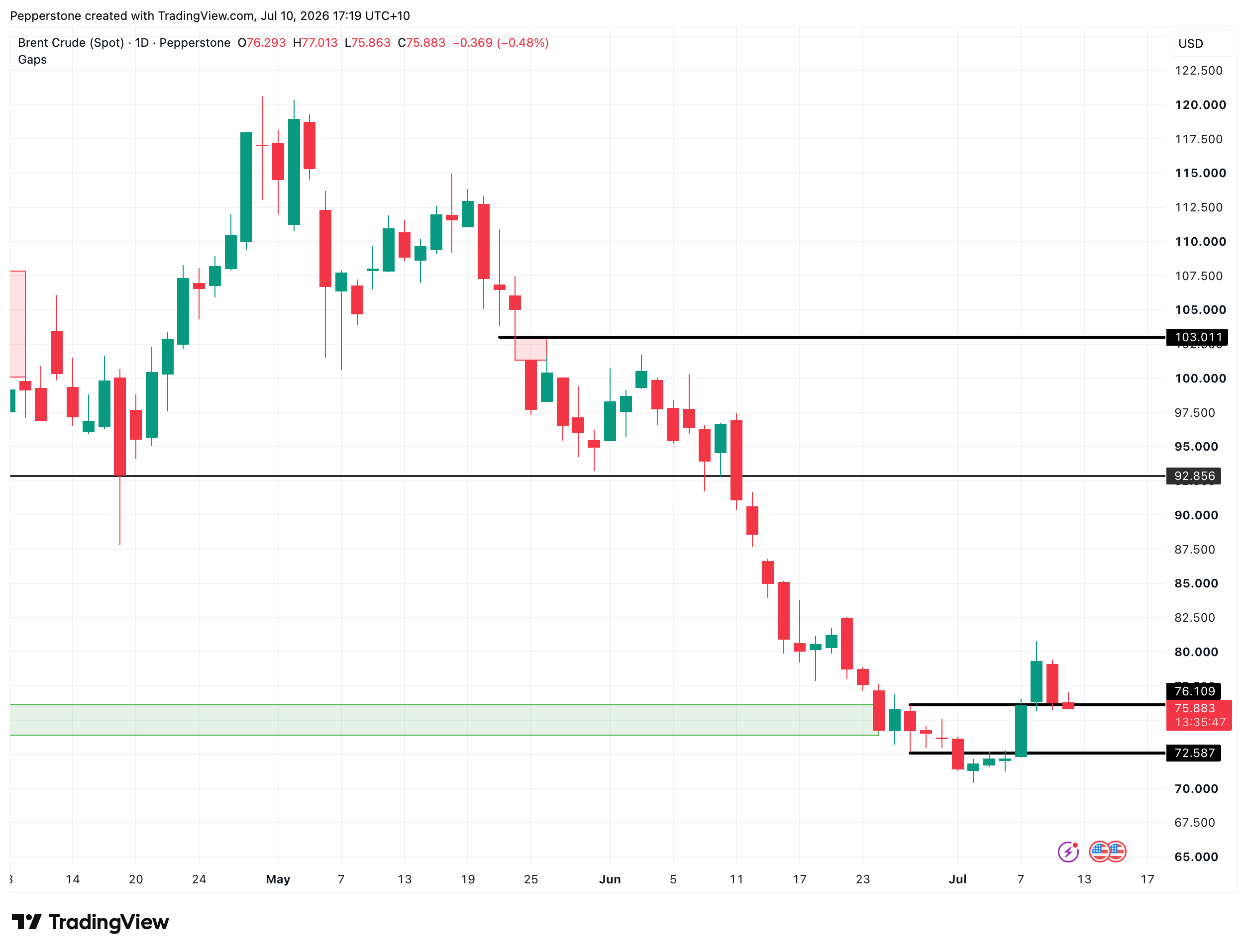
However, just two trading days later, market sentiment cooled quickly, with prices retesting the $73.9–$76.1 gap left open since the conflict erupted in late February.
Judging by price action, this round of trading did not follow the conventional "escalation leads to sustained rally" script. Instead, the market moved quickly to reassess the event's actual impact on global oil supply.
What the market is really pricing: whether supply is genuinely affected
The most notable aspect of this move isn't the escalation itself, but the fact that the market is reassessing the likelihood of the geopolitical event translating into an actual supply shock.
Despite the continued escalation in military activity, the Strait of Hormuz has yet to see any sustained disruption to shipping. Vessel-tracking data showed 26 ships transited the strait as normal on Wednesday, suggesting the global oil supply chain has not suffered any material damage.
As a result, the market has begun to treat political escalation and actual changes in supply as two separate matters. As long as the Strait of Hormuz retains basic transit capacity, the impact of geopolitical events on the global supply-demand balance remains relatively limited.
At the same time, the sharp rally over the prior two sessions had already priced in a significant portion of the geopolitical risk premium. With no new supply shock or further escalation to point to, profit-taking flows took over, driving prices to give back their gains.
Taken together, this rally looks more like an event-driven repricing of the risk premium than a shift in the underlying fundamental trend.
Short-term outlook: watch the IEA report and the OPEC+ decision
With the market refocusing on supply-demand fundamentals, two events over the coming days deserve particular attention.
The first is today's IEA monthly oil market report. Market attention will center on the global supply-demand balance, inventory changes, and whether demand forecasts are revised. If the report points to tightening inventories or a tighter supply picture, oil could find further support; if not, it may reinforce the view that supply remains ample.
The second is whether OPEC+'s decision to proceed with a 188,000-barrel-per-day output increase from August will hold up as the situation evolves. If the conflict escalates further and signs of a genuine supply disruption start to pile up, OPEC+ could still call an emergency meeting to reassess the pace of increases. But absent such signals, the plan will likely stay on track — and producers' own behavior will keep serving as evidence that the conflict has yet to materially disrupt supply.
Oil price moves could also spill over into other asset classes. If energy prices move back up and push inflation expectations higher, Treasury yields could continue to rise, adding complexity to the Fed's policy decisions. Under this scenario, equities, currencies, and rates markets could all be affected, with volatility likely to rise noticeably.
Medium-to-long-term logic: the supply-demand balance remains the key variable
The market currently expects Brent to find a "soft landing" somewhere around $70–$75 a barrel, though whether this equilibrium range holds remains to be seen.
On the supply side, OPEC+ has raised output quotas by close to 800,000 barrels per day cumulatively since April. At the same time, the UAE's exit from OPEC+, along with recent policy signals from Saudi Arabia and Russia, all suggest that major producers are currently prioritizing global market share over simply defending high prices.
On the demand side, global demand growth remains soft. The IEA expects global oil demand growth to slow further this year, and the recovery in China's oil consumption has also come in weaker than the market previously expected.
Against a backdrop of continued supply growth and limited demand improvement, the market still holds a degree of optimism about the medium-to-long-term oil price outlook. As the geopolitical risk premium gradually fades, a further decline in oil prices later this year cannot be ruled out.
It should also be noted that this scenario would not necessarily mean risk assets benefit across the board. On one hand, energy company earnings and sector valuations could come under pressure, and credit spreads on high-yield energy debt could widen. On the other hand, if a sustained decline in oil prices reflects weakening global demand, concerns about the growth outlook could rise in tandem.
For traders, rather than betting on conflict headlines themselves, it is more worthwhile to focus on the marginal changes that will determine the supply outlook.
Going forward, the market's direction will still hinge mainly on two threads: first, whether tensions in the Middle East escalate further and eventually evolve into a genuine supply disruption risk; second, whether OPEC+'s actual pace of output increases and the global supply-demand balance shift.
Until these two factors show a clear change, the oil market will most likely continue to oscillate between geopolitical risk premium and fundamentals-based pricing, with price volatility driven increasingly by the interplay of news flow and supply-demand expectations.
The material provided here has not been prepared in accordance with legal requirements designed to promote the independence of investment research and as such is considered to be a marketing communication. Whilst it is not subject to any prohibition on dealing ahead of the dissemination of investment research we will not seek to take any advantage before providing it to our clients.
Pepperstone doesn’t represent that the material provided here is accurate, current or complete, and therefore shouldn’t be relied upon as such. The information, whether from a third party or not, isn’t to be considered as a recommendation; or an offer to buy or sell; or the solicitation of an offer to buy or sell any security, financial product or instrument; or to participate in any particular trading strategy. It does not take into account readers’ financial situation or investment objectives. We advise any readers of this content to seek their own advice. Without the approval of Pepperstone, reproduction or redistribution of this information isn’t permitted.