- English


Nvidia Earnings Preview: Jensen Huang’s Exit and Margin Pressure Raise Caution

Summary
- Nvidia reports on November 17 in the middle of a leadership transition: Huang steps down as CEO and Colette Kress takes over on an interim basis, adding uncertainty to a company whose operating fundamentals remain solid.
- The stock is weighed down by margin pressure from higher HBM costs, doubts about financing for artificial intelligence infrastructure and regulatory scrutiny over exports to China.
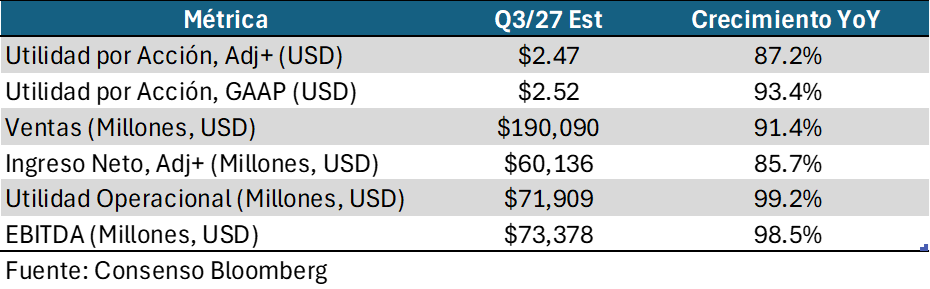
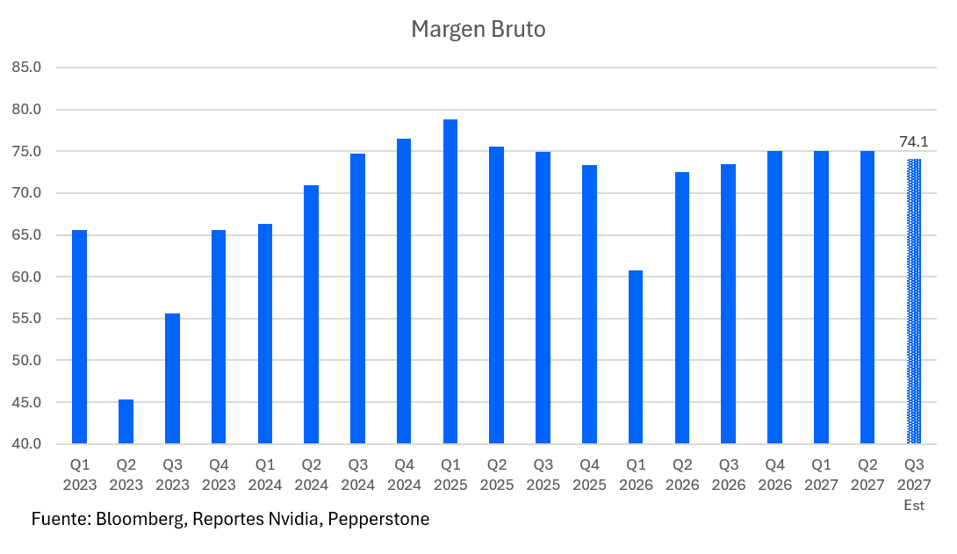
- LThe key variable is a gross margin expected near 74%, versus 75% in the previous quarter, together with the Vera Rubin rollout and guidance for the fourth quarter.
Can Huang’s Exit Overshadow Nvidia’s Earnings?
This Nvidia earnings preview comes ahead of a report scheduled for November 17 that is shaping up to be one of the most significant events for the U.S. tech market. The company faces an especially complex mix of extraordinary growth expectations, growing questions about the sustainability of artificial intelligence investment and an unexpected leadership crisis. Operating fundamentals continue to show exceptional demand for accelerated computing infrastructure, but Jensen Huang’s departure as chief executive, just announced, adds a layer of uncertainty that could end up mattering as much to the company’s valuation as its financial results. Colette Kress, until now the chief financial officer, will temporarily take over as CEO while the board searches for a permanent successor, ending more than three decades of leadership under Huang.
The transition follows several days of controversy over reports about the executive’s personal relationships, including one with a businesswoman whom U.S. authorities suspect of having ties to Chinese intelligence services. The independent investigation announced by the board on November 8 sought to determine whether there had been any risk to national security or to Nvidia’s confidential information, although the company initially stated it had no reason to believe such information had been compromised. New reports of an alleged relationship with a company executive intensified doubts about corporate governance and conflicts of interest. These circumstances remain under investigation and must be distinguished from any proven wrongdoing, but the episode raises questions about the strategic continuity of an organization whose expansion, business relationships and geopolitical positioning have been closely tied to its founder.
Revenue, Gross Margin and Vera Rubin: What Drives the Reaction
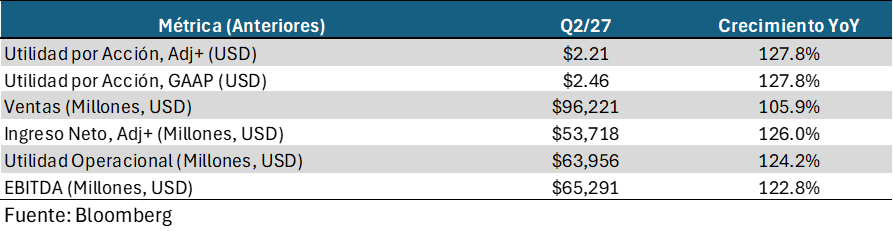
From a financial perspective, however, the backdrop for this Nvidia earnings preview remains favorable. In its last report, the company posted sales of US$96.2 billion for the previous quarter, a year-over-year increase of 106%. The data center division reached US$89.0 billion (+117%), consolidating its position as the business’s main engine and accounting for more than 92% of consolidated revenue. The company also reported a 75% gross margin and adjusted earnings of US$2.21 per share, reflecting both the strength of demand and its high operating profitability.
The evolution of Vera Rubin is another central element in assessing growth prospects. The platform, currently in a phase of commercial expansion, marks a new stage in Nvidia’s strategy of offering integrated systems that combine graphics processors, CPUs, high-speed networking and specialized software. Its importance goes beyond launching a more efficient generation of chips, as it allows the company to capture a larger share of total spending on building and operating artificial intelligence infrastructure. In August, Nvidia reported that these systems were already in production and being deployed with operators such as Microsoft Azure, Google Cloud, Oracle Cloud Infrastructure and CoreWeave. The market will be especially attentive to the pace at which this architecture is adopted in data centers, the availability of production capacity and any signals the company provides about its contribution to sales in coming quarters.
AI Financing, China and Competition: Where the Risks Lie
This Nvidia earnings preview also reflects a shift in the debate among investors, from the strength of artificial intelligence demand toward the ability to turn investment commitments into operational, commercially profitable data centers. Questions around financing availability, energy constraints, construction permits and the speed at which new facilities can begin generating revenue remain not fully resolved. This risk is especially relevant for specialized AI infrastructure operators, known as neoclouds, whose business models typically depend on external financing and rapid utilization of installed capacity. For that reason, although demand visibility for 2027 appears relatively solid, the outlook for 2028 could face greater execution risks, even in the absence of a significant deterioration in end demand.
This concern takes on added importance given Nvidia’s growing role as a financial linchpin of the AI ecosystem. In August, the company announced partnerships with Apollo, BlackRock, Blackstone, Brookfield, Goldman Sachs and KKR aimed at mobilizing more than US$500 billion in third-party capital to finance computing infrastructure. The initiative seeks to expand the investment capacity of customers and developers, but it also deepens the interdependencies among semiconductor makers, infrastructure providers, financial institutions and AI model developers. In this context, Huang’s departure could introduce uncertainty about the continuity and terms of these initiatives, given his role in creating business relationships and strategic agreements. A slowdown in these commitments could temporarily remove a significant source of liquidity from the ecosystem, precisely when high interest rates and tighter financing conditions are making projects more sensitive to their cost of capital.
Another significant risk factor comes from the U.S. regulatory environment, particularly restrictions on exports of advanced semiconductors to China. The leadership crisis could intensify scrutiny by authorities of Nvidia’s business relationships with international intermediaries and the final destination of its products, especially in Southeast Asian markets. Although the company has already excluded data center computing revenue from China from its official third-quarter guidance, indirect exposure to that market remains a potential source of uncertainty.
Regulatory uncertainty adds to a broader discussion about Nvidia’s ability to preserve its competitive advantages against AMD and Broadcom. Although the company maintains a dominant position, its customers have growing incentives to diversify suppliers, reduce costs and limit their dependence on a single manufacturer. Huang’s departure could partially accelerate these strategies, especially if buyers perceive risks to continuity in product development or commercial terms. However, any significant replacement of Nvidia’s infrastructure still faces substantial technological and operational barriers.
From a market perspective, Nvidia’s recent pullback should also be read in the context of growing selectivity toward AI-linked companies. The combination of demanding valuations, greater financing needs and doubts about the economic returns on investment has heightened investor sensitivity to any sign of deteriorating project execution. In this scenario, the leadership crisis has acted as an additional catalyst for risk aversion, with repercussions for semiconductor makers, data center operators and other companies tied to the expansion of technology infrastructure. The initial reaction also reflects the systemic importance Nvidia has acquired within the major U.S. stock indices and the global AI investment cycle.
Nvidia Heads Into Earnings With Solid Fundamentals, Uncertain Leadership
Looking ahead to November 17, management’s main challenge will be to show that the strength of its operating fundamentals can be sustained regardless of the executive transition. A result above expectations, accompanied by solid guidance for the fourth quarter, signs of a future margin recovery and confirmation of the Vera Rubin rollout, would help reinforce confidence in the continuity of growth. However, a positive reaction could be limited if doubts persist about succession, relationships with strategic customers or the regulatory consequences of the ongoing investigations.
This Nvidia earnings preview leaves a particularly relevant paradox for investors: the company’s commercial prospects continue to be backed by one of the most important technology investment cycles in recent decades, but uncertainty over its leadership and the financial sustainability of the artificial intelligence ecosystem has increased considerably. The key question is no longer only how much the company can grow over the coming quarters, but how far it can convert its technological leadership and order book into a sustainable stream of profits, while preserving its competitive advantages and the confidence of its customers. In this sense, the upcoming report could mark an inflection point for Nvidia and for the U.S. tech sector as a whole, offering the first signals of how the company will face a new stage of growth without Jensen Huang’s executive leadership.
The material provided here has not been prepared in accordance with legal requirements designed to promote the independence of investment research and as such is considered to be a marketing communication. Whilst it is not subject to any prohibition on dealing ahead of the dissemination of investment research we will not seek to take any advantage before providing it to our clients.
Pepperstone doesn’t represent that the material provided here is accurate, current or complete, and therefore shouldn’t be relied upon as such. The information, whether from a third party or not, isn’t to be considered as a recommendation; or an offer to buy or sell; or the solicitation of an offer to buy or sell any security, financial product or instrument; or to participate in any particular trading strategy. It does not take into account readers’ financial situation or investment objectives. We advise any readers of this content to seek their own advice. Without the approval of Pepperstone, reproduction or redistribution of this information isn’t permitted.