- English


Microsoft Q1 2027 Earnings Preview: Azure and AI Spending Raise the Bar on Margins

Summary
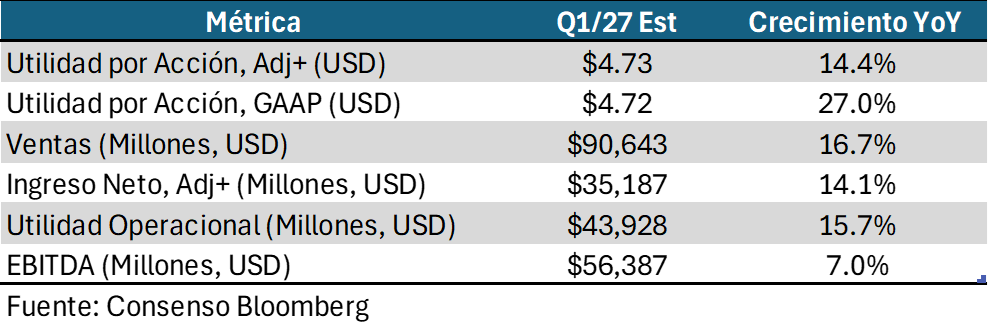
- Microsoft reports on Wednesday, October 28 after the market closes, with consensus revenue of approximately $90.6 billion (around 17% year-on-year growth) and earnings per share near $4.70.
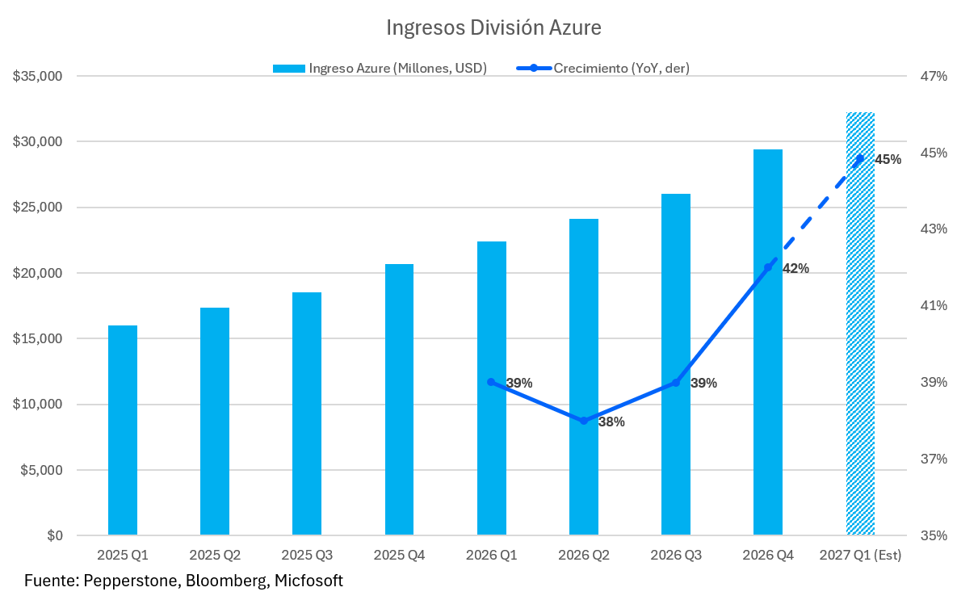
- Azure growth, which the market expects to accelerate from 42% to 45%, is the most important variable, and a result broadly in line with guidance may no longer be enough to sustain optimism.
- Capital expenditure, estimated at approximately $237 billion in fiscal year 2027, pressures margins and free cash flow and is the primary source of uncertainty.
Can Azure Growth Beat 45% Despite OpenAI Exposure?
Ahead of Microsoft Q1 2027 earnings, analyst consensus points to revenue of approximately $90.6 billion, which would represent year-on-year growth of around 17%, while earnings per share are expected to come in near $4.70. Beyond simply meeting these forecasts, however, attention will be firmly focused on Microsoft’s ability to sustain Azure’s growth, deepen Copilot monetization, and contain the pressure on margins and cash generation stemming from the expansion of its artificial intelligence infrastructure.
In Microsoft Q1 2027 earnings, Azure remains the company’s primary growth engine and the most important variable in assessing Microsoft’s outlook. After expanding by 42% in the previous quarter, the market expects growth to accelerate toward 45%, supported by the addition of new computing capacity and continued enterprise demand for artificial intelligence services that continues to exceed available infrastructure. These expectations could nevertheless be surpassed given the strength of cloud consumption, the expansion of operational capacity, and increased utilization of AI tools. The challenge, therefore, lies in exceeding significantly more demanding investor expectations. A result broadly in line with the company’s guidance may no longer be sufficient to sustain optimism unless it is accompanied by convincing signs of further acceleration over the coming quarters.
This dynamic is closely linked to the strong growth in demand for computing capacity, particularly from advanced artificial intelligence models and the enterprise applications built on top of them. Microsoft’s commercial relationship with OpenAI represents an important source of revenue, both through the use of Azure infrastructure and the commercialization of related products and services. According to company information, Microsoft disclosed approximately $24 billion in revenue from commercial agreements with OpenAI during fiscal year 2026, equivalent to roughly 7% of consolidated revenue. While this exposure allows Microsoft to benefit from the expansion of the generative AI ecosystem, it also introduces a meaningful vulnerability, as part of the company’s growth depends on the performance of a major customer and strategic partner, as well as on commercial agreements whose economic structure and future evolution are not yet entirely clear.
Copilot Gains Traction, but Capex Pressures Gross Margin
For Microsoft Q1 2027 earnings, the performance of Microsoft 365 and Copilot represents the second major area of focus, particularly because it provides an indication of whether artificial intelligence is moving from a phase dominated by infrastructure investment toward one characterized by recurring monetization within the corporate market. Microsoft ended the previous quarter with approximately 30 million paid Microsoft 365 Copilot licenses, reflecting growing adoption among enterprise customers. Given the pace of artificial intelligence adoption, it is reasonable to expect some improvement in corporate technology budgets, particularly in the United States, alongside a greater willingness among companies to integrate AI tools into their operations. Against this backdrop, the market expects Microsoft 365 Commercial Cloud to grow by around 16.0%, supported by both new licenses and greater utilization of Copilot-related services. The transition toward consumption-based pricing models could also support higher revenue per customer, although its effectiveness will ultimately depend on whether companies can identify tangible productivity improvements that justify maintaining and expanding these subscriptions.
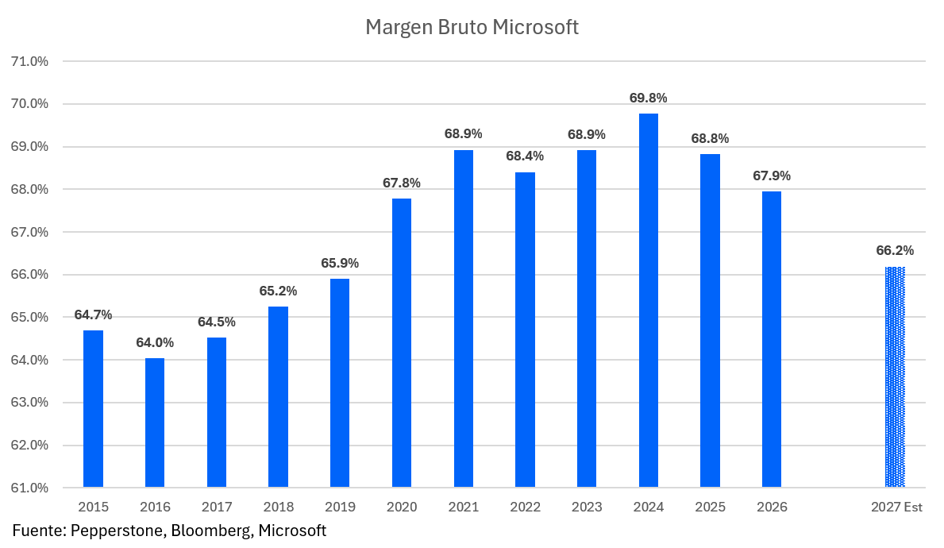
However, the primary source of uncertainty for Microsoft remains the enormous cost of financing this expansion. The construction of data centers, acquisition of advanced processors, and energy requirements associated with artificial intelligence are significantly reshaping the company’s capital structure. Capital expenditure is estimated to reach approximately $237 billion in fiscal year 2027, above the roughly $220 billion currently anticipated by the market. While these investments are necessary to expand Azure capacity and respond to demand that remains elevated, they also increase depreciation expenses and place pressure on free cash flow generation. Against this backdrop, it will be important to assess whether these dynamics begin to negatively affect the company’s gross margin, which ended the previous fiscal year at around 67.9%. The key question, therefore, is whether growth in AI-related revenue can sufficiently offset these additional costs and prevent margin deterioration from becoming more persistent. This concern has become a broader theme across the technology sector, as we have highlighted previously when discussing the pressure that the AI investment boom is exerting on cash flows across the industry.
Backlog and the Federal Reserve Shape Microsoft’s Valuation
The scale of Microsoft’s contracted backlog provides some visibility into future revenue, although it does not fully eliminate the associated risks. Microsoft ended the previous quarter with commercial remaining performance obligations of approximately $678 billion, supported by long-term commitments from enterprise customers and artificial intelligence providers. However, there is an important distinction between securing large contracts and converting those commitments into profitable revenue within the expected timeframe. Delays in bringing new data centers online, constraints on chip supply, higher energy costs, or changes in customers’ computing requirements could slow this conversion. At the same time, improvements in the efficiency of artificial intelligence models could reduce the computing resources required to perform certain tasks, introducing uncertainty around the evolution of demand for processing capacity per unit of activity. As a result, the trajectory of commercial bookings and the speed at which Microsoft converts contractual commitments into realized revenue will be just as relevant as Azure’s headline growth figures.
On the macroeconomic front, Microsoft will report its Q1 2027 earnings against a backdrop of growing scrutiny over artificial intelligence investment and heightened sensitivity in technology valuations to the interest-rate outlook. The proximity of the Federal Reserve’s monetary policy meeting adds another layer of uncertainty, particularly for companies whose market valuations remain heavily dependent on expectations of future earnings. While structural demand for digital services and artificial intelligence continues to create meaningful opportunities for expansion, an environment of higher financing costs or reduced investor risk appetite could constrain the valuation multiples the market is willing to assign to that growth. At the same time, competition among Microsoft, Amazon, and Google for corporate spending on AI infrastructure and applications continues to intensify, reinforcing the need for Microsoft to demonstrate sustainable advantages in both technological capabilities and economic efficiency.
The Question Isn’t AI, but How Much Investment It Takes
Microsoft approaches its Q1 2027 earnings with solid operating fundamentals, a strong competitive position in enterprise services, and growth expectations that have continued to strengthen. Yet that combination is precisely what raises the bar for the company’s results. Microsoft will need not only to demonstrate that Azure and Copilot remain on a favorable trajectory, but also to provide evidence that its extraordinary investment levels are translating into recurring revenue, sustainable margins, and attractive returns on committed capital. The central question is no longer whether artificial intelligence will continue to drive Microsoft’s revenue growth, but rather how much time and investment will be required to translate that growth into a proportional improvement in cash flow generation. The answer will be critical in determining the sustainability of the company’s financial outlook over the coming quarters.
The material provided here has not been prepared in accordance with legal requirements designed to promote the independence of investment research and as such is considered to be a marketing communication. Whilst it is not subject to any prohibition on dealing ahead of the dissemination of investment research we will not seek to take any advantage before providing it to our clients.
Pepperstone doesn’t represent that the material provided here is accurate, current or complete, and therefore shouldn’t be relied upon as such. The information, whether from a third party or not, isn’t to be considered as a recommendation; or an offer to buy or sell; or the solicitation of an offer to buy or sell any security, financial product or instrument; or to participate in any particular trading strategy. It does not take into account readers’ financial situation or investment objectives. We advise any readers of this content to seek their own advice. Without the approval of Pepperstone, reproduction or redistribution of this information isn’t permitted.