- English


KOSPI200 Plunges 25%: AI Returns Under Scrutiny as Korean Chip Stocks Face Further Downside Risks

Since the start of October, the global AI trade has faced a major test. Markets are no longer simply chasing growth in computing demand and chip sales. Instead, they are beginning to ask: how much profit can the ever-expanding AI capital expenditure generate, and how long will it take to recoup those investments?
South Korea's large-cap blue-chip index, the KOSPI200, has been among the hardest hit in the latest correction. Over the past two weeks, the index has seen a maximum drawdown of nearly 25%, falling rapidly from 1,100 above to around 840, with a circuit breaker triggered at one point.
The sell-off reflects more than just profit-taking. It also points to a broader reassessment of earnings quality and financing risks across the AI industry, as well as the Korean equity market's heavy dependence on the semiconductor cycle. With AI investment returns still uncertain and the earnings outlook for semiconductor companies yet to be validated, the valuation adjustment in Korean chip stocks may not be over.
Global AI Sell-Off: From Growth Expectations to Profitability and Financing Challenges
Over the past two years, markets have largely assumed that as long as demand for AI computing power continues to grow, chipmakers and data centre companies will benefit. Now, however, traders are more focused on whether massive capital investments can translate into sustainable cash flow and profits.
Recently, debt issued by AI cloud providers such as CoreWeave has come under pressure, with yields on some bonds rising to around 15%. Meanwhile, Australian data centre company Firmus has called off its IPO plans, highlighting the financing challenges facing AI infrastructure businesses.
These developments do not mean that AI demand has disappeared. Rather, markets are increasingly concerned that if AI commercialisation falls short of expectations, or cloud providers slow their investment, heavy capital expenditure and financing costs could reinforce one another, putting pressure on earnings expectations and debt-servicing capacity across the sector. US inflation and interest rate pressures have also made traders less willing to pay high valuations for growth stories that rely heavily on external financing.
Industry competition is also intensifying. Progress by China's ChangXin Memory Technologies (CXMT) in next-generation DRAM technology has raised concerns about future supply and the pricing power of Korean manufacturers. While this does not mean that the technological advantages of Samsung Electronics and SK Hynix have been overturned, competitive risks alone could be enough to trigger a valuation pullback when AI growth expectations are already fully priced in.
Why Have Korean Equities Fallen More Sharply?
The key lies in index concentration: the heavy weighting of semiconductor stocks in the Korean market has amplified the risks associated with the global AI trade.
Samsung Electronics and SK Hynix are not only major constituents of the KOSPI200 but also important players in the global AI memory chip industry. As markets question the sustainability of AI infrastructure investment, both companies have become important stocks for international investors looking to adjust their technology exposure, with their share price declines quickly feeding through to the broader index.
More importantly, strong earnings alone are no longer enough to support market confidence.
Samsung Electronics' third-quarter earnings guidance projected operating profit of KRW 107.4 trillion, a quarterly record. Yet even these impressive figures have failed to turn market sentiment around. Traders are now more focused on HBM competitiveness, long-term orders and forward earnings guidance as they try to assess how much longer the memory chip supercycle can last.
At the same time, share buyback programmes totalling around KRW 55 trillion across Samsung Electronics and SK Hynix are gradually drawing to a close, weakening a key source of buying support that had previously helped absorb selling pressure. With foreign investors continuing to reduce their holdings, the market needs fresh buyers to absorb the selling.
South Korean AI infrastructure company Elice made its KOSDAQ debut on October 20, with its shares falling as much as approximately 32% below the offer price during the session. Despite strong subscription demand ahead of the listing, its weak secondary-market performance highlights a growing gap between traders' interest in the AI growth story and the valuations they are actually willing to accept.
With both foreign and domestic institutional investors reducing their holdings, the Korean market's structural vulnerabilities have become increasingly apparent. When an index is heavily concentrated in a single industry cycle, any challenge to the prevailing investment narrative can significantly amplify market swings.
KOSPI200 Outlook: Watching 6,400 Support and Earnings Confirmation
In the near term, the KOSPI200 could remain volatile. Although the index has already suffered a series of sharp declines, there is still insufficient evidence to suggest that the valuation adjustment across the AI sector has ended.
From a technical perspective, the first area to watch is the 844-848 support zone. If this holds, the index may attempt to establish a near-term bottom. A decisive break below this range, however, could see the index fall further towards 820.
On the upside, 7,000 is the key level to watch. Regaining a foothold above this level would provide greater confidence in the sustainability of a rebound.
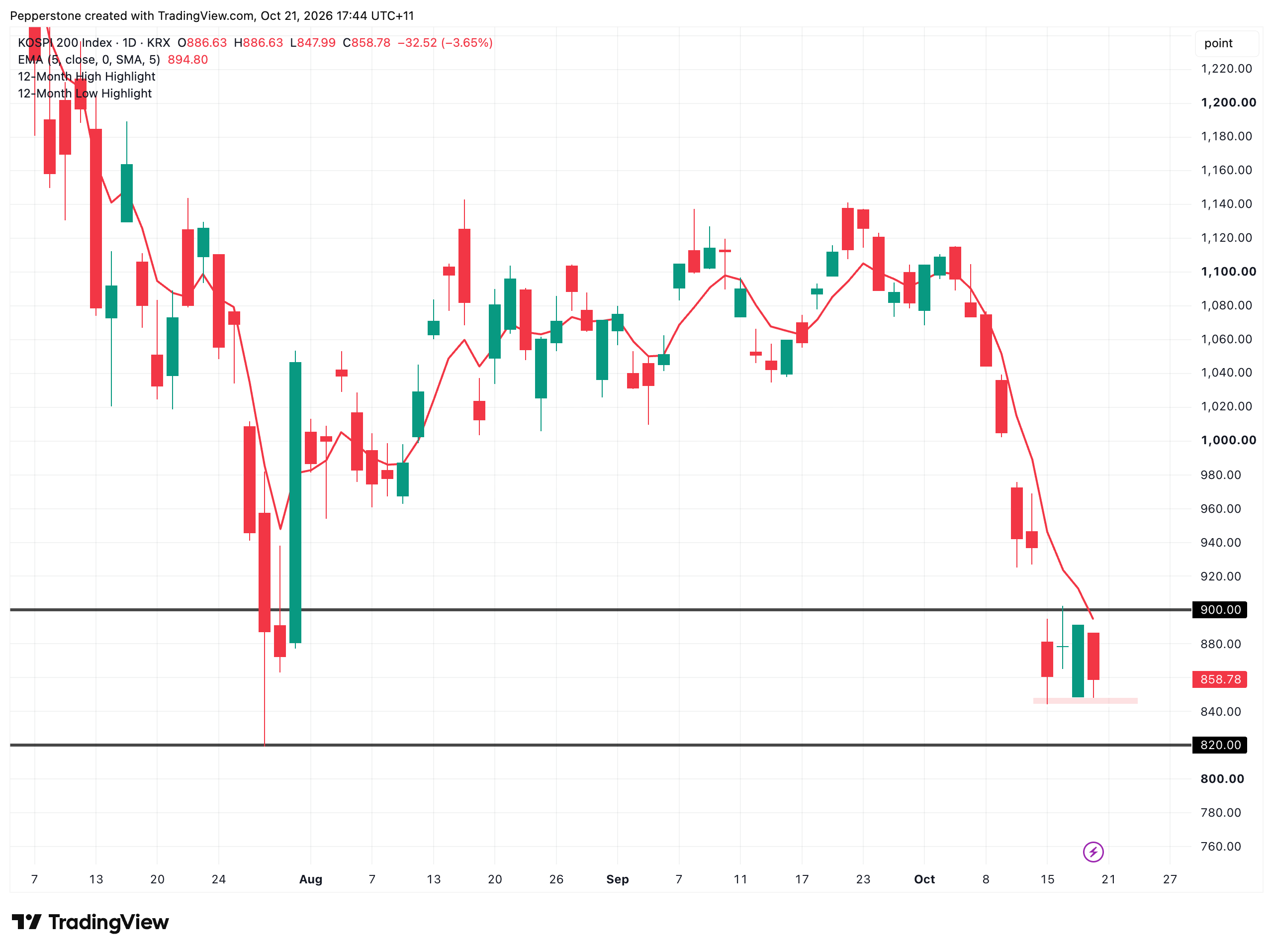
Several upcoming events will be worth watching:
- US tech earnings: Meta reports on October 21, while earnings from Tesla, Lam Research and Texas Instruments will also offer further insights into the sector. A resilient outlook for AI capital expenditure and monetisation could help restore confidence. Conversely, any signs of slowing investment or deteriorating cash flow could weigh on the hardware sector.
- Bank of Korea rate decision: The central bank announces its decision on October 22. Markets broadly expect the policy rate to remain at 3.00%, although a November rate hike is still seen as a possibility. A more hawkish signal could put pressure on equity valuations.
- Korean GDP and Samsung earnings: South Korea's preliminary third-quarter GDP figures, due on October 27, and Samsung Electronics' earnings conference call on October 29 will help traders assess whether semiconductor exports, AI-related orders and corporate earnings growth can be sustained.
- Middle East tensions and energy prices: These remain important external risks. Another rise in oil prices could intensify inflation and interest rate pressures while weakening global risk appetite.
Overall, the deep correction in Korean equity indices does not mean that the long-term AI growth story has come to an end. Rather, markets are beginning to demand clearer investment returns, healthier financing structures and more sustainable earnings growth.
For traders, a recovery in global AI investment confidence, confirmation of the earnings outlook for leading semiconductor companies, and an easing of foreign selling pressure will be key to determining whether the KOSPI200 can move beyond a technical rebound towards a more sustained recovery. Until these conditions emerge, any single-day rebound may not be enough to confirm that the market has bottomed.
Want to express your market view? Trade KR200 perpetual CFDs with Pepperstone.
The material provided here has not been prepared in accordance with legal requirements designed to promote the independence of investment research and as such is considered to be a marketing communication. Whilst it is not subject to any prohibition on dealing ahead of the dissemination of investment research we will not seek to take any advantage before providing it to our clients.
Pepperstone doesn’t represent that the material provided here is accurate, current or complete, and therefore shouldn’t be relied upon as such. The information, whether from a third party or not, isn’t to be considered as a recommendation; or an offer to buy or sell; or the solicitation of an offer to buy or sell any security, financial product or instrument; or to participate in any particular trading strategy. It does not take into account readers’ financial situation or investment objectives. We advise any readers of this content to seek their own advice. Without the approval of Pepperstone, reproduction or redistribution of this information isn’t permitted.