• Home
  • Partners
  • Help and support
  • English
Pepperstone logo
Pepperstone logo
  • Ways to trade
    • CFD trading

      Trade price movements with competitive spreads

    • Premium clients

      Exclusive rewards and bespoke benefits for high-vol traders

    • Pricing

      Discover our tight spreads, plus all other possible fees

    • Trading accounts
    • Active trader program
    • Refer a friend
    • Demo trading
    • Trading hours
    • 24-hour trading
    • Maintenance
    • Risk management
  • Markets
    • Forex

      Get great rates on majors like EUR/USD, plus minors and exotics

    • Indices

      Enjoy 24-hour pricing on the UK100, US30 and more

    • Commodities

      Trade on metals, energies & softs, with oil spreads from 2 cents

    • Shares
    • ETFs
    • Currency indices
    • Dividends for index CFDs
    • Dividends for share CFDs
    • CFD forwards
  • Trading platforms
    • TradingView

      Trade through the world-famous supercharts with great pricing

    • MetaTrader 5

      Explore the apex in trading automation with our execution tech

    • The Pepperstone platform
    • MetaTrader4
    • CopyTrading
    • cTrader
    • Trading tools
  • Market analysis
    • Navigating markets

      Latest news and analysis from our experts

    • The Daily Fix

      Your regular round-up of key events

    • Meet our analysts

      Our global team giving your trading the edge

  • Learn
    • Trading guides

      Trading guides & educational materials

    • Webinars

      Grow your knowledge

  • About us
    • Who we are

      Pepperstone was born from the dream of making trading better

    • Pepperstone reviews
    • Press releases
    • Company awards
    • Protecting clients online
    • CFD trading

      Trade price movements with competitive spreads

    • Premium clients

      Exclusive rewards and bespoke benefits for high-vol traders

    • Pricing

      Discover our tight spreads, plus all other possible fees

    • Trading accounts
    • Active trader program
    • Refer a friend
    • Demo trading
    • Trading hours
    • 24-hour trading
    • Maintenance
    • Risk management
    • Forex

      Get great rates on majors like EUR/USD, plus minors and exotics

    • Indices

      Enjoy 24-hour pricing on the UK100, US30 and more

    • Commodities

      Trade on metals, energies & softs, with oil spreads from 2 cents

    • Shares
    • ETFs
    • Currency indices
    • Dividends for index CFDs
    • Dividends for share CFDs
    • CFD forwards
    • TradingView

      Trade through the world-famous supercharts with great pricing

    • MetaTrader 5

      Explore the apex in trading automation with our execution tech

    • The Pepperstone platform
    • MetaTrader4
    • CopyTrading
    • cTrader
    • Trading tools
    • Navigating markets

      Latest news and analysis from our experts

    • The Daily Fix

      Your regular round-up of key events

    • Meet our analysts

      Our global team giving your trading the edge

    • Trading guides

      Trading guides & educational materials

    • Webinars

      Grow your knowledge

    • Who we are

      Pepperstone was born from the dream of making trading better

    • Pepperstone reviews
    • Press releases
    • Company awards
    • Protecting clients online
JPY
Geopolitics

KOSPI & Nikkei Plunge: Concentrated Bulls and Elevated Energy Drive Sell-Off

Dilin Wu
Dilin Wu
Research Strategist
Mar 4, 2026
Share
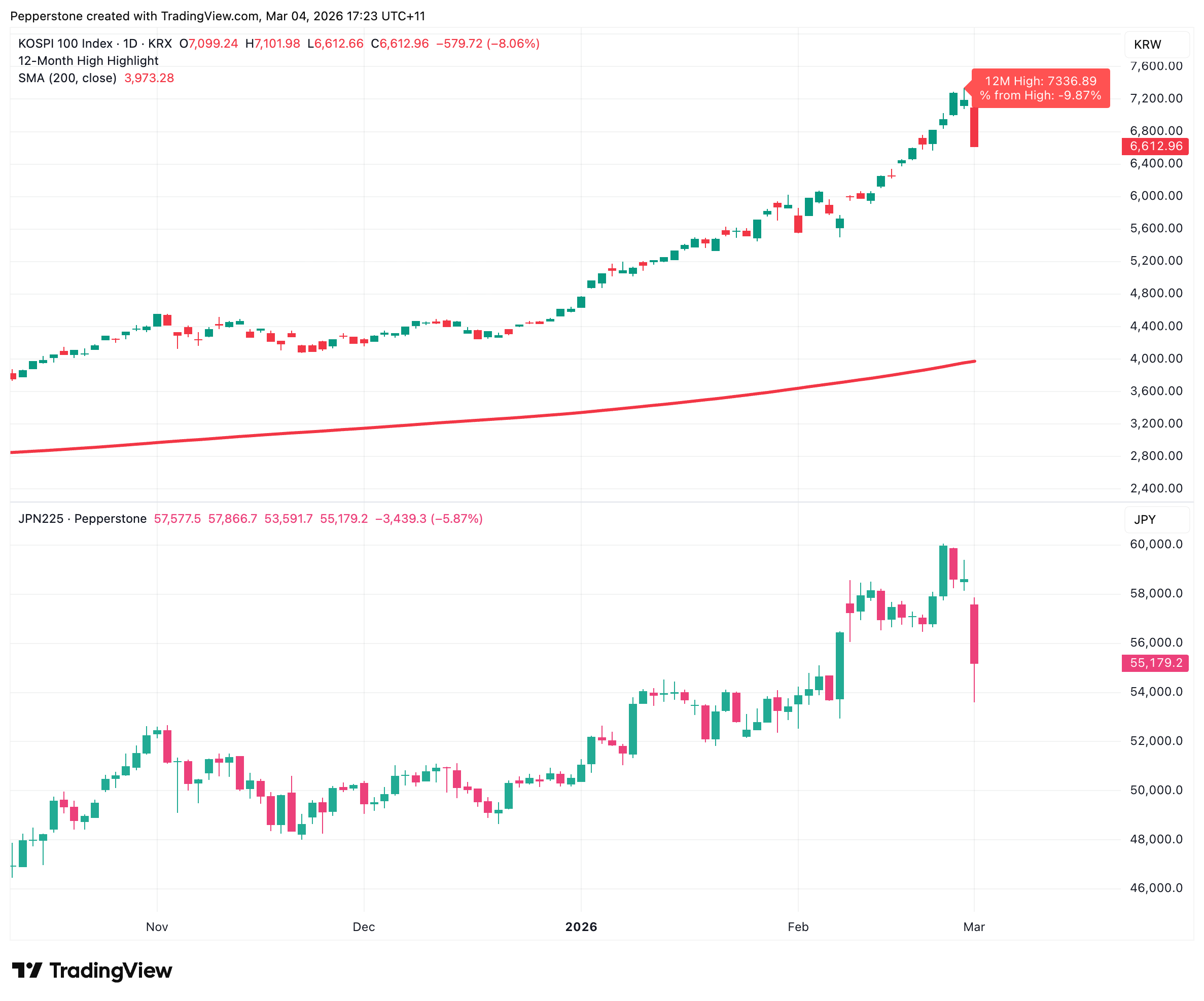
Heightened Middle East tensions combined with soaring energy prices have triggered sharp declines across Asian stock indices. KOSPI and the Nikkei have both retraced more than 10% from their late-February highs. Concentrated bullish positions and simultaneous equity-currency pressures have intensified selling, keeping risk management top of mind for traders in the near term.

Amid Middle East geopolitical tensions, global risk assets have come under pressure, with Asian stock markets taking the brunt of the impact. 

The South Korean KOSPI index experienced trading halts for two consecutive days, marking a cumulative drop of over 10% from last Thursday’s high. The Nikkei 225 saw a similar decline over the same period, breaking below 54,000 intraday today. Other markets, including the Hang Seng, TAIEX, and Australia’s ASX200, also faced notable pullbacks.
Preview

Compared with the relative resilience of U.S. equities, why have Asian markets appeared particularly fragile? And when might the large-scale selling abate? 

Two Key Drivers Behind the Sharp Pullback 

While geopolitical tensions are affecting global assets broadly, certain structural features of Asian markets have made them especially vulnerable in this sell-off. 

At the start of the year, strong gains in the tech sector led to concentrated bullish positioning. For instance, the KOSPI’s year-to-date peak gain approached 60%, reflecting elevated risk appetite and capital concentration. When geopolitical shocks hit, these crowded long positions tend to unwind quickly. Heavyweights such as Samsung Electronics and SK Hynix breaking critical support levels have amplified the magnitude of the decline. 

Beyond technical pressures, fundamental factors also play a significant role. Asian economies rely heavily on oil and gas imports. Persistently high energy prices directly raise manufacturing and transport costs, compress corporate margins, and weigh on earnings expectations. 

Additionally, inflationary pressures may prompt central banks to delay easing measures, limiting liquidity for risk assets. 

High energy prices are also pressuring Asian currencies like the yen and won, creating a classic equity-currency double hit. While currency depreciation can partially support exports, geopolitical disruptions may affect aviation, transport, and logistics, while increasing costs and uncertainties for domestic manufacturing. 

For export-oriented economies, these overlapping pressures magnify market vulnerability and help explain why Asian markets are seeing larger retracements than U.S. equities. 

Will the Selling Momentum Continue? 

In the short term, markets have entered a phase where technical short positions and sentiment-driven selling are overlapping. Whether the downward momentum persists depends on two key factors. 

First, developments in the Middle East and energy price trends are critical. There is currently no sign of conflict easing. If future negotiations or resumption of regional air transport occur and energy prices stabilize, the selling pressure could quickly subside, allowing a potential short-term rebound across risk markets, including Asian equities. 

Conversely, if the conflict continues or spreads to energy infrastructure, the selling momentum may persist, exposing Asian indices to a second leg of declines, potentially exceeding the first round of losses. 

Second, global capital flows will also influence the sustainability of the sell-off. If U.S. equities remain resilient while Asian markets struggle under external shocks, capital could increasingly flow toward U.S. markets or safe-haven assets, intensifying selling pressure in Asia. Rising volumes and continued weakness in large-cap stocks may further reinforce technical short positions. 

Managing Risk and Observing Sector Divergence 

Overall, the sharp declines in Asian stock indices reflect a combination of geopolitical risk, elevated energy prices, internal valuation adjustments, and selling momentum. 

Until there is clear easing in geopolitical tensions, risk management remains paramount. Traders need to carefully manage exposure, strictly control positions, and monitor stop-loss and volatility levels to navigate near-term market swings. 

At the same time, the market is showing clear structural divergence. Not all sectors are falling in unison: defense, energy, and resource-related sectors have held up relatively well amid high oil prices, while high-beta, export-sensitive tech stocks, as well as aviation and travel sectors, have seen larger pullbacks. 

This type of sector differentiation could serve as a reference for traders navigating risk, highlighting where capital might find relative stability in the weeks ahead.

The material provided here has not been prepared in accordance with legal requirements designed to promote the independence of investment research and as such is considered to be a marketing communication. Whilst it is not subject to any prohibition on dealing ahead of the dissemination of investment research we will not seek to take any advantage before providing it to our clients.

Pepperstone doesn’t represent that the material provided here is accurate, current or complete, and therefore shouldn’t be relied upon as such. The information, whether from a third party or not, isn’t to be considered as a recommendation; or an offer to buy or sell; or the solicitation of an offer to buy or sell any security, financial product or instrument; or to participate in any particular trading strategy. It does not take into account readers’ financial situation or investment objectives. We advise any readers of this content to seek their own advice. Without the approval of Pepperstone, reproduction or redistribution of this information isn’t permitted.

Other sites

  • The Trade Off
  • Partners
  • Group
  • Careers

Ways to trade

  • Pricing
  • Trading accounts
  • Premium clients
  • Active trader program
  • Refer a friend
  • Trading hours

Platforms

  • Trading platforms
  • TradingView
  • MT5
  • MT4
  • Copy trading
  • cTrader
  • Trading tools

Markets and Symbols

  • Forex
  • Shares
  • ETFs
  • Indices
  • Commodities
  • Currency indices
  • CFD forwards

Insights

  • Navigating markets
  • The Daily Fix
  • Meet our analysts
  • Trading guides
  • Videos
  • Webinars

About

  • Press releases
Pepperstone logo
support@pepperstone.com
+254203893547
The Oval | Ring Road Parklands
P.O.Box 2905-00606 | Nairobi, Kenya
  • Legal documents
  • Privacy policy
  • Website terms and conditions
  • Cookie policy
  • Sitemap

Risk Warning:

Margin trading products are complex instruments and come with a high risk of losing money rapidly due to leverage. 88% of retail investor accounts lose money when trading on margin with this provider. You should consider whether you understand how margin trading works and whether you can afford to take the high risk of losing your money. You don't own or have rights in the underlying assets. Past performance is no indication of future performance and tax laws are subject to change. The information on this website is general in nature and doesn't take into account your personal objectives, financial circumstances, or needs. Please read our PSF, RDN and other legal documents and ensure you fully understand the risks before you make any trading decisions. We encourage you to seek independent advice.

The information on this site and the products and services offered are not intended for distribution to any person in any country or jurisdiction where such distribution or use would be contrary to local law or regulation.


Pepperstone Markets Kenya Limited 2nd Floor, The Oval, Ring Road Parklands, PO Box 2905-00606 Nairobi, Kenya is licensed and regulated by the Capital Markets Authority.

© 2025 Pepperstone Markets Kenya Limited | Company No.PVT-PJU7Q8K | CMA License No.128