- English


Gold Outlook: Treasury Yields Pull Back From Highs, Fueling a Bounce — September CPI Is a Key Test
.jpg?height=93&quality=30)
Gold traded in a broad range for most of last week. In the first half, rising Treasury yields, a stronger dollar, and renewed inflation concerns weighed on prices. The mood shifted in the back half of the week: Trump’s comments on Iran eased some geopolitical concerns, news around OpenAI’s results prompted markets to reassess AI investment returns, and Treasury yields pulled back from their highs — together driving a steady rebound in gold.
Heading into this week, September CPI, Warsh’s remarks at the IMF’s annual meeting in Bangkok, and the direction of U.S.-Iran talks will likely be the key factors in determining whether this recovery can extend further.
Technical Outlook: $4,200 Is the Key Level for the Bounce to Continue
On the XAUUSD daily chart, gold dipped intraday to a two-month low of $4,066 last week before dip buyers stepped in, pushing prices back up. Given how modest the rebound has been, with price yet to convincingly break the downtrend structure in place since late August, some traders still view this as a technical correction following the sharp selloff, rather than confirmation of a trend reversal.
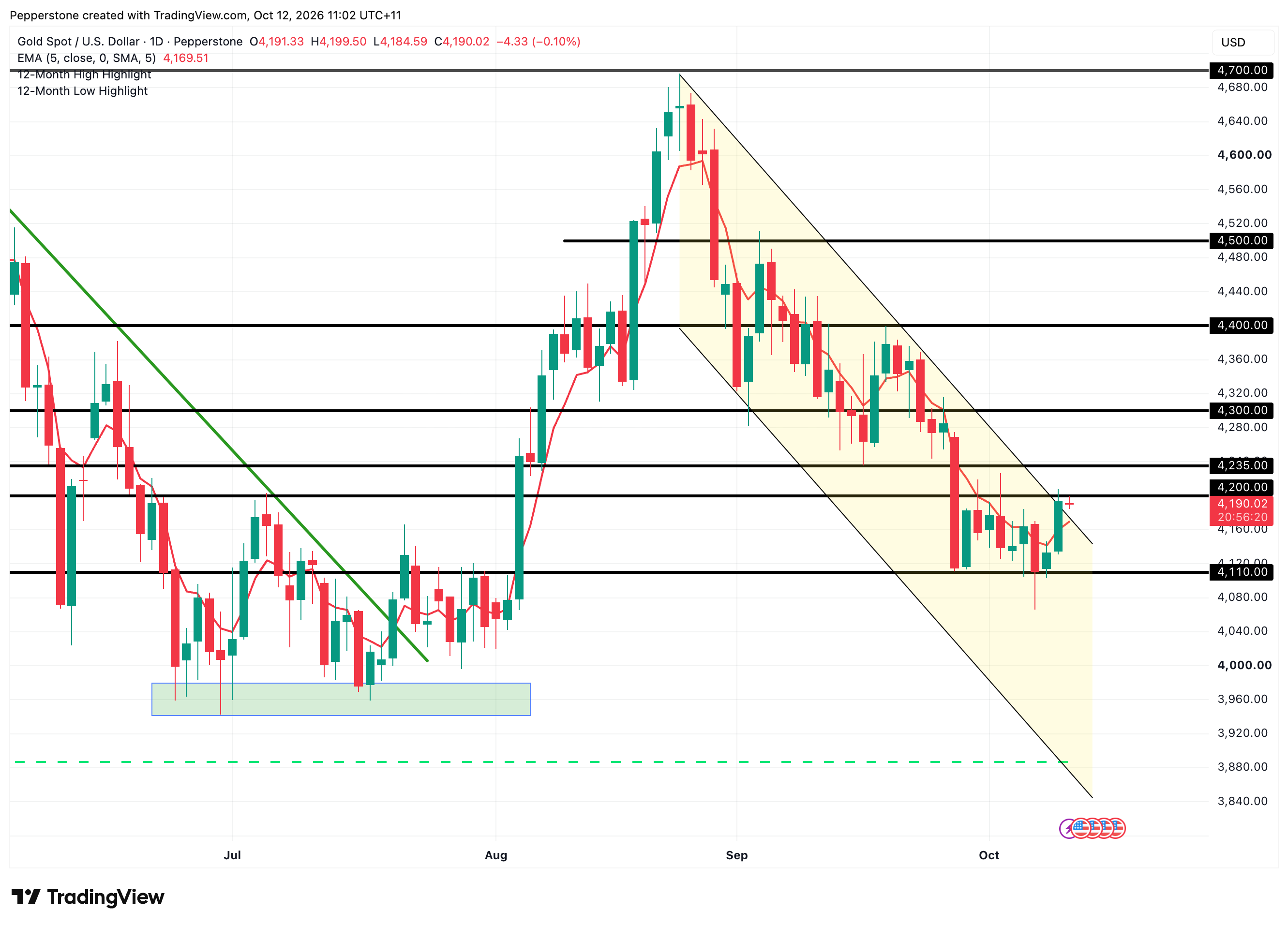
In the near term, $4,200 is the key level for judging whether the bounce can continue. A daily close above this level would mark further improvement in the short-term technical structure, with $4,235 and $4,300 coming into focus above. Conversely, if gold meets renewed resistance near $4,200, prices could retest $4,110, or even revisit the prior low at $4,066.
Treasury Yields: The Core Variable Behind Gold’s Short-Term Swings
As a non-yielding asset, gold’s opportunity cost rises along with Treasury yields. This pricing logic has had a significant influence on gold’s recent price action.
Last week, the FOMC minutes struck a hawkish tone, with markets continuing to weigh the chances of another hike before year-end. The 10-year Treasury yield briefly climbed above 5.36%, pressuring gold down to a two-month low.
Strong demand at the 10- and 30-year Treasury auctions, combined with disappointing OpenAI earnings that prompted markets to reassess AI-related investment returns and growth prospects, then pulled Treasury yields back from their highs — giving gold room to rebound.
That said, the pullback in yields isn’t enough on its own to say gold has shaken off the pressure. Growing U.S. government debt could keep pushing traders to demand a higher term premium. Competition for funding between corporate borrowing needs and Treasury issuance could also continue to weigh on how long-dated bonds are priced.
So whether gold can strengthen further depends not just on whether yields pull back, but on whether that trend holds, and on whether real rates and the dollar soften in tandem. If long-end yields remain elevated and the dollar stays firm, gold prices could continue to face pressure.
Geopolitics and Inflation: The Medium-Term Pressure on Gold Hasn’t Lifted
The U.S.-Iran situation remains an important factor for gold. Trump’s latest comments on Iran eased some concerns about further escalation, providing short-term support for prices. However, the disruption to shipping through the Strait of Hormuz has not improved meaningfully, and elevated tanker freight rates and insurance costs show that the strain on physical crude transport persists.
Inflation expectations are also worth watching closely. The latest University of Michigan survey showed U.S. consumers’ one-year inflation expectations rising to 4.7%, with long-term expectations climbing to 3.5%. If geopolitical risk continues to push energy prices higher and inflation pressure proves slow to ease, gold’s medium-term upside could be notably constrained.
Structural Support: Central Bank Buying and ETF Inflows Continue to Build
Despite the dual pressure from rates and geopolitics in the near term, the medium-to-long-term demand case for gold remains supported. As of the end of September, China’s central bank had extended its gold-buying streak to 23 consecutive months. A number of other central banks, including Poland’s, have also been gradually raising the share of gold in their reserves, lending further support to prices.
World Gold Council data shows global gold ETFs attracted roughly $10 billion in inflows in September alone, with Q3 inflows reaching a record $31 billion and holdings climbing to an all-time high of 4,256 tonnes — reflecting robust institutional allocation demand.
That said, in an environment where short-term rate pressure coexists with longer-term allocation demand, gold may still need time to work through this tension. Central bank buying supports the longer-term demand picture, but what determines price direction in the near-to-medium term remains rate expectations, the dollar, and shifts in trading flows.
This Week’s Focus: September CPI and Warsh’s Remarks
Overall, gold’s rebound from a two-month low last week reflects both short-term momentum from falling Treasury yields and longer-term support from central bank buying and ETF inflows. But with inflation expectations elevated, long-end yields still high, and uncertainty over the Middle East situation, gold has not fully shaken off the pressure.
In the near term, a more durable rally for gold likely requires at least one of two key conditions: either meaningful progress in U.S.-Iran talks that drives oil prices notably lower and eases inflation pressure, prompting markets to scale back rate-hike expectations; or a steady decline in Treasury yields accompanied by softer real rates and a weaker dollar.
Currently, market expectations for a further Fed hike in October have cooled significantly, though a hike before year-end is still almost fully priced in. Wednesday’s September CPI release will be an important input for markets to reassess this outlook.
Consensus expects headline CPI to accelerate from 0.4% to 0.6% month-on-month, driven by higher gasoline prices, while core CPI is expected to ease from 0.3% to 0.2%.
If core inflation comes in softer than expected, bets on a further hike by year-end could cool, giving gold room to rebound. Conversely, if core CPI surprises to the upside, sticky inflation could reignite rate expectations, with a stronger dollar and higher real rates weighing on gold.
On Friday, Warsh is set to appear in a fireside chat at the IMF’s annual meeting in Bangkok, and markets will be looking for his latest read on the inflation outlook and policy stance. If he maintains a hawkish tone and reiterates that price stability takes precedence over everything else, that could reinforce pricing for a hike later this year and cap gold’s room to rebound.
The material provided here has not been prepared in accordance with legal requirements designed to promote the independence of investment research and as such is considered to be a marketing communication. Whilst it is not subject to any prohibition on dealing ahead of the dissemination of investment research we will not seek to take any advantage before providing it to our clients.
Pepperstone doesn’t represent that the material provided here is accurate, current or complete, and therefore shouldn’t be relied upon as such. The information, whether from a third party or not, isn’t to be considered as a recommendation; or an offer to buy or sell; or the solicitation of an offer to buy or sell any security, financial product or instrument; or to participate in any particular trading strategy. It does not take into account readers’ financial situation or investment objectives. We advise any readers of this content to seek their own advice. Without the approval of Pepperstone, reproduction or redistribution of this information isn’t permitted.