- English


Gold Outlook: July FOMC Goes Live — All Eyes on Oil and Warsh
.jpg?height=93&quality=30)
Last week, gold continued to trade within the $4,000–$4,200 range. An easing in Middle East tensions helped pull oil prices lower, while markets continued to recalibrate their expectations for the Fed's rate path. Gold drifted sideways amid the tug-of-war between bulls and bears.
This week, the FOMC rate decision, Warsh's press conference, and further developments in the Middle East are all on the agenda. With multiple risk events converging at once, the question of whether gold can break out of its rangebound pattern may finally get an answer in the days ahead.
Technical Observation: Range Holds — Waiting for a Catalyst
On the XAUUSD daily chart, gold remains in a consolidation phase, though the balance of power within the range has shifted noticeably in recent sessions.
In the first half of last week, softer-than-expected U.S. June inflation data sparked a quick recovery from near $4,000, pushing gold above $4,100 and briefly touching an intraday high of $4,166. The move then reversed as fresh developments in the Middle East lifted oil prices, prompting markets to reassess the inflation and rate outlook. Gold slipped back below $4,100, where bulls are now making another attempt to reclaim that level.
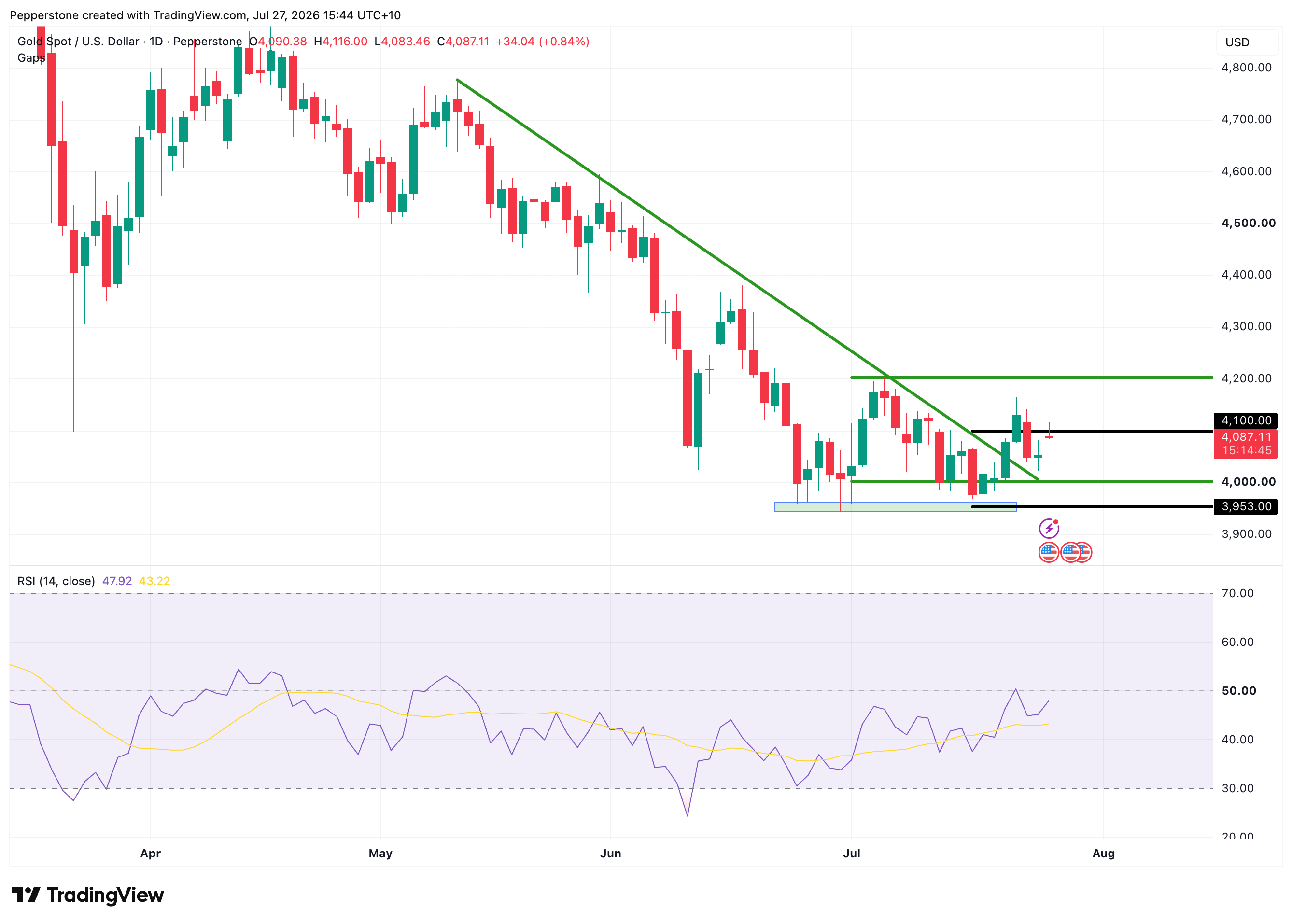
The $4,000–$4,200 range remains intact overall. The market's current bias is toward range-trading rather than trend-following. A sustained hold above $4,100 would put last week's high at $4,166 and then the top of the range at $4,200 back in focus. A drop back below $4,100, on the other hand, would shift attention once again to the $4,000 psychological support level.
For now, the technical setup is neutral. A genuine directional break will need a fundamental catalyst — and this week has several candidates.
Geopolitical Easing: Oil Pulls Back, Gold Gets Room to Breathe
Last Friday, the U.S. military announced no new strikes against Iran for the first time in two weeks, with both sides entering what amounts to a de facto pause in hostilities. Regional mediators are actively working to restart formal negotiations, and the improved mood has been visible in markets.
Oil prices responded quickly, with Brent crude pulling back notably from the $100 level. The retreat eased fears of an energy-driven inflation rebound and cooled the "oil higher → inflation expectations up → rate-hike bets rise → gold under pressure" chain that had been the dominant pricing logic in recent weeks — creating some breathing room for gold.
That said, traders should stay cautious. Every ceasefire signal over the past few months has reversed quickly. Iran has explicitly rejected the U.S. proposal conveyed by the Iraqi prime minister, stating it will not accept any temporary deal that leaves the question of Strait of Hormuz control unresolved. Whether talks can produce a genuine breakthrough remains the week's biggest geopolitical unknown.
July FOMC: From a Non-Event to a Genuine Cliffhanger
Two weeks ago, the July FOMC meeting was widely expected to be a non-event — a straightforward hold with little drama. That view has shifted. Market pricing for a 25 basis point hike has risen quickly to around 34%, roughly tripling from just 12.8% a week ago. What was supposed to be an uneventful meeting is fast becoming the most consequential risk event for gold in the near term.
The rate decision drops at 2:00 pm ET on Wednesday, followed by Warsh's press conference. This will be his first public appearance since abandoning forward guidance, now facing a market that has reopened the debate on rate hikes. How Warsh manages to signal the Fed's direction without making a policy commitment will be closely watched and will act as a key catalyst for gold.
Three scenarios are worth keeping in mind:
- Hold with a neutral tone: Further cooling in rate-hike expectations, a softer dollar and lower Treasury yields — gold gets a chance to retest $4,166 and potentially challenge $4,200.
- Hold with a hawkish warning: If Warsh emphasizes sticky inflation and flags September as a live meeting, gold stays under pressure and continues to chop between $4,000 and $4,100.
- Surprise 25 basis point hike: A low-probability outcome, but the most significant downside risk for gold if it materializes. Prices could quickly fall back to test $4,000 and potentially extend lower toward $3,940–$3,960.
Beyond the Two Main Themes: PCE and Earnings Could Add Noise
Gold is at a pivotal juncture, waiting for the next major repricing catalyst. Technical resistance near $4,200 and rising rate-hike expectations cap the upside, while steady central bank buying and physical demand around $4,000 provide a floor — making a sharp breakdown unlikely in the near term. Absent a significant surprise on either the Fed or geopolitical front, gold is more likely to continue consolidating.
Beyond the two main themes, Friday's U.S. June PCE data and the ongoing wave of corporate earnings reports could generate additional short-term noise.
If PCE comes in hotter than expected, it could reignite rate-hike fears and weigh on gold. At the same time, if results or guidance from major hyperscale cloud companies disappoint and trigger a meaningful equity selloff, cross-asset deleveraging could put near-term pressure on gold as well.
The material provided here has not been prepared in accordance with legal requirements designed to promote the independence of investment research and as such is considered to be a marketing communication. Whilst it is not subject to any prohibition on dealing ahead of the dissemination of investment research we will not seek to take any advantage before providing it to our clients.
Pepperstone doesn’t represent that the material provided here is accurate, current or complete, and therefore shouldn’t be relied upon as such. The information, whether from a third party or not, isn’t to be considered as a recommendation; or an offer to buy or sell; or the solicitation of an offer to buy or sell any security, financial product or instrument; or to participate in any particular trading strategy. It does not take into account readers’ financial situation or investment objectives. We advise any readers of this content to seek their own advice. Without the approval of Pepperstone, reproduction or redistribution of this information isn’t permitted.