- English


Gold Outlook: Jobs Miss Fuels the Rally — CPI Could Be the Real Turning Point
.jpg?height=93&quality=30)
Last week, gold completed the first leg of its technical recovery — but the market remains in a "wait and see" mode. A less hawkish tone from Warsh and a badly missed jobs report combined to lift prices, yet no new directional trend has taken hold. With inflation still sticky, the Fed's policy path for the rest of the year continues to cap gold's upside.
Monday's ISM Services PMI and Wednesday's FOMC minutes are the main events this week, though both are more likely to be sources of near-term noise than genuine trend-setters. The real test of whether gold can transition from a bounce to a trend comes next week, on July 14 — when the June CPI report and Warsh's congressional testimony land on the same day.
Technical Observation: Bounce Takes Hold — $4,200 Is the Line to Watch
On the XAUUSD daily chart, gold reclaimed the $4,000 level last week before pushing through resistance at $4,065 and the $4,100–$4,115 zone, and recovering its 20-day moving average. The week's total gain came in at roughly 2.3%, ending seven consecutive weeks of losses and marking a clear improvement in bullish momentum.
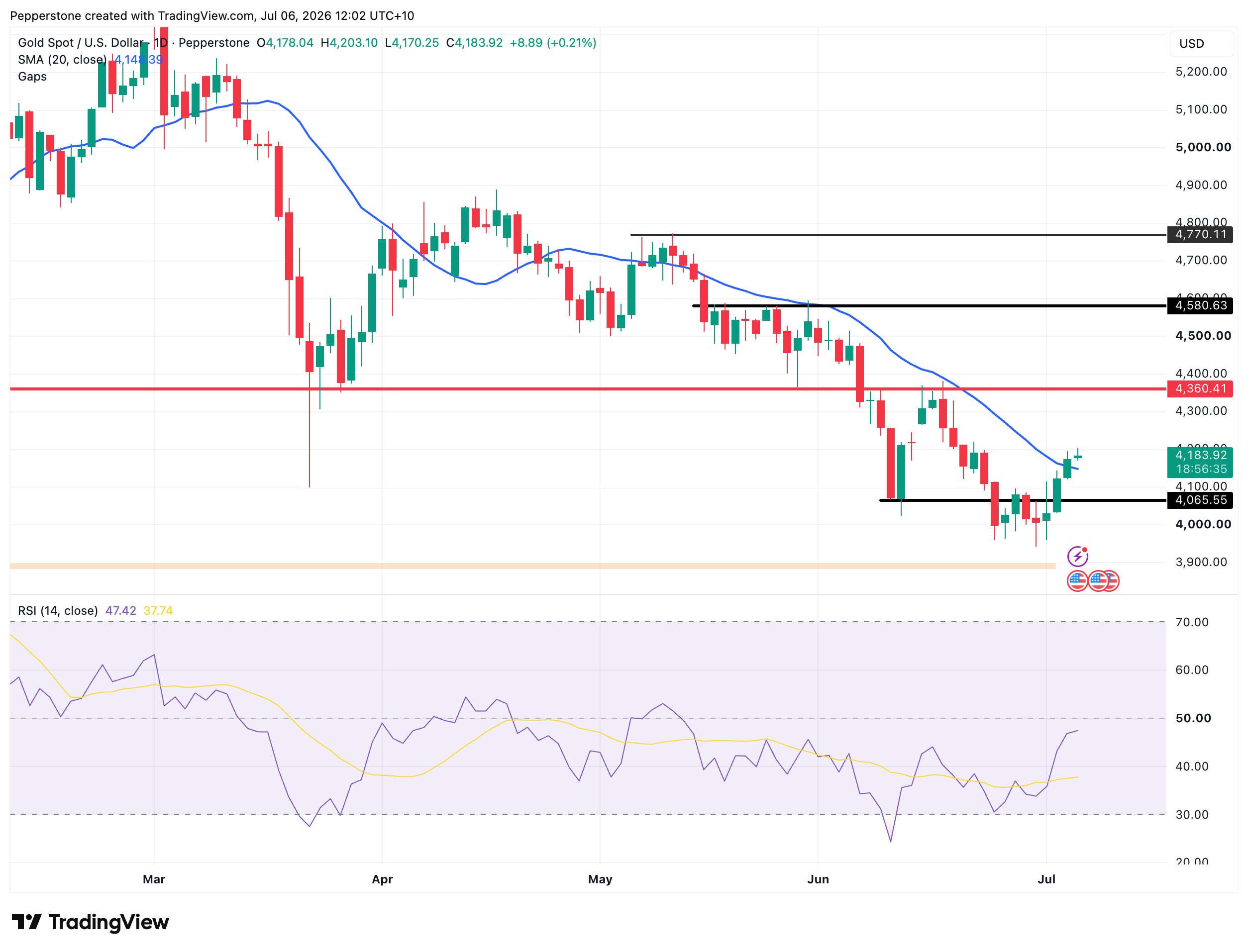
Monday's early session saw price repeatedly testing the $4,200 resistance level. This now stands as the key short-term dividing line. A convincing break higher on strong volume would extend the recovery, with bulls then eyeing the June high near $4,360.
On the downside, $4,100 is the floor that needs to hold for the uptrend to remain intact. A drop below this level would reframe the move as a oversold bounce rather than the start of a new advance, with support then found at $3,940–$3,960 and $3,880–$3,900 in succession.
The 14-day RSI has shifted from bearish to neutral — a constructive sign, though confirmation of a genuine trend reversal still depends on the fundamental picture.
The Fed: Hawkish Consensus Cracks — But Inflation Hasn’t Let Go
As emphasized in previous editions of this outlook, the rate path remains the single most important driver of gold. Last week, the market's consensus around "higher for longer" showed its first meaningful cracks.
Warsh's appearance at the Sintra forum sent a mixed signal: he stressed the necessity of restoring price stability, but also acknowledged that inflation risks have eased at the margin, and expressed openness to the idea that AI-driven supply-side improvements could have lasting disinflationary effects. Markets took this as a prompt to start questioning just how rigid the Fed's policy stance really is.
On the data side, the U.S. economy added just 57,000 jobs in June — well short of the 115,000 expected — while prior months were revised down by a combined 74,000. The unemployment rate dipped to 4.2%, but that largely reflected a decline in labor force participation rather than genuine hiring strength.
Together, these developments nudged Treasury yields and the dollar modestly lower, pulling the market's implied probability of a September rate hike from around 66% to below 50%. For a non-yielding asset like gold, the reduction in opportunity cost provided a meaningful tailwind.
That said, inflation has not gone away. The latest core PCE reading came in at 3.4% year-over-year — still well above the Fed's target. With the conditions for a policy pivot not yet in place, gold's upside remains constrained, and a rangebound recovery is the more likely near-term scenario.
Structural Support: Central Bank and Institutional Demand Remains Strong
Beyond the rate picture, central bank buying continues to provide an important foundation for gold's recovery.
World Gold Council data released last week showed global central banks added a net 41 tonnes in May — the second-highest monthly total of the year. Emerging market central banks led the way: Poland topped the list with 18 tonnes, while China added 10 tonnes, marking its twentieth consecutive month of net purchases and the largest single-month addition since December 2024.
The Shanghai Gold Exchange premium stood at roughly $20 per ounce, pointing to robust physical demand within China. Notably, the composition of that demand has shifted — away from retail jewelry and small bars, and toward large-bar and institutional buying, driven in part by regulatory reforms in both China and India that now allow major insurance companies and asset managers to hold gold.
Together, sustained central bank buying and growing institutional demand provide a firm floor under prices, limiting how far any pullback can realistically go.
Watch the FOMC Minutes — Then Wait for July 14
Gold has completed an initial recovery from deeply oversold levels, but whether this rebound can develop into a sustained trend still hinges on what the inflation data shows.
This week's ISM Services PMI and FOMC minutes will offer short-term guidance. If the PMI's employment sub-index holds up while price pressures ease noticeably, it could reinforce expectations for a delayed rate hike and give gold a modest lift.
The minutes, meanwhile, are a useful window into the Fed's new operating style under Warsh — if they show that some officials' inflation concerns have softened at the margin, that would help keep rate-hike bets in check and support gold's continued recovery.
The real moment of truth, however, is July 14. The June CPI report and Warsh's congressional testimony arrive on the same day.
If CPI cools meaningfully, Warsh will likely use the testimony to highlight the disinflationary effects of falling oil prices and AI-driven productivity gains — signaling that inflation is on a downward path and taking some of the pressure off the hike narrative. That combination would give gold's medium-term recovery thesis a genuine fundamental footing.
If inflation stays stubborn, a sustained breakout above current levels will be hard to sustain, and a rangebound grind is the more likely outcome.
Until the CPI picture becomes clearer, many traders are likely to stay on the sidelines, watching how price behaves around key resistance levels and waiting for the next directional signal.
The material provided here has not been prepared in accordance with legal requirements designed to promote the independence of investment research and as such is considered to be a marketing communication. Whilst it is not subject to any prohibition on dealing ahead of the dissemination of investment research we will not seek to take any advantage before providing it to our clients.
Pepperstone doesn’t represent that the material provided here is accurate, current or complete, and therefore shouldn’t be relied upon as such. The information, whether from a third party or not, isn’t to be considered as a recommendation; or an offer to buy or sell; or the solicitation of an offer to buy or sell any security, financial product or instrument; or to participate in any particular trading strategy. It does not take into account readers’ financial situation or investment objectives. We advise any readers of this content to seek their own advice. Without the approval of Pepperstone, reproduction or redistribution of this information isn’t permitted.