- English


Gold Outlook: Inflation Pressure vs Recession Concerns – Nonfarm Report Could Trigger Volatility
.jpg?height=93&quality=30)
Over the past week, gold has been trapped in a “directionless market”—pressured by inflation and a strong USD on one side, while rising recession concerns provided support on the other. With bullish and bearish forces simultaneously at play, prices largely remained in consolidation.
Looking ahead, while markets continue to monitor geopolitical developments, attention will increasingly turn to a series of key U.S. economic data, including the nonfarm payroll report. Any significant deviation from expectations could sharply amplify gold’s volatility.
Technical Observation: Range-bound, direction still uncertain
On the XAUUSD daily chart, after a brief dip to $4,100 last Monday, gold has remained within the $4,300–$4,600 range. Frequent long upper and lower wicks indicate ongoing tug-of-war between buyers and sellers, with no clear trend established.
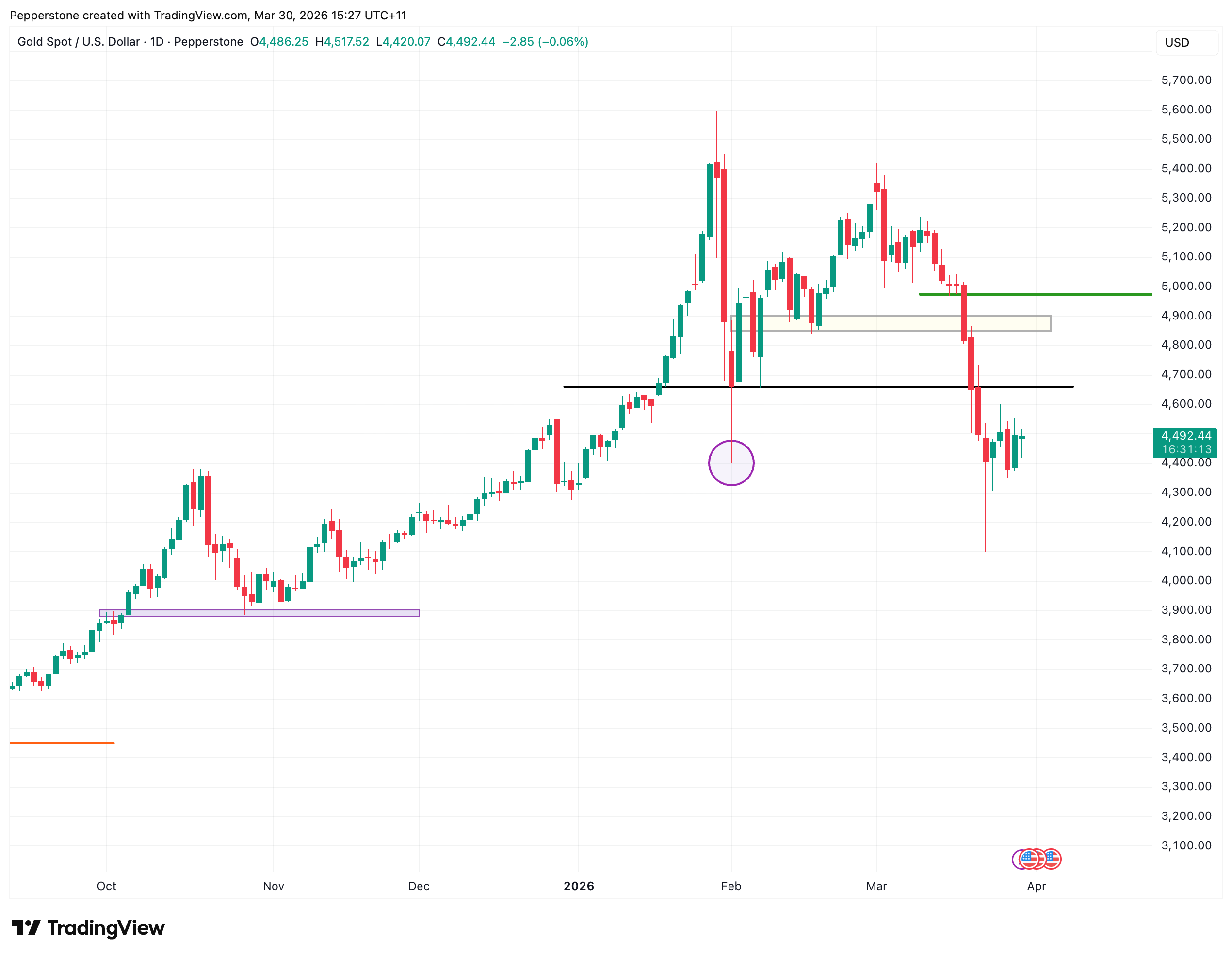
As of writing, gold is trading near $4,500. A sustained close above this level could see the next upside target at $4,660. On the downside, $4,300 and $4,250 are likely initial support zones; a break below could open the door to retesting $4,100.
Dual Pressures: Inflation boosting the dollar and central bank gold sales
Geopolitics remain a key short-term driver of asset performance. Although Trump has delayed the “ultimatum” to Iran by 10 days to April 7, and discussions on the “15-point plan” continue, actual military actions and deployments have not paused.
Recent reports indicate the U.S. Department of Defense is considering sending around 10,000 additional troops to the Middle East. The formal involvement of Houthi forces has triggered a stronger response from Israel, further escalating regional tensions.
In this context, a short-term de-escalation appears unlikely, while energy and fertilizer prices continue to rise, adding inflationary pressure.
As a result, market pricing of major central bank policies has become more hawkish. Combined with the dollar’s safe-haven appeal, the greenback has attracted flows, weighing on dollar-denominated gold.
Since March, some central banks—including Russia, Poland, France, and Turkey—have reported net gold sales. While this largely reflects liquidity needs amid war, fiscal, and currency pressures rather than a bearish view on gold, it has added to downward pressure on prices in a market where risk assets are broadly weaker.
Additionally, some Western central banks and major financial institutions trimmed their positions at fiscal year-end as part of window-dressing. Seasonal futures and options expirations have further amplified selling pressure, adding to inflation-related concerns.
From “news trades” to “recession trades”: Gold finds support
Despite short-term pressure, pullbacks in gold have found support, reflecting a shift in underlying market logic. The market is gradually moving from “news-driven trades” around geopolitical events toward pricing in the economic impact of conflicts—or even “recession trades.”
This shift is evident in U.S. Treasury yields. While inflation and hawkish expectations should theoretically push yields higher, recent movements have instead seen yields retreat. The surge in Treasury buying indicates growing focus on slowing growth risks and the economic drag from high energy costs.
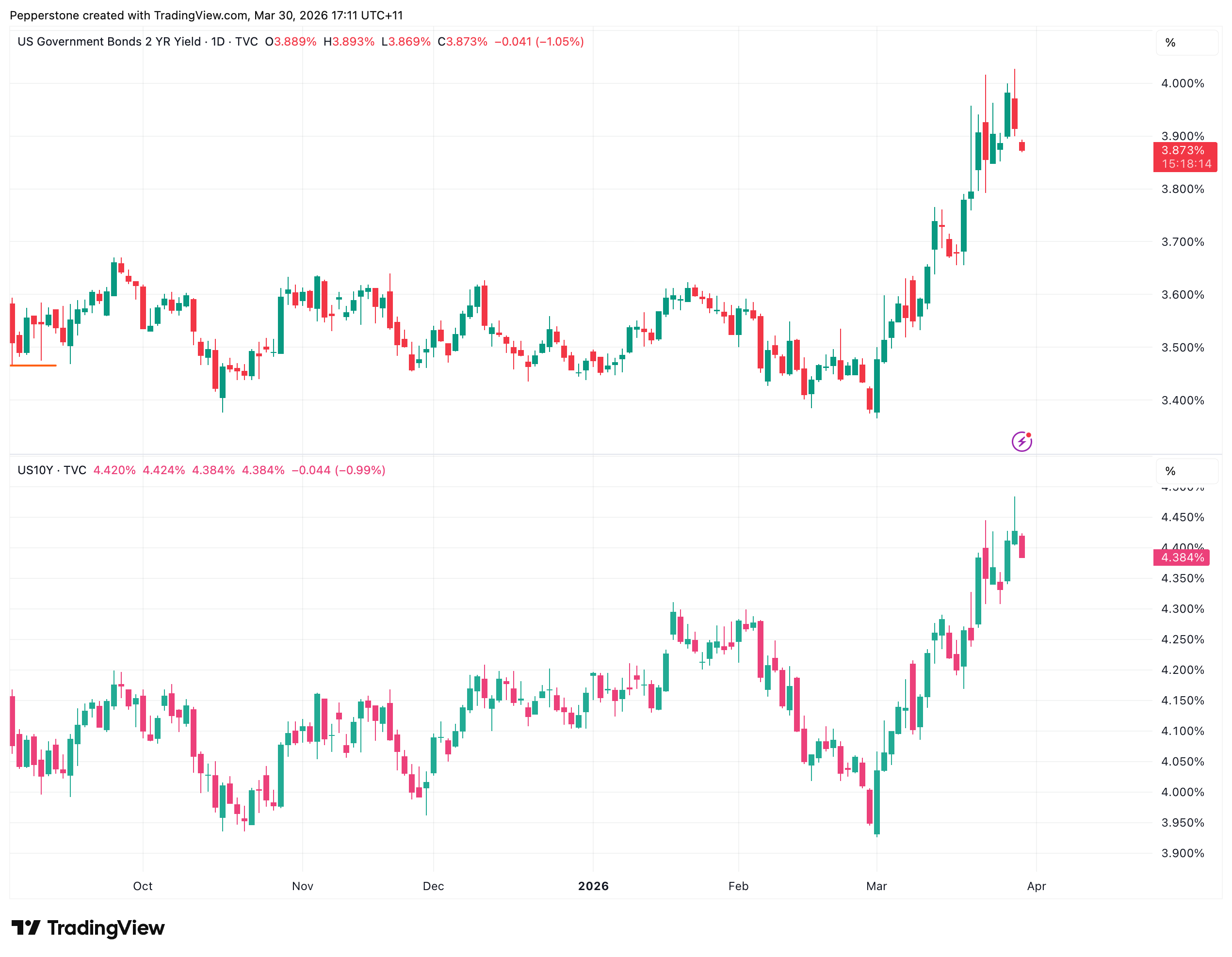
Lower yields benefit non-interest-bearing assets like gold, explaining why prices have remained relatively resilient amid multiple headwinds. If the market narrative shifts from “inflation-driven” to “growth slowdown” or recession pricing, gold may once again attract allocation flows.
Eyes on U.S. Nonfarm Payrolls – Volatility could spike
Overall, gold remained range-bound last week. Strength in the U.S. dollar and some passive selling limited upside, while recession concerns provided underlying support. In the absence of major catalysts, short-term consolidation is likely to continue. Progress on ceasefire talks, developments in conflicts, and Fed policy signals will remain key drivers of price direction.
This week, the market faces several potential risk events, including the March ISM manufacturing and services PMIs, nonfarm payrolls, and Fed Chair Powell’s remarks. These could act as triggers that alter market expectations, especially on the interest rate front.
Labor market data is particularly critical. Market expectations call for 60,000 new jobs (previously -92,000) and an unemployment rate steady at 4.4%.
Given fragile market sentiment, traders may be especially sensitive to downside surprises. If job additions fall to 20,000–30,000 or the unemployment rate rises to 4.5% or higher, the Fed could face a policy dilemma, potentially triggering significant gold volatility.
Additionally, U.S. and European equities will be closed on Good Friday, requiring traders to watch for position adjustments that could generate extra volatility. In such an environment, risk management remains more important than directional bets.
The material provided here has not been prepared in accordance with legal requirements designed to promote the independence of investment research and as such is considered to be a marketing communication. Whilst it is not subject to any prohibition on dealing ahead of the dissemination of investment research we will not seek to take any advantage before providing it to our clients.
Pepperstone doesn’t represent that the material provided here is accurate, current or complete, and therefore shouldn’t be relied upon as such. The information, whether from a third party or not, isn’t to be considered as a recommendation; or an offer to buy or sell; or the solicitation of an offer to buy or sell any security, financial product or instrument; or to participate in any particular trading strategy. It does not take into account readers’ financial situation or investment objectives. We advise any readers of this content to seek their own advice. Without the approval of Pepperstone, reproduction or redistribution of this information isn’t permitted.