- English


Gold Outlook: Bulls Target $4,400 Again — Jackson Hole Is the Real Test
.jpg?height=93&quality=30)
Last week, gold found itself rangebound again, albeit at a higher price level. Cooler U.S. CPI and PPI, combined with retail sales missing consensus, pushed back rate-hike expectations. With central bank and institutional buying continuing to provide a floor, gold briefly touched $4,450. Geopolitical developments, however, kept disrupting oil prices and capped the bulls' ability to push higher.
The data calendar is relatively light in the near term. Thursday's FOMC minutes and the Jackson Hole symposium at the end of the month will be the most important policy windows for markets. Warsh's first keynote address at Jackson Hole could help re-anchor expectations around the Fed's policy direction and set the tone for gold's next leg.
Technical Observation: $4,400 Is the Near-Term Hurdle — $4,500 Would Confirm the Momentum
On the XAUUSD daily chart, gold traded within the $4,300–$4,450 range last week. Bulls made several attempts to hold above $4,400 but failed to stage a convincing breakout, reflecting the weight of profit-taking pressure above that level. RSI is around 65 — close to overbought territory but not there yet — and the technical structure remains tilted to the upside.
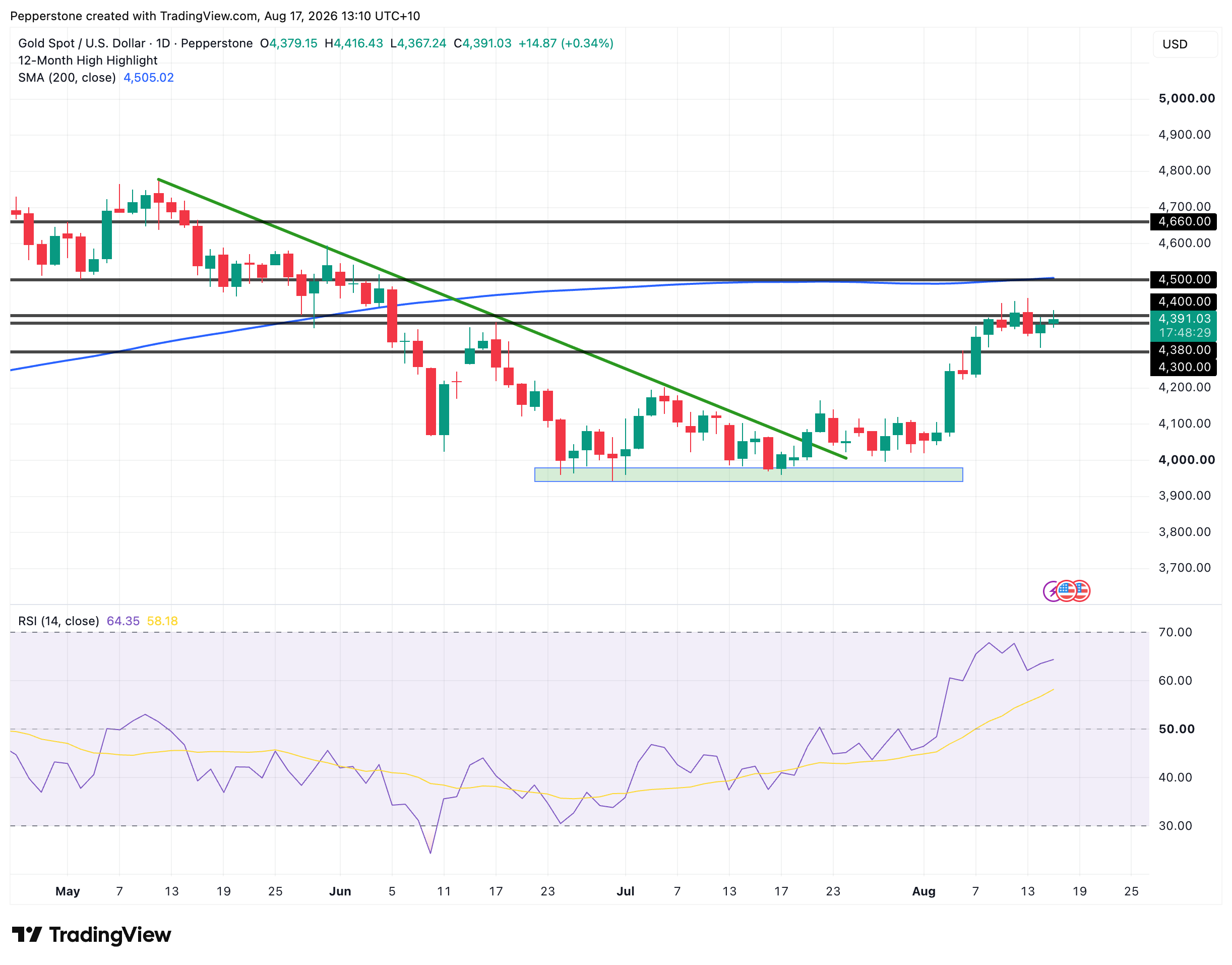
In the near term, $4,400 is the most important resistance level to watch. A sustained break and close above it would bring last week's high at $4,450 and the 200-day moving average near $4,500 into focus. A drop back below $4,300, on the other hand, would call the structure of this recovery into question, with the $4,200 area coming back into view.
Inflation and Rate Expectations: The Disinflationary Case Holds — But Its Staying Power Is Unclear
U.S. CPI and PPI have now come in soft for two consecutive months, and the implied probability of a September rate hike has fallen to around 30%. The dollar index has remained below 100, and the 2-year Treasury yield has pulled back meaningfully from its late-July high of 4.37% — both of which offer some near-term support for a non-yielding, dollar-denominated asset like gold.
That said, the durability of recent disinflation is worth questioning. The cooling in June and July inflation was largely driven by falling energy prices — and that, in turn, rested on a pause in U.S.-Iran hostilities and expectations of a Strait of Hormuz reopening.
Iran and Oman have reached a preliminary understanding on strait management, but U.S.-Iran relations remain fraught. Transit through the Strait of Hormuz is still extremely depressed, and attacks on UAE tankers have underscored that energy supply risks have not gone away. If oil prices turn back up, August's inflation reading could reverse course entirely — and that would put renewed pressure on gold.
Stagflation Fears Resurface: Gold's Asymmetric Advantage
Soft retail sales, a negative July nonfarm payrolls print, and a second-quarter GDP reading of just 1.5% are adding to a picture of slowing economic momentum. With inflation still running above the Fed's target, some traders are beginning to worry that the U.S. economy is drifting toward a "high inflation, low growth" stagflationary environment.
Historically, that is precisely the kind of macro backdrop in which gold tends to perform well.
Also worth noting: U.S. Treasury term premiums have risen again. Even as slowing rate-hike expectations have weighed on short-end yields, long-end Treasury yields have remained elevated — likely reflecting market concerns about fiscal deficits and the Fed's credibility. That increase in term premiums reinforces gold's appeal as a hedge against credit risk.
For gold, the current setup presents a fairly clear asymmetry. If Warsh tightens too aggressively and tips the economy into a hard landing, rate-cut expectations would surge and gold would benefit. If inflation stays sticky yet the Fed finds itself unable to hike, the resulting policy paralysis would fuel safe-haven demand while potentially weighing on real yields — again, a constructive outcome for gold.
The scenario that would genuinely challenge gold is a clean soft landing — inflation normalising on its own, growth staying stable — the so-called "Goldilocks" outcome. But with U.S.-Iran tensions repeatedly flaring and fiscal deficits running high, the odds of that playing out neatly remain far from certain.
Structural Support: Central Bank and Institutional Buying Provides a Floor
Beyond rates and the dollar, central bank buying remains an important structural pillar for gold.
The People's Bank of China has now added to its gold reserves for more than 21 consecutive months, and global central banks added a net 289 tonnes in the second quarter — up 62% year-on-year. Unlike short-term trading flows, central bank demand is driven by strategic allocation considerations, which means pullbacks toward lower price levels tend to attract official buying rather than deter it.
Global gold ETF holdings also moved higher in tandem last week — an important signal that allocation-driven capital is returning to the market.
If central bank buying holds at elevated levels and ETF inflows continue, the long-term investment case for gold will be further reinforced. If ETF holdings start to reverse again, gold could find itself pulled back into a macro regime dominated by rates and the dollar.
FOMC Minutes May Cause a Ripple — Jackson Hole Is the Real Moment
The broad picture is one of gold consolidating near its highs around $4,400. Easing rate-hike expectations, lower real yields, and steady central bank demand are providing a floor, but repeated geopolitical flare-ups and elevated oil prices mean a sustained move higher still needs a fresh catalyst.
Thursday's FOMC minutes will be the first thing to watch this week. The meeting ended in a 9-3 vote to hold, and the key question is how officials assessed whether the energy shock has started to bleed into core inflation — and what that implies for September. A hawkish tone in the minutes could weigh on gold in the near term; a more measured discussion than markets are expecting could boost confidence among bulls.
But it is Jackson Hole that could genuinely set the direction for the next phase. Warsh delivers his first keynote address as Fed chair on August 28, just 19 days before the September 16 FOMC decision — the timing makes it unusually consequential.
A dovish signal from Warsh would push September rate-hike odds lower still and give gold a shot at clearing the $4,400–$4,450 ceiling and moving toward $4,500. A hawkish tone, on the other hand, would keep profit-taking pressure firmly in place around $4,400 and limit the rally's upside.
The material provided here has not been prepared in accordance with legal requirements designed to promote the independence of investment research and as such is considered to be a marketing communication. Whilst it is not subject to any prohibition on dealing ahead of the dissemination of investment research we will not seek to take any advantage before providing it to our clients.
Pepperstone doesn’t represent that the material provided here is accurate, current or complete, and therefore shouldn’t be relied upon as such. The information, whether from a third party or not, isn’t to be considered as a recommendation; or an offer to buy or sell; or the solicitation of an offer to buy or sell any security, financial product or instrument; or to participate in any particular trading strategy. It does not take into account readers’ financial situation or investment objectives. We advise any readers of this content to seek their own advice. Without the approval of Pepperstone, reproduction or redistribution of this information isn’t permitted.