- English


Gold Outlook: Bulls Break the Stalemate — CPI To Decide Whether the Rally Has Legs
.jpg?height=93&quality=30)
Last week, gold finally delivered the directional break markets had been waiting for.
Positive signals from U.S.-Iran negotiations pulled oil prices lower, easing concerns about inflation and rate hikes, and pushed gold through the $4,200 resistance level that had been capping the market for weeks. Friday's July nonfarm payrolls then surprised to the downside, crushing September rate-hike expectations and giving the rally a second leg up.
Heading into this week, July CPI is the data point that matters most for gold. Whether the cooling in energy prices from the geopolitical de-escalation has already filtered through to the July inflation reading will shape how the market prices the Fed's next move — and set the tone for gold from here.
Technical Observation: Six-Week Range Broken — $4,300 Now Holds as Support
On the XAUUSD daily chart, gold bulls kicked into gear mid-week, launching from near the 20-day moving average and clearing the $4,000–$4,200 range that had contained price action for more than six weeks. Price is now trading above the upper Bollinger Band on the 20-day timeframe, with RSI having moved sharply higher from the 50 level — both signs that the technical structure is shifting in the bulls' favor.
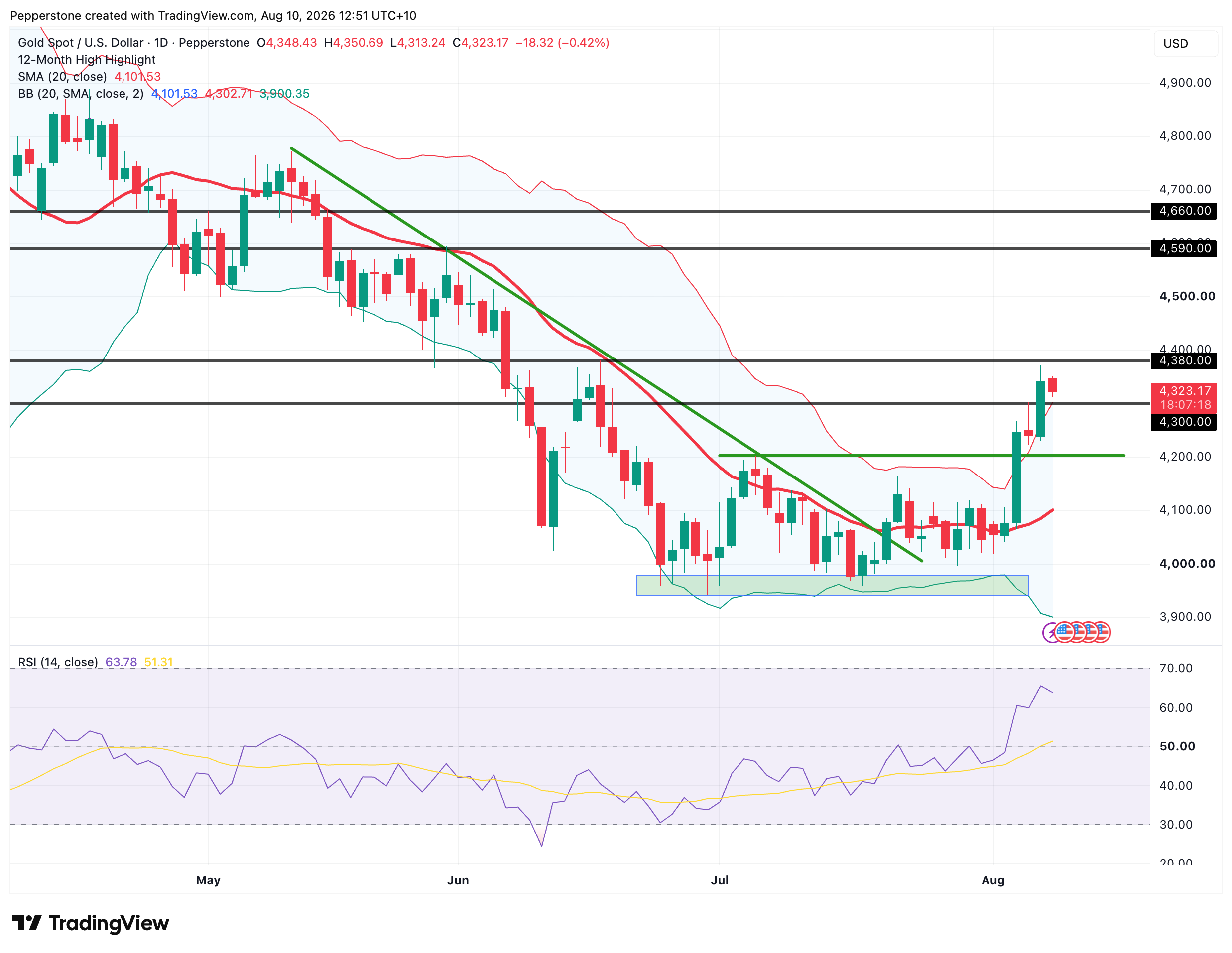
In the near term, $4,300 is the support level bulls need to defend.
Resistance above sits at $4,380–$4,390, which marks both the mid-June highs and the vicinity of the 100-day moving average. A sustained break above that zone would suggest a larger recovery is underway, with the next targets around $4,590 and $4,660.
On the downside, a drop back below $4,300 would be a warning sign — and would raise the risk of gold falling back into the $4,000–$4,200 consolidation range.
Oil Pulls Back, Clearing the Path Higher
U.S.-Iran talks continued to make incremental progress last week, and the resulting easing in geopolitical risk pulled oil prices meaningfully lower. With supply disruption fears fading, concerns about energy-driven inflation also cooled — removing one of the key headwinds that had been holding gold back and providing the initial lift for the breakout.
That said, no formal agreement has been reached yet, and the Strait of Hormuz remains effectively closed. That keeps a floor under oil and injects ongoing uncertainty into gold's near-term outlook.
The approach of the U.S. midterm elections is also worth keeping in mind. The August–September window may prove to be a natural opportunity for Washington to push for a diplomatic breakthrough, given how sensitive oil prices are politically. Any meaningful progress in talks could quickly feed through to energy prices, inflation expectations, and gold.
Soft Payrolls Gut Rate-Hike Odds — Gold Holds Its Ground
The July jobs report was another reason gold held up so well last week.
U.S. nonfarm payrolls fell by 23,000 in July — the first monthly decline since February — while May and June figures were revised down by a combined 103,000. The unemployment rate edged lower to 4.1%, though that mostly reflected a drop in the labor force participation rate rather than genuine hiring strength. Average hourly earnings growth slowed to 3.2% year-on-year, the softest reading since May 2021.
The resilience of the labor market had been the core argument used by three FOMC dissenters to push for an immediate rate hike at the July meeting. That argument has taken a serious hit. The implied probability of a September hike fell from 55% to 42% after the data, the two-year Treasury yield dropped to around 4.2%, and the dollar index remained below 100.
Shortly after, Treasury Secretary Bessent suggested the Fed had no pressing need to raise rates at this stage. With the midterms approaching, the political cost of pushing for further tightening in a weakening labor market is also rising for Warsh.
The transmission mechanism for gold is fairly direct here: weaker jobs → lower rate-hike expectations → lower real yields → lower opportunity cost of holding gold. That is the fundamental backdrop underpinning the current rally.
Structural Support: Central Banks Keep Buying, ETFs See Inflows
Beyond geopolitics and rate expectations, institutional buying has been providing meaningful support.
The People's Bank of China extended its gold-buying streak to 21 consecutive months, with reserves rising to 76.08 million troy ounces at end-July. At the institutional level, official demand hasn't stepped back despite the price correction — and that structural floor isn't going away anytime soon.
Global gold ETF holdings also moved higher in tandem last week, with allocation-driven buying adding to the support. GLD saw net inflows for four consecutive trading days, and junior gold mining stocks have rallied roughly 24% since August 3.
Some traders are reading these moves as early signs that institutional money is returning to the gold market in a more meaningful way — a dynamic that reinforces the current bullish sentiment.
This Week: CPI Is the Test That Matters
The broad picture is that gold's fundamental backdrop has improved meaningfully. Soft payrolls and progress on the Hormuz talks have together triggered a "narrative shift" for a dollar-denominated, non-yielding asset with safe-haven characteristics.
But whether this rally can extend further ultimately depends on how the market reprices the Fed's policy path after this week's CPI release.
The consensus expects July headline CPI to come in at 3.4% year-on-year, a slight step down from 3.5% previously, with core CPI also expected to ease modestly to 2.5%.
The June PCE index already turned negative on a monthly basis — the first decline in six years — suggesting the disinflationary trend is starting to take hold. If July CPI points in the same direction, markets are likely to further push back Fed tightening bets, opening up more room for gold to the upside.
If inflation surprises to the upside, September rate-hike expectations will snap back, and $4,300 will quickly become the level everyone is watching.
The material provided here has not been prepared in accordance with legal requirements designed to promote the independence of investment research and as such is considered to be a marketing communication. Whilst it is not subject to any prohibition on dealing ahead of the dissemination of investment research we will not seek to take any advantage before providing it to our clients.
Pepperstone doesn’t represent that the material provided here is accurate, current or complete, and therefore shouldn’t be relied upon as such. The information, whether from a third party or not, isn’t to be considered as a recommendation; or an offer to buy or sell; or the solicitation of an offer to buy or sell any security, financial product or instrument; or to participate in any particular trading strategy. It does not take into account readers’ financial situation or investment objectives. We advise any readers of this content to seek their own advice. Without the approval of Pepperstone, reproduction or redistribution of this information isn’t permitted.