- English


Gold Outlook: $4,000 Under Threat — Can Rate Decisions and Tech Earnings Stabilise Prices?

Gold faced intense selling pressure last week. Rising oil prices fueled inflation concerns, while the sell-off in technology stocks may have prompted some traders to deleverage or meet margin calls. As a result, gold struggled to find support despite a sharp decline in US Treasury yields.
Markets face a packed calendar of event risks this week. Five central banks, including the Fed, will announce interest rate decisions, while US GDP and PCE inflation data and earnings from major technology companies are also due. Together, these events will test whether gold can shake off its recent downward pressure.
Technical Observation: Can Gold Reclaim the $4,000 Level?
Gold came under significant selling pressure last week, falling around 4% and recording its largest weekly decline since June.
Looking at the XAUUSD daily chart, gold broke below the $4,100–$4,200 trading range that had been in place since late September. Prices briefly fell to around $3,975 on Friday, marking a roughly three-month low. The weekly close below the psychological $4,000 level signals a clear deterioration in the near-term technical picture.
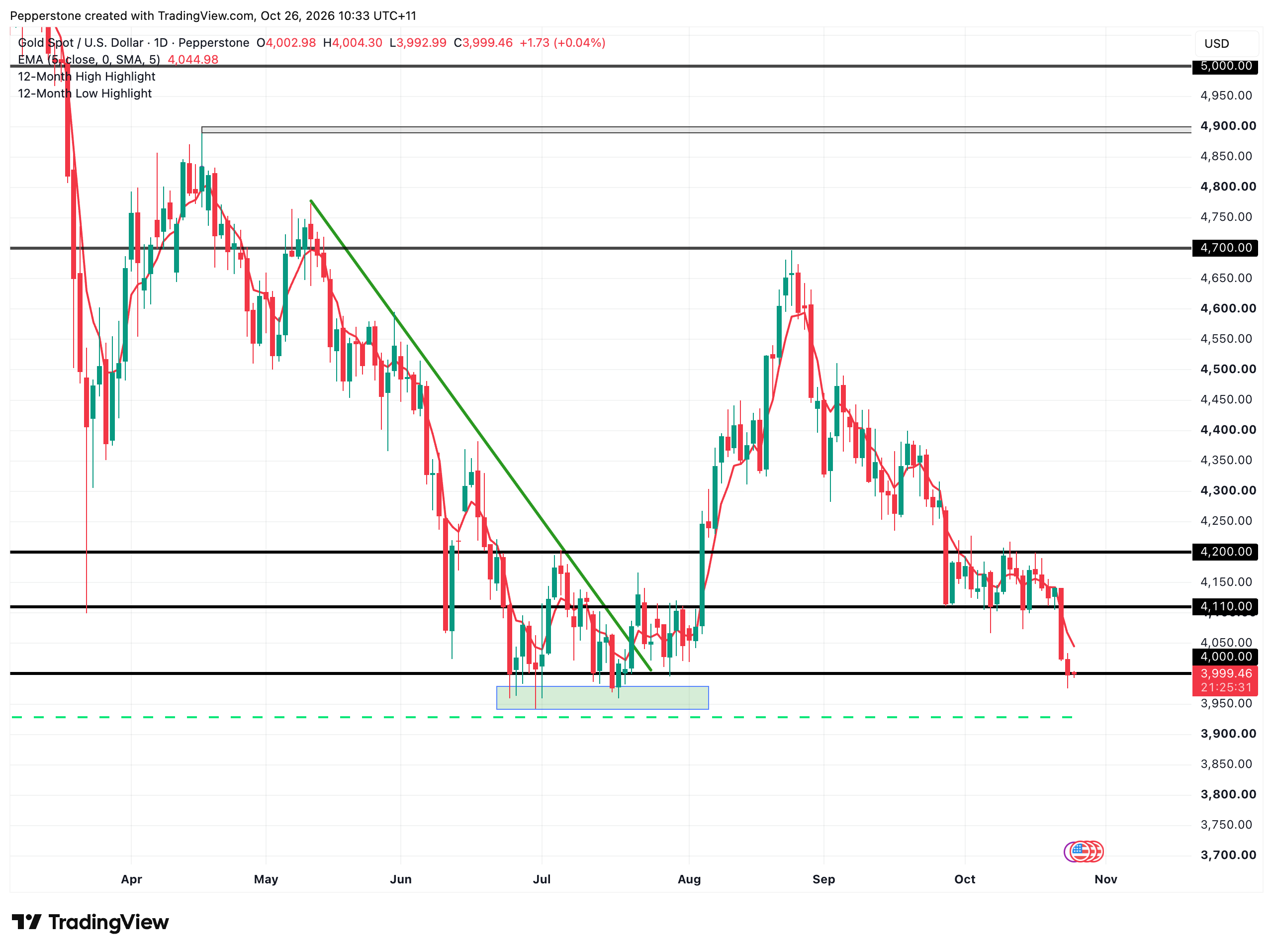
Given that $4,000 is a key psychological level that has previously attracted dip buyers on several occasions, it has become an important dividing line in determining whether gold can stabilise.
If gold can swiftly reclaim and hold above $4,000, the next levels to watch are $4,066 and the $4,100–$4,110 area. A further break above this resistance zone would be needed to ease the recent downward pressure and potentially pave the way for a rebound towards $4,200.
Conversely, if gold continues to struggle below $4,000, traders should watch last week's low near $3,975. A decisive break below this level could open the door to a test of the $3,940–$3,960 support zone.
Given the scale of gold's recent decline, some short covering or a technical rebound would not be surprising. However, until prices reclaim and hold above key resistance levels, it would be premature to conclude that the downtrend has ended simply because gold has already fallen sharply.
Treasury Yields Have Tumbled — So Why Is Gold Still Under Pressure?
One of the most notable developments in the gold market recently has been a weakening of the typically inverse relationship between gold prices and US Treasury yields.
Last week, Treasury yields fell across the curve, with the 10-year yield dropping below 5%. Normally, lower yields reduce the opportunity cost of holding non-interest-bearing gold, which tends to support prices. Yet gold failed to benefit and instead suffered a sharp decline.
This suggests that liquidity needs and position adjustments may, for now, be outweighing the support that lower yields would typically provide.
As markets reassess the financing models, scale of capital expenditure and return prospects for AI infrastructure, US technology stocks have come under heavy selling pressure. Some traders may be reducing their gold exposure to offset losses elsewhere, meet margin calls or boost their cash reserves. At the same time, safe-haven buying has been directed more towards highly liquid US Treasuries than gold.
Whether gold's next rebound can be sustained will therefore depend not only on whether Treasury yields continue to fall, but also on whether selling pressure in equity markets begins to ease.
Elevated Oil Prices: Rate Hike Risks Add to Gold's Headwinds
Beyond market deleveraging, rising energy prices have been another important source of pressure on gold.
Last week, Houthi attacks on Saudi energy facilities heightened concerns about potential supply disruptions in the Middle East, pushing Brent crude to its highest level in nearly six months.
Markets are concerned that higher transport and production costs could increasingly feed through to goods and services prices, keeping US inflation persistent for longer. This could force the Fed to maintain elevated interest rates or even raise them further, weighing on gold.
This week, traders should watch not only whether there is any improvement in the Middle East situation, but, more importantly, whether oil prices remain elevated and how changes in energy prices influence the Fed's policy outlook.
This Week’s Focus: Fed Decision, PCE and Big Tech Earnings
Overall, gold suffered a sharp sell-off last week, pressured by rising energy prices and rate hike expectations, as well as deleveraging triggered by the technology stock rout. Although medium- to long-term supportive factors, including central bank gold purchases, remain in place, a more sustained recovery in gold will likely require an easing of liquidity pressures, alongside more supportive moves in interest rates and the US dollar.
This week's FOMC meeting, US GDP and PCE inflation data, and major technology earnings will provide important clues as to whether these conditions can emerge.
The Fed will announce its interest rate decision on Wednesday. With markets already widely expecting rates to remain unchanged, the focus will be on how Fed Chair Warsh guides expectations for the December meeting and the future path of interest rates.
If Warsh emphasises inflation risks, rising energy costs and the need for further policy tightening, US Treasury yields and the dollar could strengthen again, putting renewed pressure on gold.
Conversely, if he places greater emphasis on slowing economic growth, financial market volatility and the lagged effects of previous rate hikes, this could ease some tightening expectations and provide room for gold to rebound.
Thursday's release of US third-quarter GDP and PCE data will provide a further test of the Fed's policy stance.
Markets expect US third-quarter GDP to grow at an annualised, seasonally adjusted quarter-on-quarter rate of 3.2%, up from 2.2% in the second quarter. Meanwhile, September core PCE inflation is expected to edge up to 0.3% month on month, from 0.2%. If growth remains resilient while inflation fails to cool, expectations for another rate hike in December could strengthen, weighing on gold.
Meanwhile, SK Hynix, Microsoft and Alphabet and are due to report earnings on Wednesday, followed by Samsung and Amazon on Thursday. The focus will not only be on AI-related revenue growth, but also on whether massive capital expenditure can translate into sustainable profits and cash flow.
If markets experience another wave of large-scale deleveraging, gold could face further spillover selling pressure. Conversely, if earnings ease financing concerns and liquidity pressures subside, gold may be better positioned to benefit from falling Treasury yields.
With these major risk events still ahead, gold could remain volatile. Traders should pay particular attention to whether price breakouts around the announcements can be sustained.
The material provided here has not been prepared in accordance with legal requirements designed to promote the independence of investment research and as such is considered to be a marketing communication. Whilst it is not subject to any prohibition on dealing ahead of the dissemination of investment research we will not seek to take any advantage before providing it to our clients.
Pepperstone doesn’t represent that the material provided here is accurate, current or complete, and therefore shouldn’t be relied upon as such. The information, whether from a third party or not, isn’t to be considered as a recommendation; or an offer to buy or sell; or the solicitation of an offer to buy or sell any security, financial product or instrument; or to participate in any particular trading strategy. It does not take into account readers’ financial situation or investment objectives. We advise any readers of this content to seek their own advice. Without the approval of Pepperstone, reproduction or redistribution of this information isn’t permitted.