- English


AMD 2Q26 Earnings Preview: EPYC Drives Growth, But Instinct and Helios Will Define the Bias

-AMD enters this 2Q26 earnings preview with expected revenue near US$11.3 billion, a figure that already prices in a modest beat versus the company's own US$11.2 billion guidance, along with earnings per share near US$1.60-US$1.62.
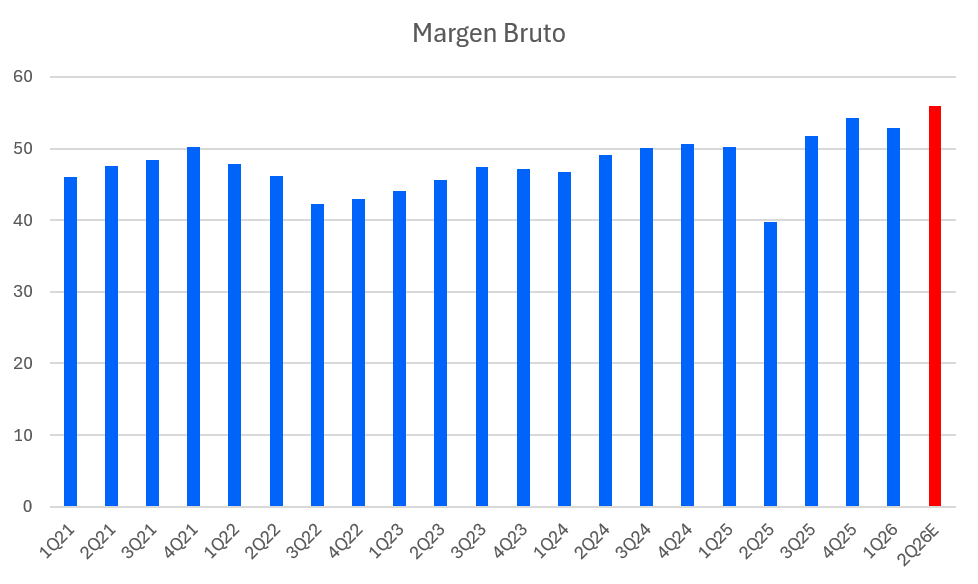
-The market will focus on the recovery of Instinct, the Helios shipment timeline toward the end of the third quarter, and whether gross margin holds near 56%, up from 53% in the prior quarter.
-On the technical side, the stock trades at US$482.48, below its short-term moving averages, with resistance between US$489 and US$503 and critical support at US$432-433.
Can EPYC Sustain Data Center Growth?
AMD closed the first quarter with revenue of US$10.253 billion, up 38% year-over-year, driven primarily by the data center business, whose sales reached US$5.8 billion and grew 57%. For the second quarter, the company guided for US$11.2 billion (+/- US$300 million), a gross margin near 56%, and a sequential increase of roughly 9.2%; consensus sits slightly above, around US$11.3 billion. Within that figure, data center is expected to contribute US$6.6 billion, with approximately US$3.63 billion from server processors, US$2.75 billion from AI accelerators, and US$284 million from FPGAs.
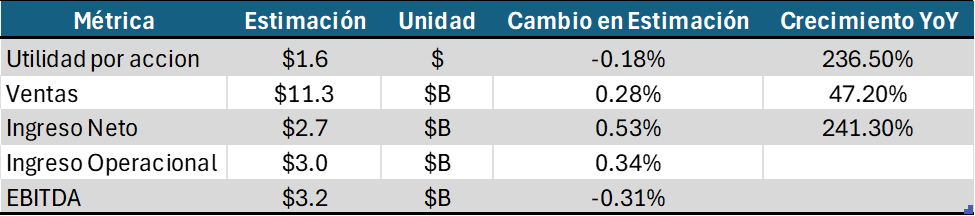
EPYC's strength against Intel remains the first variable to confirm: last quarter's growth was driven by market share gains in cloud and enterprise applications, and Intel's recent solid data center performance is a favorable read on aggregate demand, though it also signals that CPU competition will remain intense. For the remaining segments, the market anticipates roughly US$3.0 billion in Client, US$780 million in Gaming, and US$960 million in Embedded.
The potential of the Meta, OpenAI, and Anthropic deals could push earnings per share toward roughly US$19 in 2027 and US$27.57 in 2028, well above the market's more conservative estimates.
Instinct and Helios as AMD's Real Catalyst
The second element, and probably the most important, is the recovery of Instinct accelerators. During the first quarter, the data center GPU business was constrained by the transition of products destined for China, while segment growth was led by CPUs.
The market will need to see accelerator sales return to double-digit sequential growth, without relying exclusively on EPYC; a data center result at or above US$6.6 billion, with a balanced contribution from CPU and GPU, would carry considerably higher quality than a beat driven solely by traditional processors.
AMD has also reported that Helios is already in production, with first shipments expected toward the end of the third quarter. The platform integrates 72 MI455X accelerators, 18 EPYC Venice processors, Pensando networking, and ROCm software, and the company claims it can deliver up to 30% more inference tokens per dollar than its competitors. OpenAI expects to begin using these systems in the fourth quarter and ramp deployments in 2027, while Meta is already validating workloads on Helios.
Margins will be another key test: both the company and consensus expect a gross margin near 56%. A higher result would suggest EPYC growth is offsetting the upfront costs of HBM memory, advanced packaging, and rack-scale systems; a lower margin would point to a less favorable mix or higher component costs.
Outside of data center, the picture is more subdued: Client should benefit from Ryzen share gains and a better product mix, though rising memory prices could weigh on demand and seasonality in the second half of the year. These segments won't determine the stock's reaction on their own, but a deeper slowdown would raise AMD's dependence on the AI investment cycle.
Ultimately, the reaction will hinge on confirmed Helios shipments, a more pronounced acceleration in the fourth quarter, and guidance that convincingly beats the roughly US$12.5 billion currently expected for the next period.
Technical Outlook: Support and Resistance in AMD
From a technical standpoint, AMD is going through a short-term correction within a still-constructive underlying structure. The price, at US$482.48, trades below the 10-day EMA (489.40), the 21-day EMA (502.45), and the 50-day SMA (512.91), keeping an immediate bearish bias in place. RSI at 46.31 reflects neutral-to-weak momentum, while ADX at 14.29 points to weak trend strength and raises the probability of consolidation.
The first resistance zone sits between US$489 and US$503; a daily close above it would open room toward 513, then 530-550. A prudent bullish entry would require a confirmed recovery of 503-513, with protection below 489, while a more aggressive alternative would be to look for bounces above 455-460, provided a clear buying rejection appears.
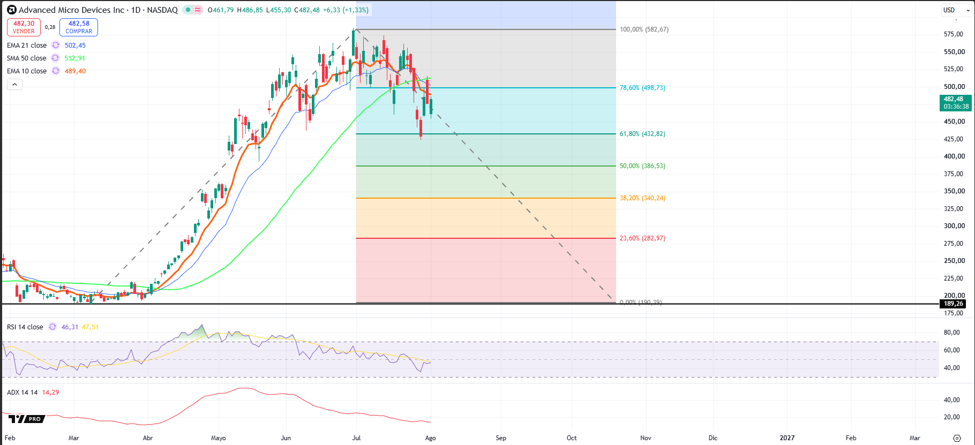
Critical support sits at US$432-433, corresponding to the 61.8% Fibonacci retracement; a loss of this level would favor declines toward 386.53. A break of 455 would be a defensive signal, and below 432 technical deterioration would be considerable.
AMD: The Quarter Matters Less Than the Guidance
With EPYC confirmed as the growth engine and Instinct/Helios still to be proven, this AMD 2Q26 earnings preview holds a neutral bias: the structural thesis against Nvidia depends on confirmed Helios shipments and guidance above the roughly US$12.5 billion expected, while the short-term technical picture requires reclaiming 503-513 or defending the 432-433 support to clear the immediate bearish bias.
The material provided here has not been prepared in accordance with legal requirements designed to promote the independence of investment research and as such is considered to be a marketing communication. Whilst it is not subject to any prohibition on dealing ahead of the dissemination of investment research we will not seek to take any advantage before providing it to our clients.
Pepperstone doesn’t represent that the material provided here is accurate, current or complete, and therefore shouldn’t be relied upon as such. The information, whether from a third party or not, isn’t to be considered as a recommendation; or an offer to buy or sell; or the solicitation of an offer to buy or sell any security, financial product or instrument; or to participate in any particular trading strategy. It does not take into account readers’ financial situation or investment objectives. We advise any readers of this content to seek their own advice. Without the approval of Pepperstone, reproduction or redistribution of this information isn’t permitted.