- English


Alphabet Q3 2026 Earnings Preview: Can Cloud and TPU Growth Justify the AI Spending Boom?

Alphabet (GOOGL) will report its Q3 2026 earnings after the US market closes on October 28.
The market expects quarterly revenue of approximately $112.7 billion, up 28.9% year on year, and operating income growth of around 37.9%. However, adjusted net income is expected to decline 7.6% to approximately $38.2 billion.
While revenue and operating income are expected to maintain strong growth, adjusted net income could move in the opposite direction. This divergence puts the drivers of profitability and the impact of non-operating items under scrutiny, alongside the headline revenue figures.
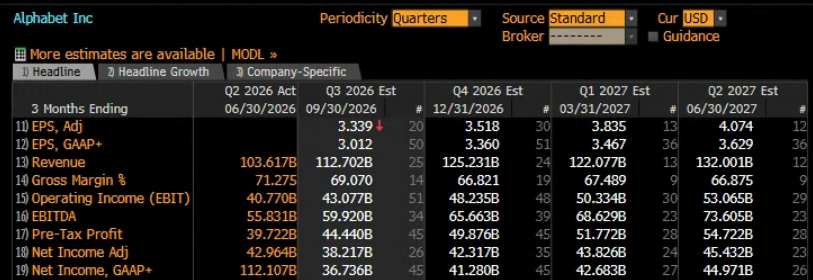
With returns on AI investment facing growing scrutiny, traders are particularly focused on three questions: Can Google Cloud sustain its rapid growth? Can Alphabet's in-house TPUs unlock new profit opportunities? And is the rise of AI-powered search beginning to reshape the growth trajectory of Google's core advertising business?
Consistent Earnings Beats Raise the Bar as Options Price in Greater Volatility
Bloomberg data shows that Alphabet has beaten revenue expectations in each of the past eight quarters, while adjusted EPS has exceeded estimates in seven of them. Analysts remain broadly optimistic, with 16 Buy ratings, one Hold and no Sell ratings. The average price target of $427.08 implies approximately 27.6% upside from current levels.
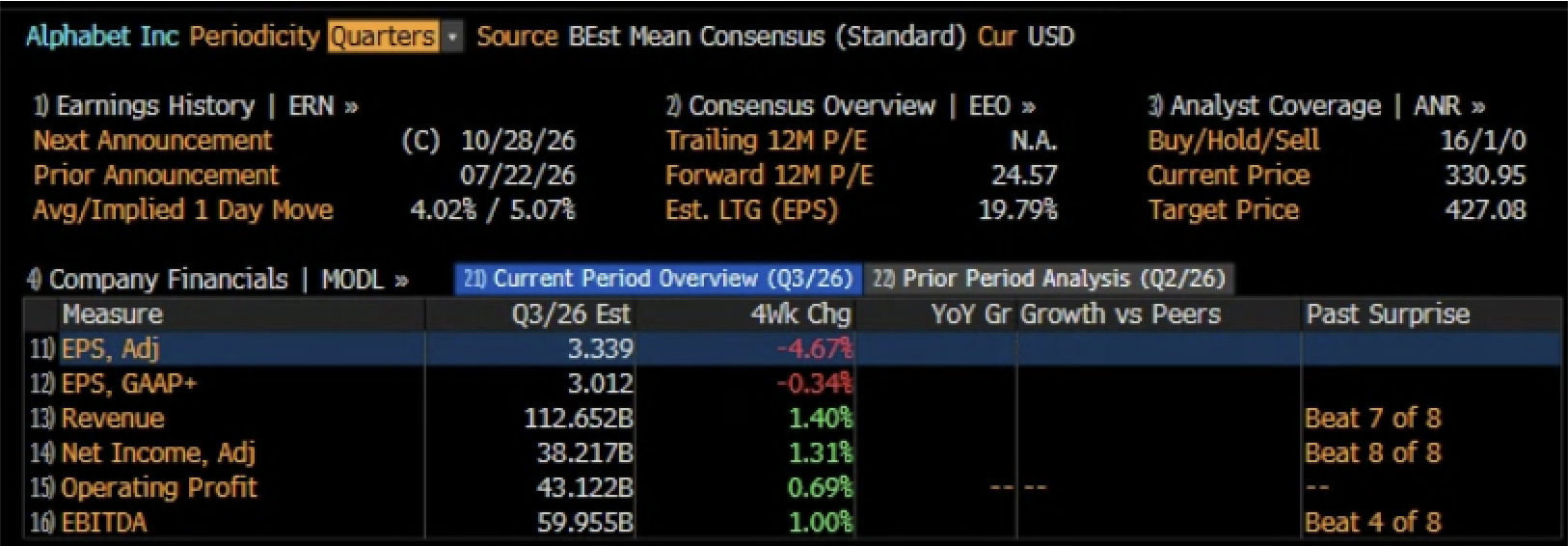
Consistently strong earnings have become the market's baseline expectation. Yet options are pricing in a 5.07% one-day move around this earnings release, above the historical average of 4.02%, suggesting traders remain wary of potential surprises.
Alphabet currently trades at around 24.57 times expected earnings over the next 12 months, with long-term EPS growth projected at 19.79%. At this valuation, another earnings beat alone may not be enough to sustain further share price gains.
Traders will also want evidence that AI investment is translating into earnings growth, alongside an upbeat outlook from management, to encourage further buying interest.
Three Key Factors to Watch: Cloud Growth, Search Resilience and AI Investment Returns
With elevated interest rates continuing to weigh on risk assets, Alphabet's ability to stage a post-earnings rebound will hinge on three key factors: cloud growth, core advertising revenue and returns on AI investment.
1. Can Google Cloud Beat Expectations Again, and How Much Can TPUs Contribute?
Google Cloud is arguably the most promising growth driver heading into this earnings release. Beyond rising enterprise demand for AI computing power, expanding cloud capacity and external sales of Alphabet's in-house TPU chips could provide additional momentum.
Originally developed primarily for Google's own AI model training and inference, TPUs are increasingly being offered to external customers. This could strengthen Google Cloud's competitive position while helping customers reduce their reliance on Nvidia GPUs.
Meanwhile, OpenAI recently announced plans to make some of its advanced AI models and Codex tools available through Google Cloud, potentially making the platform more attractive to enterprise customers and broadening its revenue opportunities.
However, revenue growth does not necessarily translate into higher profits. Traders will be watching whether TPUs and new business opportunities can lower computing costs and improve cloud profitability, rather than simply fuel another round of capital-intensive expansion. Greater clarity around their commercial potential, particularly if it prompts upgrades to 2027 earnings forecasts, could provide support for the share price.
2. Can AI Search Protect Google's Core Advertising Revenue?
Search revenue grew 17% year on year in the second quarter, demonstrating that the rollout of features such as AI Overviews has not materially weakened Google's advertising business so far. However, that could change this quarter.
The key question is whether AI is reshaping user search behaviour and advertising monetisation. If AI features drive more search queries while improving ad pricing and conversion rates, Google's core cash-generating business could remain resilient.
Conversely, if Search growth falls below the expected range of around 14%–15%, or the additional costs associated with AI features begin to erode profits, concerns about disruption to the traditional search business model could resurface.
3. When Will Massive AI Capital Expenditure Translate Into Cash Flow Returns?
This could be the most important factor determining the post-earnings share price reaction.
The ongoing expansion of data centres, TPU capacity and AI infrastructure may support future revenue growth, but it also brings higher depreciation, operating and financing costs. Alphabet previously guided for 2026 capital expenditure of $195 billion to $205 billion. Investment on this scale makes financing and cash flow management increasingly important.
In the second quarter, Alphabet raised approximately $49.6 billion through equity financing and issued around $20.3 billion in senior unsecured notes to support investments, including AI infrastructure.
The scale of this financing also highlights the funding demands of AI expansion. Beyond capital expenditure guidance, traders will therefore be watching cloud margins, depreciation expenses and free cash flow to assess whether these substantial investments are gradually translating into sustainable earnings returns.
Technical Outlook: $330 Support Faces a Test
Alphabet shares have come under pressure recently, retreating after encountering resistance around $360. The pullback reflects both the broader sell-off in AI-related stocks and some investors reducing risk exposure ahead of earnings.
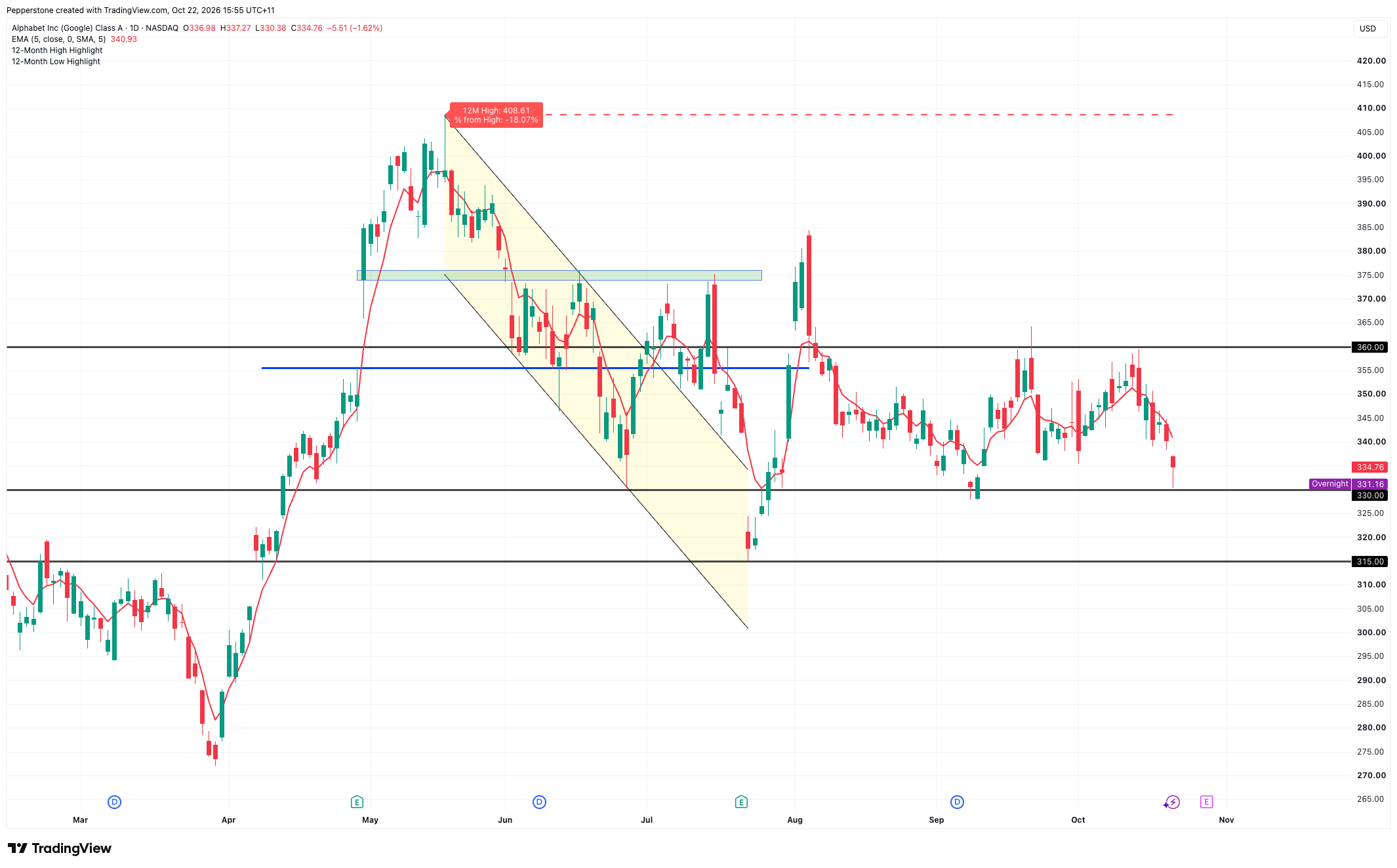
Technically, the $328–$330 area is an important near-term support zone. If earnings reveal a notable slowdown in Search growth, pressure on cloud margins, or another increase in capital expenditure guidance without a clear path to returns, this level could come under renewed pressure. A decisive break below it could open the way towards $315.
Conversely, if cloud performance beats expectations again, Search growth remains resilient and management strikes an optimistic tone on AI profitability, the shares could stage a recovery and retest resistance around $360.
Growth Remains Strong, but Earnings Quality Takes Centre Stage
Overall, Alphabet is still expected to deliver another quarter of solid growth, with traders looking for potential upside surprises from Google Cloud and TPU commercialisation. However, the market's expectations have shifted from simply demonstrating that AI can drive revenue growth to proving that this growth can justify the ever-rising investment costs.
Only if the resilience of its core advertising business, cloud profitability and the path to returns on AI investment are all validated will Alphabet have a stronger chance of turning market optimism around AI into sustained valuation support.
The material provided here has not been prepared in accordance with legal requirements designed to promote the independence of investment research and as such is considered to be a marketing communication. Whilst it is not subject to any prohibition on dealing ahead of the dissemination of investment research we will not seek to take any advantage before providing it to our clients.
Pepperstone doesn’t represent that the material provided here is accurate, current or complete, and therefore shouldn’t be relied upon as such. The information, whether from a third party or not, isn’t to be considered as a recommendation; or an offer to buy or sell; or the solicitation of an offer to buy or sell any security, financial product or instrument; or to participate in any particular trading strategy. It does not take into account readers’ financial situation or investment objectives. We advise any readers of this content to seek their own advice. Without the approval of Pepperstone, reproduction or redistribution of this information isn’t permitted.