- English (UK)


Tesla Earnings Under the Microscope: Are the Numbers Sufficient to Re-anchor the Stock Near Its Highs?

Tesla is set to report its financial results on January 28, against a backdrop of heightened market sensitivity. Consensus expectations point to earnings per share of $0.33, down from $0.66 in the corresponding period last year. This gap underscores a broader shift in investor focus, moving away from the company’s accelerated growth narrative toward a more forensic assessment of margins, cost control and the durability of earnings in an increasingly competitive landscape shaped by persistent macro headwinds.
Assessing Recent Earnings Surprises and Share Price Dynamics
The past four quarters illustrate that earnings surprises, in isolation, have lost much of their explanatory power when it comes to Tesla’s share price performance. In the quarter ending December 2024, the company delivered a modest positive surprise, yet the equity response was subdued. Ongoing concerns around electric vehicle pricing pressure and margin compression diluted the impact of short-term earnings outperformance.
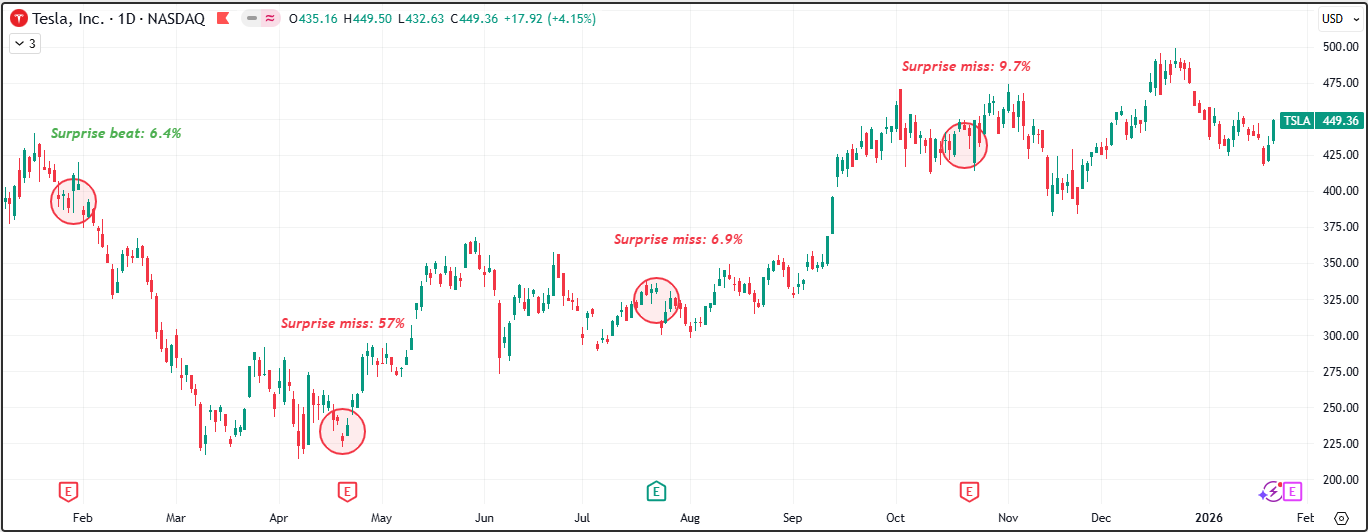
In first quarter of 2025, the downside earnings miss was more pronounced than expected, though the accompanying sell-off was not purely a function of weaker results. The move coincided with peak tensions between Donald Trump and Elon Musk, alongside a broader deterioration in global risk appetite. The market response therefore resembled a repricing of political and macro risks rather than a narrow reassessment of Tesla’s operating performance at that point in time.
By June and September 2025, further negative surprises emerged but with reduced intensity. Importantly, the stock displayed greater resilience, suggesting that expectations had already been reset lower and that investors were increasingly framing Tesla’s outlook through a longer-term lens.
January 2026 Earnings: Beyond the Headline Numbers
Heading into Q4 earnings release, attention is firmly centred on forward guidance, evidence of cost control and Tesla’s capacity to protect margins amid intensifying global competition, particularly from Chinese manufacturers. Upside reaction could possibly prove limited unless management delivers a compelling narrative around demand visibility, robotaxi improvement and cash flow sustainability.
Key 2026 Themes and Implications for the Stock
As Tesla enters 2026, several drivers remain in focus, most notably autonomous driving and licenses to operate, scaling of artificial intelligence applications and Musk’s plan to achieve the highest compensation package in history. Signals related to regulation and licensing in Europe as well as progress in navigating trade frictions, could all play a meaningful role in shaping post-earnings market reactions.
In summary, Tesla’s upcoming results function as a broader gauge of investor sentiment, testing the company’s ability to reinforce confidence in its long-term vision and to justify elevated management compensation in a rapidly evolving global environment.
The material provided here has not been prepared in accordance with legal requirements designed to promote the independence of investment research and as such is considered to be a marketing communication. Whilst it is not subject to any prohibition on dealing ahead of the dissemination of investment research we will not seek to take any advantage before providing it to our clients.
Pepperstone doesn’t represent that the material provided here is accurate, current or complete, and therefore shouldn’t be relied upon as such. The information, whether from a third party or not, isn’t to be considered as a recommendation; or an offer to buy or sell; or the solicitation of an offer to buy or sell any security, financial product or instrument; or to participate in any particular trading strategy. It does not take into account readers’ financial situation or investment objectives. We advise any readers of this content to seek their own advice. Without the approval of Pepperstone, reproduction or redistribution of this information isn’t permitted.