- English (UK)


Tesla Earnings Highlight Margin Strength as Stock Reaction Turns Constructive

Tesla’s Q4 earnings delivered a mix of slowing automotive and improving financial quality, but the stock’s post-results behavior suggests markets remain more focused on cost control, healthy margins and long-term company optionality.
Tesla Q4 Earnings: Beating Margin Estimates As the Company Navigates a Challenging Auto Cycle
Tesla’s Q4 earnings delivered a mixed but ultimately market constructive signal, with a modest top line shortfall offset by a clear bottom line beat, as earnings per share came in at 50 cents, comfortably above the market’s 45 cent expectation. Revenue reached $24.9 billion, slightly below consensus forecasts of $25.1 billion, though still lower than the revenue recorded in the same period last year. This suggests that Tesla is not growing at its previous pace, but still capable of outperforming conservative expectations with a clear beat on the cost control lines.
The softness was most visible in automotive revenue which declined near 11% year over year to $17.7 billion. Lower vehicle volumes and ongoing pricing pressure continued to weigh on the segment, reflecting the current intensifying competition in the EV sector.
Margins and Diversification Offer Key Support
Where the earnings release surprised positively was on margins and business mix. Tesla reported a total gross margin of 20.1%, well above market expectations and a notable improvement from a year earlier. This +20% margin suggests that cost controls, operational efficiency and a richer revenue mix are beginning to offset some of the pricing headwinds in vehicles.
Non-automotive segments played a growing role as energy generation and storage revenue jumped 25% year over year, while services and other revenue rose to 18%. These segments are increasingly viewed as strategic pillars to the company providing revenue diversification away from the cyclical swings of vehicle demand and highlighting Tesla’s optionality as a broader energy and technology platform.
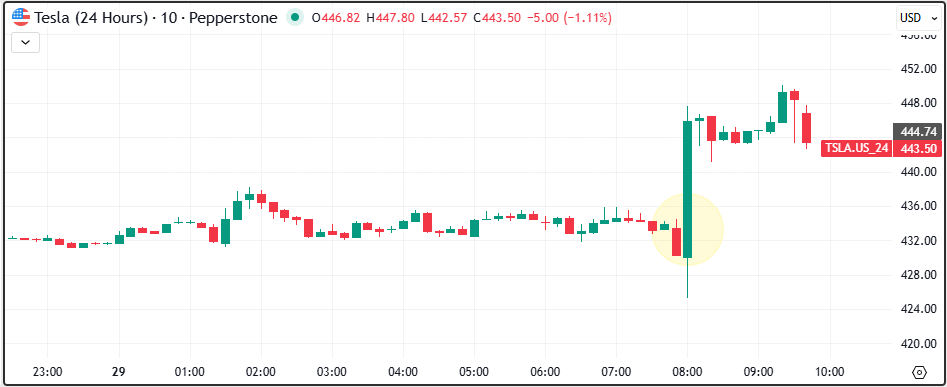
Stock Reaction
The stock’s reaction following the earnings release leaned constructive. Short-term price action showed an initial dip quickly met by buying interest, suggesting that much of the bad news had already been priced in. More importantly, the longer-term chart context shows a pattern that has repeated over recent quarters. Even when Tesla delivers earnings misses or mixed results, downside reactions have tended to be shallow and short-lived.
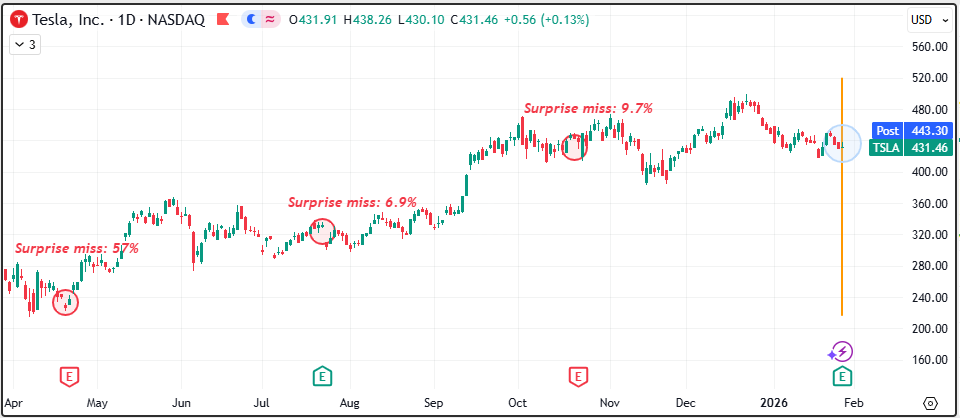
This points to a market that is increasingly focused on trajectory more than quarter to quarter volatility. As long as margins stabilize and non-automotive growth continues to scale, investors appear willing to look beyond near-term delivery weakness. The latest earnings reinforced that dynamic, with price action hinting that support is building around the broader narrative, with potential to revisit last year price level in the coming period.
The material provided here has not been prepared in accordance with legal requirements designed to promote the independence of investment research and as such is considered to be a marketing communication. Whilst it is not subject to any prohibition on dealing ahead of the dissemination of investment research we will not seek to take any advantage before providing it to our clients.
Pepperstone doesn’t represent that the material provided here is accurate, current or complete, and therefore shouldn’t be relied upon as such. The information, whether from a third party or not, isn’t to be considered as a recommendation; or an offer to buy or sell; or the solicitation of an offer to buy or sell any security, financial product or instrument; or to participate in any particular trading strategy. It does not take into account readers’ financial situation or investment objectives. We advise any readers of this content to seek their own advice. Without the approval of Pepperstone, reproduction or redistribution of this information isn’t permitted.