- English (UK)


Q1 26 UK GDP Review: This Year's Peak Is Probably Already In

In the three months to March, the economy grew by 0.6% QoQ, in line with consensus expectations, and the fastest pace of quarterly growth since this time last year, which in turn saw the annual growth rate rise to an above-expected 1.1% YoY.
As for the drivers of that growth, the services sector proved the largest contributor to the expansion seen in Q1, growing 0.8% QoQ, though all three sectors contributed to growth in the first quarter. That said, headwinds continue to face the production sector, which despite growing 0.2% QoQ, chalked up an unchanged pace of output compared to this time a year ago, while construction output has actually shrunk by 1.3% YoY.
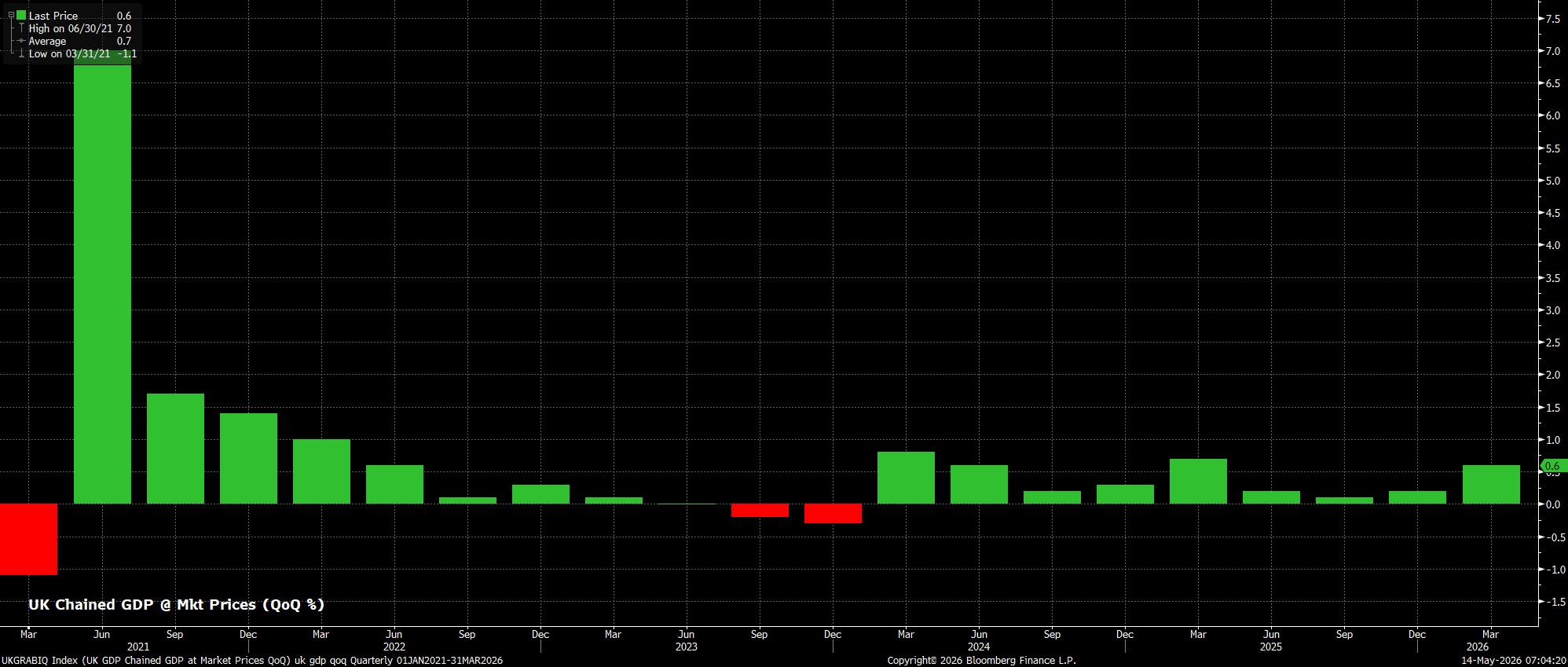
In any case, it would be remiss of me not to mention that this morning's data seems to underscore what has become a running issue with UK growth figures, whereby the economy appears to surge at the beginning of the year, before slowing as time wears on, repeating a pattern that has been seen since at least the start of 2022. Although, this year, the impact of conflict in the Middle East will clearly act as a drag on growth, it is increasingly clear that there is a high degree of statistical noise within the data. Not only does this make discerning a clear trend more troubling than it otherwise would be, it also complicates the job of both monetary and fiscal policymakers, while adding to the litany of quality issues that continue to plague ONS releases.
All that said, and setting aside the aforementioned issues, it is highly likely that Q1 will mark the peak in terms of UK growth this year. Risks remain clearly tilted to the downside moving forwards, principally as a result of the ongoing Middle East conflict, and subsequent surge in energy prices, which will in turn impact the economy in the manner of a significant negative demand shock, over the next couple of quarters. Added to which, renewed political uncertainty in Westminster is also likely to act as a significant headwind to the economy at large, not only delaying major investment decisions, but with said uncertainty having also resulted in considerably tighter financial conditions as a result of the recent sell-off in Gilts across the curve.
For the Bank of England, this morning's data is unlikely to 'move the needle' too significantly. Having stood pat on policy at the last three meetings running, the MPC are set to stick with this 'wait and see' approach for the foreseeable future, with policymakers' attention, and reaction function, centring largely on the risks of second-round inflation effects emerging.
The path to a Bank Rate cut being delivered this year now seems a very narrow one indeed, with the base case as such being that the 'Old Lady' is now on hold for the remainder of 2026, even if further hawkish dissents among MPC members are increasingly likely, especially in the event of a more prolonged energy price shock.
UK assets, however, are much more likely to take their lead from developments in Westminster, at least in the short-term, as PM Starmer's future remains in doubt. In turn, risks to both Gilts and the GBP tilt to the downside for the time being, as participants discount not only elevated political uncertainty, but also the potential for a significantly looser fiscal stance moving forwards.
The material provided here has not been prepared in accordance with legal requirements designed to promote the independence of investment research and as such is considered to be a marketing communication. Whilst it is not subject to any prohibition on dealing ahead of the dissemination of investment research we will not seek to take any advantage before providing it to our clients.
Pepperstone doesn’t represent that the material provided here is accurate, current or complete, and therefore shouldn’t be relied upon as such. The information, whether from a third party or not, isn’t to be considered as a recommendation; or an offer to buy or sell; or the solicitation of an offer to buy or sell any security, financial product or instrument; or to participate in any particular trading strategy. It does not take into account readers’ financial situation or investment objectives. We advise any readers of this content to seek their own advice. Without the approval of Pepperstone, reproduction or redistribution of this information isn’t permitted.