- English (UK)


Oracle Earnings Miss: Rising Capex, Weak Cash Flow and Higher CDS Spark Investor Concerns
Trader Takeouts and Market Reaction
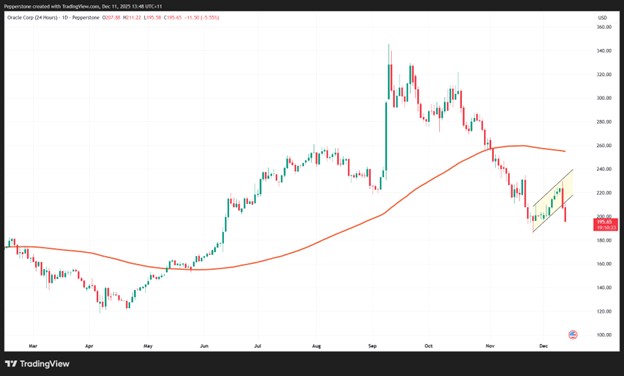
Pepperstone’s 24-hour Oracle share CFDs are down 11.8% to $196.74 in post-market trade following the earnings release.
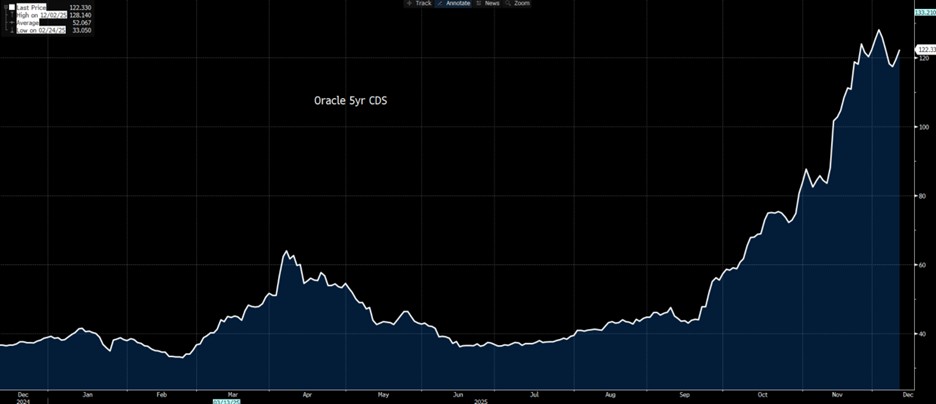
Oracle’s credit default swaps (CDS) widened 4bp to 112bp, implying a 10% cumulative probability of a credit event over the next five years. CDS levels rising here signal that credit investors are increasingly uncomfortable with Oracle’s balance-sheet trajectory and funding needs.
What Investors Didn’t Like & Impacted the Share Price
• Capex plans increased by $15b from September guidance, now targeting $50b in 2026
• Q2 revenue: $16.06b vs $16.21b expected by analysts
• Total cloud revenue: $8b (+36 percent) vs $8.04b expected
• Cloud infrastructure revenue: +66 percent vs +69.1 percent expected
• Free cash flow: -$10b vs -$5b expected
The standout concern was the doubling of negative free cash flow, which raises questions about Oracle’s ability to self-fund its aggressive AI-infrastructure expansion.
What Investors Liked from the Earnings
• Remaining performance obligations (RPO): $523b, coming in above expectations, showing a strong order pipeline
• Q2 EPS: ahead of expectations
• FY26 sales guidance reaffirmed: $69b vs consensus $67b
The pipeline remains robust, suggesting strong long-term revenue visibility.
Oracle’s Position in the AI-Infrastructure Trade
Oracle has been under pressure since late September, with investors growing cautious due to:
• Its deep relationship with OpenAI
• The need to fund capex through debt markets, including its $18b corporate bond sale
• Concerns about whether the company can convert large RPO into cash-generating revenue quickly enough
Investors wanted clarity on sales momentum, order conversion capabilities, and - critically - future funding requirements.
Funding Pressures and Credit Market Signal
With quarterly free cash flow falling by $10b, Oracle’s negative free cash flow to total debt ratio is worsening, meaning:
• The company will likely continue issuing corporate bonds to fund AI-infrastructure growth
• Funding costs are rising, making expansion more expensive
• Concerns are emerging about credit rating sustainability and the potential impact on gross margins
For the fourth-largest hyperscaler, the reliance on bond markets is becoming a central risk the equity market cannot ignore.
Why Traders Are Watching Oracle’s CDS
Equity traders are now highly focused on Oracle’s CDS spreads:
• If Oracle’s CDS continue to rise, its perceived credit risk increases and subsequently the equity typically trades lower
• Many equity traders use Oracle CDS as a hedge against broad AI-trade downside risk
• This mirrors dynamics seen in SoftBank and, to a lesser degree, Nvidia, where exposure to capital-intensive AI buildouts increased equity volatility
A further spike in Oracle’s CDS would almost certainly weigh on the stock.
OpenAI vs Google Partnerships: A Shifting Narrative
Oracle’s deep alignment with OpenAI has become a headwind.
Investors are increasingly favouring companies aligned with Google and Gemini 3.0, such as Broadcom, which have materially outperformed. The perception that Gemini 3.0 may surpass ChatGPT in enterprise use cases has contributed to capital rotation away from OpenAI-dependent partners.
Summary and Technical Outlook
Oracle increasing its capex plans has become the dominant equity risk. Expectations of further bond issuance to fund expansion are seen as a potential drag on margins, credit quality and valuation.
The reaction in Oracle’s corporate bonds and CDS will be the key driver of the equity from here. Based on current price action and technical structure, Oracle’s shares look likely to re-test - and potentially break - the 25 November low of $185.63.
Any additional detail from management regarding funding plans or credit-market strategy could be essential for investors positioning around the next leg of this move.
The material provided here has not been prepared in accordance with legal requirements designed to promote the independence of investment research and as such is considered to be a marketing communication. Whilst it is not subject to any prohibition on dealing ahead of the dissemination of investment research we will not seek to take any advantage before providing it to our clients.
Pepperstone doesn’t represent that the material provided here is accurate, current or complete, and therefore shouldn’t be relied upon as such. The information, whether from a third party or not, isn’t to be considered as a recommendation; or an offer to buy or sell; or the solicitation of an offer to buy or sell any security, financial product or instrument; or to participate in any particular trading strategy. It does not take into account readers’ financial situation or investment objectives. We advise any readers of this content to seek their own advice. Without the approval of Pepperstone, reproduction or redistribution of this information isn’t permitted.