
The February US jobs report pointed to payrolls having unexpectedly declined last month, and unemployment rising to 4.4%. The FOMC, however, are unlikely to over-react to the data, given one-off factors skewing the payrolls print lower, and the fog of uncertainty caused by ongoing conflict in the Middle East.
Payrolls Unexpectedly Decline
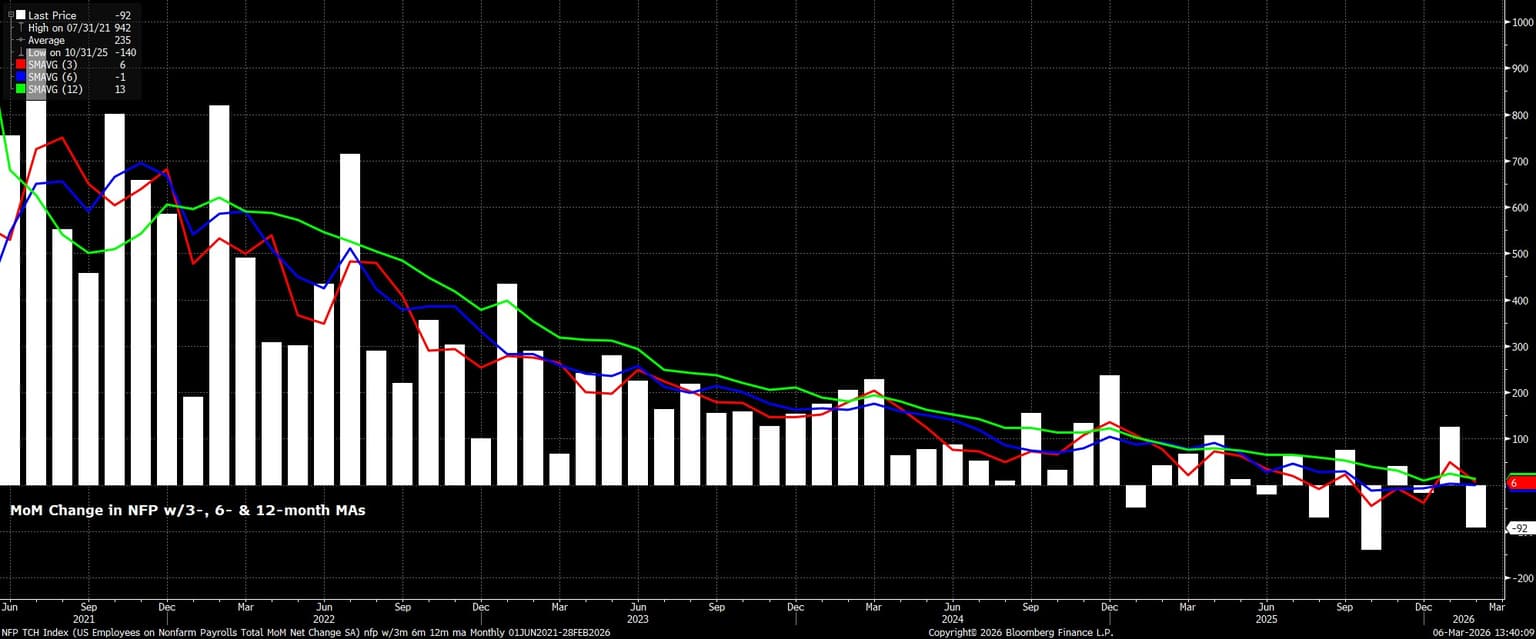
Headline nonfarm payrolls declined by -92k in February, massively below expectations for an increase of +55k, and outside of the typically-wide forecast range, of -10k to +115k. Compounding the bad news, one must continue to take into account data quality concerns when it comes to the payrolls print, especially with Chair Powell having recently indicated that the figure may be overstating headline employment growth by as much as 60k per month, meaning that the ‘true’ fall in employment could be even larger
That said, in conjunction with the release of the February payrolls print, the prior two datapoints were revised by a net -69k, in turn taking the 3-month average of job gains to just 6k, well below the breakeven rate of around 50k.
Under The Surface
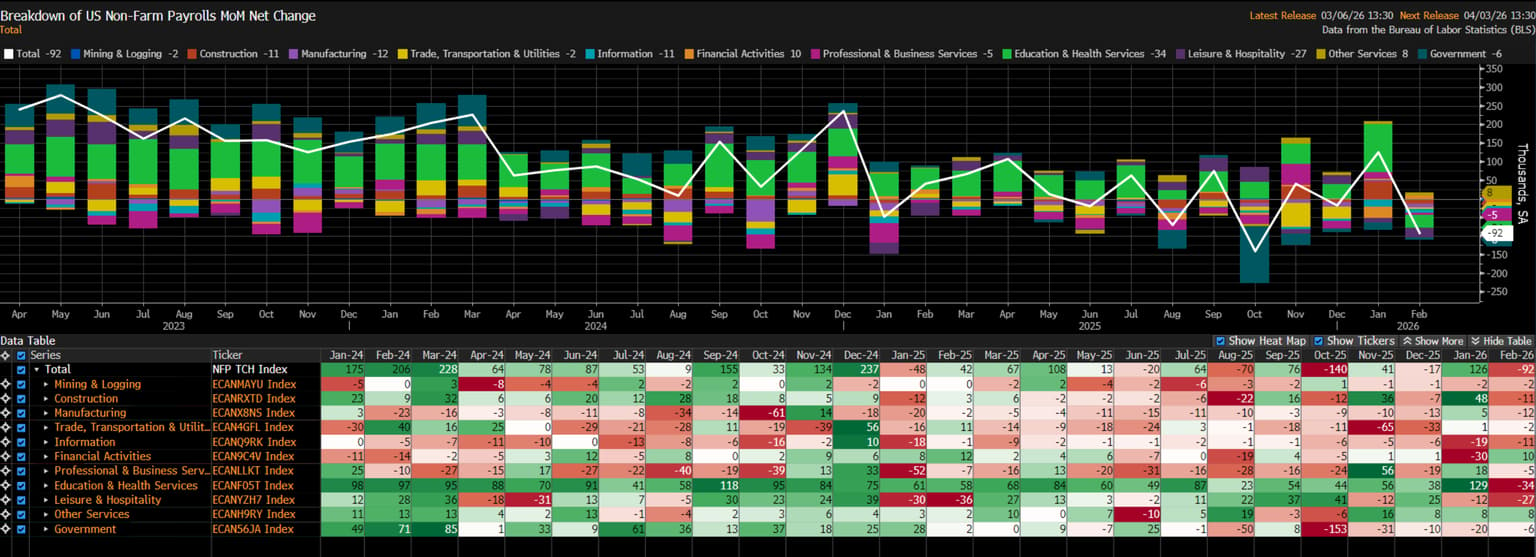
Back to the February report, where again the sectoral split of job gains is instructive, and helps explain the huge headline miss.
Employment in the Healthcare sector fell by 19k on the month, largely reflecting strike activity, with the fall here likely having an outsized impact given the way in which the sector has underpinned private sector hiring over the last twelve months. Construction employment also fell, by 11k on the month, likely reflective of the poor weather seen in late-Jan/early-Feb. Overall, though, employment did fall in 9 of the 11 sectors that the BLS report, painting a fairly dismal picture of the overall hiring backdrop.
Earnings Pressures Contained
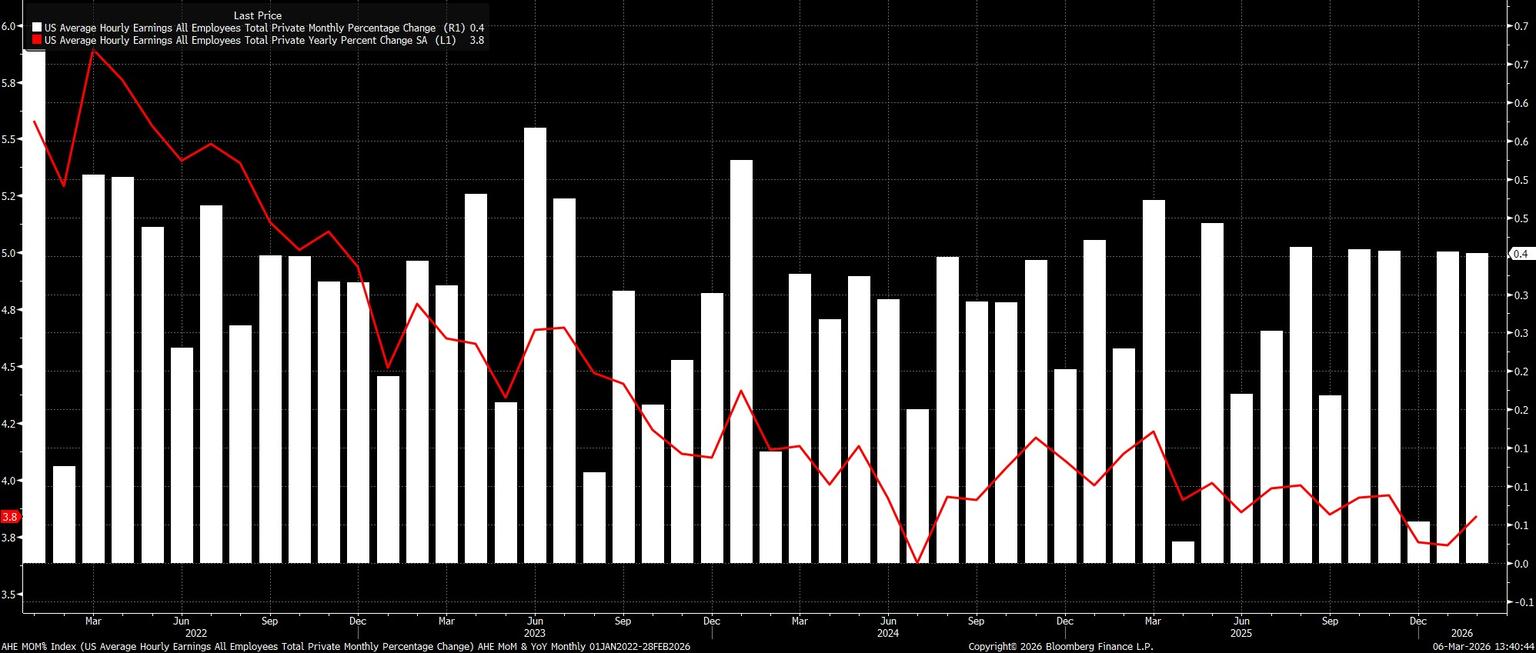
Remaining with the establishment survey, the report indicated that earnings pressures remain relatively contained, with the labour market at this time not a source of significant upside inflation risk. That risk, however, does present itself in the form of the ongoing energy price shock as a result of recent geopolitical tensions in the Middle East.
In any case, average hourly earnings rose by 0.4% MoM/3.8% YoY last month, both a touch hotter than consensus, though unchanged, on an MoM basis, from a month prior.
Household Survey Also Downbeat
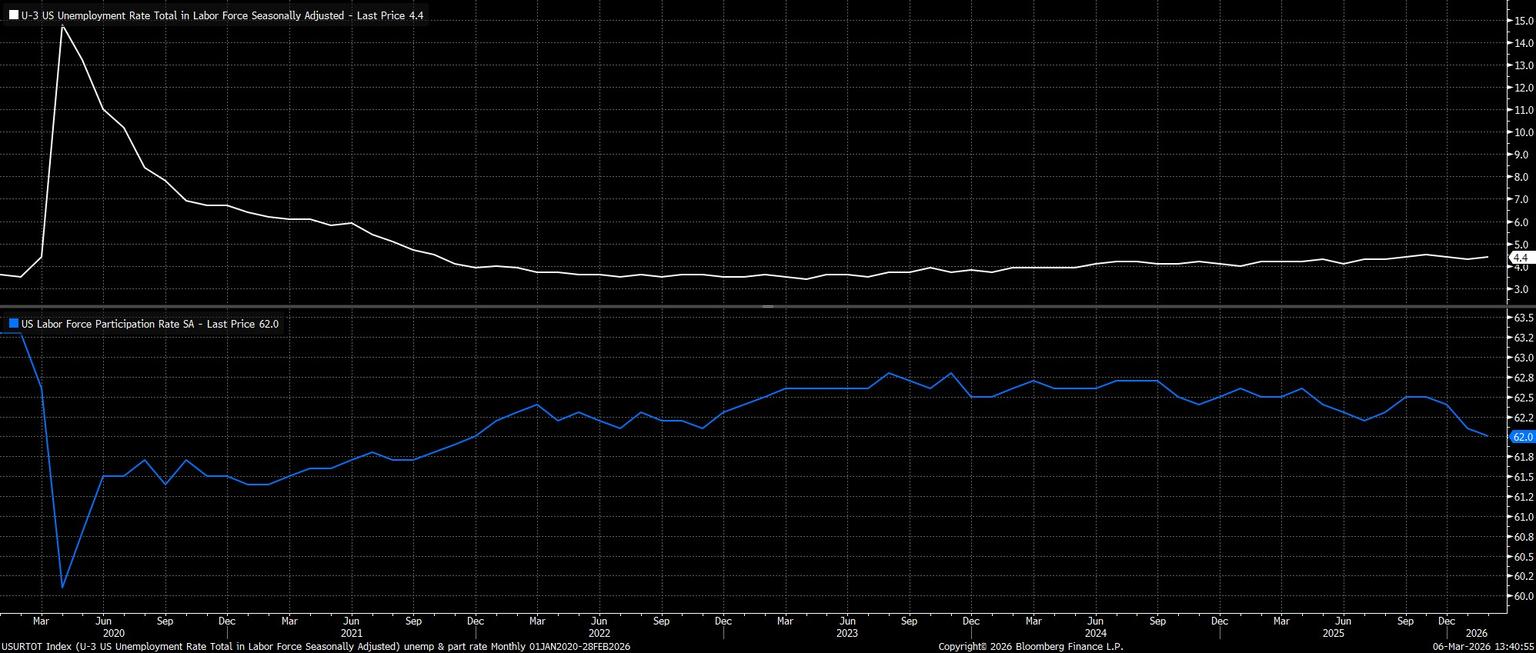
Turning to the household survey, a downbeat message also came through. Headline unemployment unexpectedly rose to 4.4%, equalling the highs seen in late-2025, while labour force participation plunged to 62.0%, its lowest level since December 2021.
As has now been the case for some time, the household survey carries with it greater policy implications, as FOMC policymakers attempt to gauge the degree of slack present in the labour market. Still, this data must also be accompanied by a bit of a ‘health warning’, with survey response rates remaining low, and the BLS continuing to grapple with the changing size, and composition, of the labour force.
Money Markets Reprice Dovishly
In reaction to the data, money markets underwent a marginal dovish repricing. The USD OIS curve now fully prices the next 25bp cut by July, compared to September pre-release, while also discounting a total of 45bp easing by year-end, up from the 35bp priced pre-payrolls.
Conclusion
Zooming out, it seems unlikely that the February labour market report will materially ‘move the needle’ in terms of the near-term Fed policy outlook, even with the figures being rather grim.
Having adopted a ‘wait and see’ stance at the January FOMC, policymakers are set to continue with that approach for the time being, not only given the various aforementioned caveats that must accompany the headline print, but also considering the fog of uncertainty that now clouds the outlook, as a result of the energy price shock stemming from ongoing conflict in the Middle East.
Still, labour market risks appear to tilt clearly to the downside at the current time, with January’s solid data being more of a ‘one-off’, than marking a turning point. Consequently, further rate reductions are likely to be on the cards later in the year, especially if signs of labour market weakness were to grow more significant. Said cuts, though, are likely to come under the stewardship of Chair designate Warsh, who at the current juncture is likely to have some difficulty in convincing his new colleagues to adopt as dovish a stance as we’re led to believe he may seek, barring a material further deterioration in incoming data.