- English (UK)


Downside GBP & Gilt Risks Grow As Political Uncertainty Mounts

Political developments, as has so often been the case over the last decade or so, look set to re-assert themselves as the main short-term driver of UK assets.
After a disastrous result in local elections last week, PM Starmer’s future in Number 10, and as Labour leader, appears to be on increasingly fragile ground, as an increasing number of Labour MPs voice their displeasure with the leadership, either calling for an immediate departure, or for Starmer to at least set out a timetable for when he will leave post.
Scenarios
From here, there are three likely scenarios that could pan out:
- Soldiering On: PM Starmer’s keynote speech today (Monday) is enough to quell any discontent within the party for the time being, and a leadership challenge is put on hold. Following which, a Cabinet reshuffle is plausible, including the potential return to Westminster of Manchester Mayor Andy Burnham. Such a scenario, while possible, would leave Starmer with effectively no political capital left, likely finding it difficult/impossible to govern as a result, and thus resulting in a degree of political paralysis
- Stalking Horse: Starmer’s speech does little to soothe nerves within the party, meaning Catherine West MP follows through on her threats to trigger an immediate leadership challenge, acting as a ‘stalking horse’ for other candidates to enter the race. Such a race would likely prove to be Health Sec. Streeting vs. former Deputy Leader Rayner, with the latter being the favourite in such a contest
- Timetable: Starmer’s speech fails to calm nerves within the party, though rather than an immediate leadership election, Starmer is instead forced to set out a plan for his departure by the end of the year. Such a scenario would give time for Burnham to return to Westminster, and likely result in the contest being Burnham vs. the aforementioned Streeting, with the former being favoured by the Labour membership
Do note that, in the event of any leadership contest, PM Starmer would automatically be on the ballot paper if he so desired, though the chances of him being victorious in such an election are very slim indeed.
Dates To Watch
In the short-term, today’s set-piece speech from Starmer is pivotal, and will likely set the agenda for developments from here on in. Beyond that, West has set a deadline of Tuesday morning for her ‘stalking horse’ challenge, while the King’s Speech on Wednesday will also be closely watched as the Government set out their agenda for the upcoming Parliamentary session.
Longer-term, in the event of a leadership challenge, it seems logical that the Labour Party would seek for a new leader to be in place by the time of party conference in September, though the precise timetable for such an election would be set out by the NEC in due course.
Market Implications
At present, the ‘Stalking Horse’ and ‘Timetable’ scenarios are assigned roughly equal odds of 40% apiece, thus leaving around a 20% chance that Starmer is able to soldier on for the time being. Quite clearly, though, any and all of these scenarios mean a return to considerably higher levels of political uncertainty, which cable trading at $1.36 does not yet seem to have adequately discounted.
In terms of risks, as frequently noted throughout the year thus far, the triggering of a leadership election, and a subsequent change in Prime Minister, leaves the GBP and Gilts not only grappling with a ratcheting up of political uncertainty, but also being forced to face up to a likely more left-wing successor to Starmer. Such an outcome would, in all likelihood, lead to a substantial loosening of the ‘fiscal rules’, along with considerably higher government spending, and even higher taxes, possibly even including a manifesto breach in raising NI, VAT, or income tax.
Taking all that into account, it seems unlikely that the yield premium on a 10-year Gilt over G7 peers will fade any time soon.
_10_2026-05-11_07-20-37.jpg)
As for the FX space, options, to my mind, seem to be under-pricing the potential for GBP vol, at this stage. Cable straddles imply a move of just +/- 105 pips over the upcoming week, and just a couple of big figures over the next month, which seems rather conservative considering the downside risks that are quite clearly on the horizon.
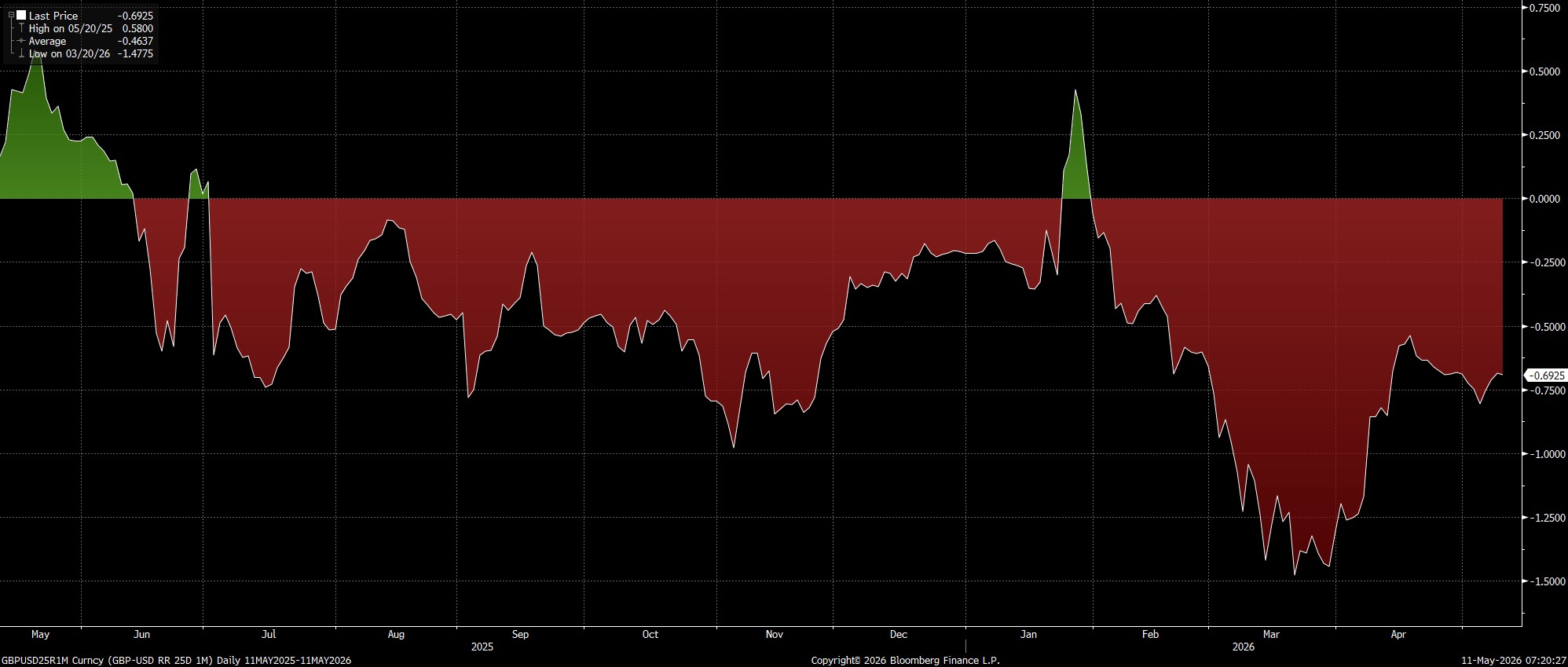
The same, incidentally, can be said of cable risk reversals which, while continuing to show puts trading at a premium to calls, are well off the bearish extremes printed in mid-March. Again, this seems far too optimistic to me, and suggests considerable downside risks for spot too.
In terms of levels to watch, the 1.35 handle is obvious psychological support in the near-term, helped by the 100-day moving average residing here too, around the 1.3480 mark. Beneath here, the 200-day moving average at 1.3425 is worth keeping on the radar, before we’d look to the March lows around the 1.32 mark.
_2026-05-11_07-20-09.jpg)
The material provided here has not been prepared in accordance with legal requirements designed to promote the independence of investment research and as such is considered to be a marketing communication. Whilst it is not subject to any prohibition on dealing ahead of the dissemination of investment research we will not seek to take any advantage before providing it to our clients.
Pepperstone doesn’t represent that the material provided here is accurate, current or complete, and therefore shouldn’t be relied upon as such. The information, whether from a third party or not, isn’t to be considered as a recommendation; or an offer to buy or sell; or the solicitation of an offer to buy or sell any security, financial product or instrument; or to participate in any particular trading strategy. It does not take into account readers’ financial situation or investment objectives. We advise any readers of this content to seek their own advice. Without the approval of Pepperstone, reproduction or redistribution of this information isn’t permitted.