- English (UK)


Apple Q2 26 Earnings Review: Record Quarter, but Growth Quality Under Scrutiny
.jpg?height=93&quality=100)
Apple reported its fiscal second-quarter results after the bell on April 30. Revenue, EPS, and gross margin all came in ahead of consensus, with management noting that performance exceeded the high end of its own prior guidance.
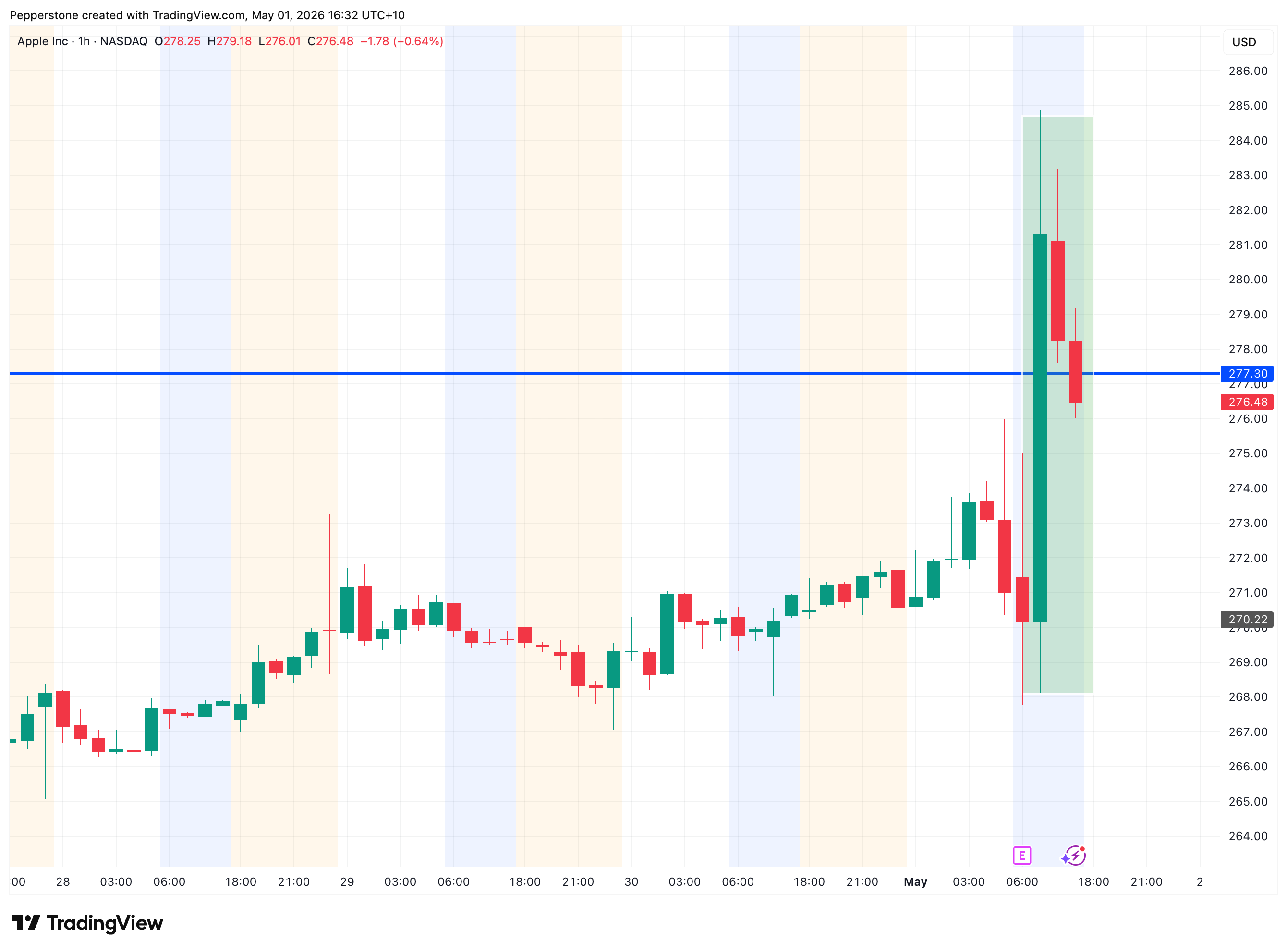
The market reaction, however, was far from straightforward. Shares rallied nearly 4% in after-hours trading before pulling back. Faced with Q3 revenue guidance that came in well above expectations — alongside persistently elevated memory costs — traders are paying close attention to the quality and sustainability of Apple's growth.
iPhone and China: Demand Resilience Intact, but Constrained by Supply
iPhone remained the quarter's core revenue driver, generating approximately $57 billion, up more than 20% year-over-year. Management called it the strongest March quarter in Apple's history, reflecting the combined effect of a favorable product cycle and ongoing premiumization trends.
Greater China was a particular standout. Revenue reached $20.5 billion, up 28% year-over-year and meaningfully ahead of expectations. Against a backdrop of broader smartphone market weakness, Apple grew and gained share — a testament to the durability of its brand premium and user stickiness in the premium segment.
That said, strong demand did not fully translate into shipments. The company was explicit: a surge in AI-related chip demand has absorbed a significant share of advanced node capacity, constraining Apple's supply across the iPhone and Mac product lines and preventing some demand from converting into revenue in the period.
As a result, current revenue levels reflect Apple's ability to ship under constrained conditions, not the true ceiling of demand. Should supply conditions improve, pent-up demand could offer support in subsequent quarters.
Services and Capital Allocation: The Compounding Logic Continues to Deliver
Beyond the headline figures, Services continued to be a key driver of earnings quality. Revenue reached $31 billion, a new all-time high. Supported by over 2.5 billion active devices, Apple's ecosystem monetization efficiency continues to improve.
More importantly, the high-margin nature of Services has been the structural force driving Apple's overall gross margin from the high-30% range to nearly 50% today. That structural improvement is a meaningful pillar of Apple's ability to sustain a premium valuation over the long term.
On capital allocation, Apple maintained a relatively measured approach. The company authorized a new $100 billion share buyback, raised its dividend, and moved away from its "net cash neutral" financial target. Compared to Microsoft, Google, and Meta — all of which continue to ramp AI capital expenditure — Apple is more focused on returning cash to shareholders.
This approach supports near-term earnings and valuation stability, but it also means the company's investment in AI infrastructure is comparatively restrained, and its reliance on external ecosystems is higher. That dynamic has contributed to ongoing debate about Apple's AI competitiveness.
Q3 Guidance: A Strong Top Line, a Tighter Bottom Line
On the back of a strong quarter, Apple guided Q3 revenue growth of 14% to 17% — substantially above the roughly 9% consensus heading into the print. This provided clear near-term support for sentiment.
Gross margin guidance, however, pointed in a more cautious direction: 47.5% to 48.5%, stepping down from the current quarter's ~49%. Management indicated that memory costs will be "meaningfully higher" in Q3, with the pressure expected to persist and intensify over the coming quarters.
R&D spending growth, which is outpacing revenue, adds further pressure on the margin line. This combination of revenue expansion and margin compression is a key reason the stock's after-hours reaction remained measured.
That said, Apple noted it has filed for refunds on tariffs already paid and has committed to reinvesting those proceeds into U.S.-based innovation and advanced manufacturing — a development that could partially offset near-term profit pressure.
AI Strategy and Leadership Transition: The Core Rerating Variables
Looking further out, the variables driving Apple's valuation are increasingly shifting away from near-term business performance and toward AI strategy and the leadership transition.
Tim Cook, who has led Apple for 15 years, will step down in September, with hardware engineering head John Ternus set to take over. Ternus has a strong track record in product engineering, which could in theory help accelerate on-device AI capabilities and the development of new product categories.
From a capital markets perspective, however, Apple's central challenge is not about execution — it's about positioning. Unlike peers that are monetizing AI directly through compute infrastructure and proprietary models, Apple is taking a more integrative approach, embedding AI capabilities into its existing ecosystem through Apple Intelligence. The commercial roadmap for this strategy remains to be clarified.
This distinction has created a divide in how the market views Apple's role in the AI era: is it a durable ecosystem integrator that stands to benefit from AI as a structural tailwind, or does it need to demonstrate a new growth curve entirely? The answer implies very different valuation ranges.
From Certainty Premium to Growth Quality Re-Rating
On the whole, this quarter once again validated Apple's strong and resilient fundamentals. But the market's pricing logic is shifting.
Historically, Apple's premium valuation has rested on predictability — stable cash flows and a highly visible growth trajectory. Today, the market is placing increasing weight on the quality, composition, and scalability of that growth.
The pace at which supply constraints ease, the degree to which rising costs weigh on margins, the smoothness of the leadership transition, and the commercial traction of Apple's AI strategy are all becoming more central to how the stock is valued.
At the same time, tightening restrictions from EU and U.S. antitrust regulators on the App Store and related services represent a long-term structural friction on the Services growth thesis — one that warrants a place in any rigorous valuation framework.
The material provided here has not been prepared in accordance with legal requirements designed to promote the independence of investment research and as such is considered to be a marketing communication. Whilst it is not subject to any prohibition on dealing ahead of the dissemination of investment research we will not seek to take any advantage before providing it to our clients.
Pepperstone doesn’t represent that the material provided here is accurate, current or complete, and therefore shouldn’t be relied upon as such. The information, whether from a third party or not, isn’t to be considered as a recommendation; or an offer to buy or sell; or the solicitation of an offer to buy or sell any security, financial product or instrument; or to participate in any particular trading strategy. It does not take into account readers’ financial situation or investment objectives. We advise any readers of this content to seek their own advice. Without the approval of Pepperstone, reproduction or redistribution of this information isn’t permitted.