- English
- عربي


JPY & JGBs Firm On Fragile Belief In Fiscal Discipline

Summary
- Post-Election Calm: Tentative signs of fiscal discipline have led to post-election gains for the JPY and for JGBs
- Unsustainable Policy Mix: Still, the desire for loose fiscal & easy monetary policies, coupled with a relatively firm JPY, remains unsustainable long-term
- Downside Risks: With that in mind, downside JPY risks remain, with intervention still a medium-term possibility that can't be ruled out
The ‘Have Cake & Eat It’ Policy Mix
On a number of occasions, I’ve characterised the current Japanese policy mix as one of ‘having your cake and eating it’.
In short, PM Takaichi is seeking to ‘run it hot’, delivering chunky fiscal stimulus in an attempt to breathe some life into the domestic economy, while at the same gently leaning against the BoJ to encourage a more sluggish pace of policy tightening, as well as seeking to prevent the JPY from softening too notably. If one were to draw a Venn diagram, none of those three circles would overlap.
Japanese Assets Exhibit Post-Election Calm
However, for the time being at least, having endured notable JPY and JGB volatility earlier in the year, market participants appear to be giving Takaichi & Co the ‘benefit of the doubt’, in the aftermath of the weekend’s election, which saw the LDP win a two-thirds ‘supermajority’ of seats in the lower house.
Importantly, contrary to my base case that such a majority would see Takaichi move relatively rapidly, the Administration appear set to take more of a ‘slow and steady’ approach to proceedings. Chiefly, focus has fallen on a proposed sales tax cut on food, where Takaichi has adopted more of a deliberate approach than expected, with a report on the matter due to be published before summer, followed by negotiations to see whether consensus can be found with opposition parties.
Furthermore, the Admin have signalled that such a tax cut will be limited in scope, to only food & drinks, and in duration, to a maximum of two years, with Finance Minister Katayama having also reiterated that additional JGB issuance will not be required to fund the measure.
This has all been music to the market’s ears, especially at the long- and ultra-long-end of the JGB curve, where 30- and 40-year yields have fallen 10bp apiece since the election result became clear, and the aforementioned soothing comments were made.
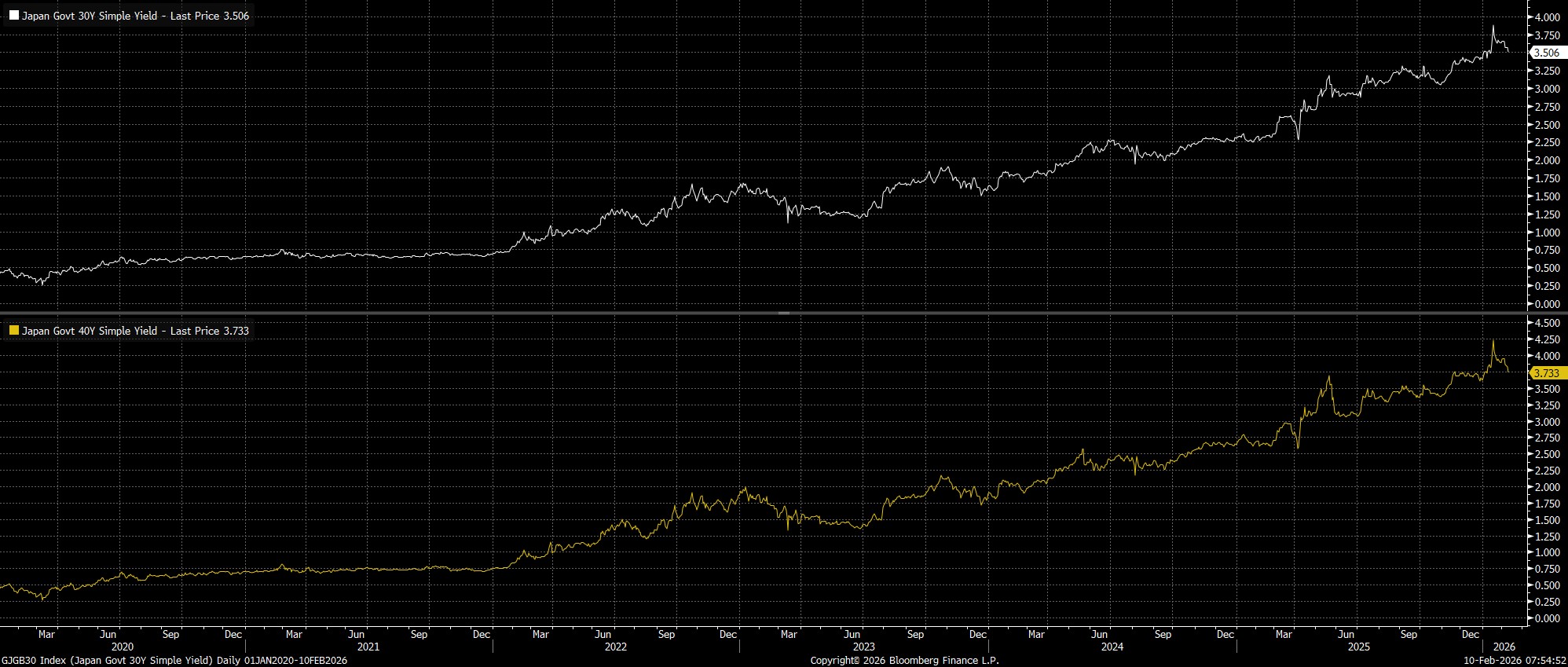
Simultaneously, relatively calm conditions in the FI space have spilled over into the FX complex, and have given the JPY a bit of breathing space. Clearly, a degree of the two-and-a-half big figure decline in spot USD/JPY seen since owes to the broadly softer USD tone which has been seen across G10, though the yen has also been relatively firm in the crosses.
Naturally, such a rally has lessened the imminent risk of any further jawboning or intervention from the MoF, at least for the time being. A chunky decline in JPY implied vols has also reduced the probability of any near-term action.
_D_2026-02-10_07-53-02.jpg)
Stability Seems Temporary
All that said, I’d be more inclined to frame this recent stability more as a temporary reprieve for JGBs, and the JPY, than something of a structural game-changer. Substantial further downside in USD/JPY doesn’t appear the most likely prospect for the time being, at least not below the lows around the 152 figure that we printed towards the back end of last month, with spot potentially being primed to settle into a range between that handle, and recent highs around 157.50, for the time being.
In terms of breaking that range, a move below the bottom of the range lows seems implausible for the time being, even if one were to argue that Japanese assets have priced too much by way of a fiscal risk premium, the recent lows are – as near as makes no difference – where spot traded prior to Takaichi’s election as LDP leader, further supporting the idea that this region will be a tough nut to crack.
A much bigger risk is that of further JPY downside, likely stemming from renewed pressure across the JGB curve, given the fragile nature of the market’s belief in the Takaichi Admin’s commitment to maintaining fiscal discipline. In such an event, talk of intervention would likely ramp up relatively rapidly, especially considering that the market has already called the MoF’s bluff after the mid-Jan ‘rate checks’ weren’t followed up with any monetary action.
The material provided here has not been prepared in accordance with legal requirements designed to promote the independence of investment research and as such is considered to be a marketing communication. Whilst it is not subject to any prohibition on dealing ahead of the dissemination of investment research we will not seek to take any advantage before providing it to our clients.
Pepperstone doesn’t represent that the material provided here is accurate, current or complete, and therefore shouldn’t be relied upon as such. The information, whether from a third party or not, isn’t to be considered as a recommendation; or an offer to buy or sell; or the solicitation of an offer to buy or sell any security, financial product or instrument; or to participate in any particular trading strategy. It does not take into account readers’ financial situation or investment objectives. We advise any readers of this content to seek their own advice. Without the approval of Pepperstone, reproduction or redistribution of this information isn’t permitted.