- English
- عربي


How to Trade China in 2026: Focus on Policy Guidance and Sector Divergence
.jpg?height=93&quality=100)
As 2025 draws to a close, China’s markets have outperformed expectations despite recurring tariffs and trade tensions, slowing global growth, and rising external demand uncertainties.
Year-to-date, the Hang Seng Index has risen over 26%, clearly outperforming the S&P 500 and Nasdaq, while the CN50 has gained more than 12%, reflecting a marginal improvement in international risk pricing for Chinese assets.
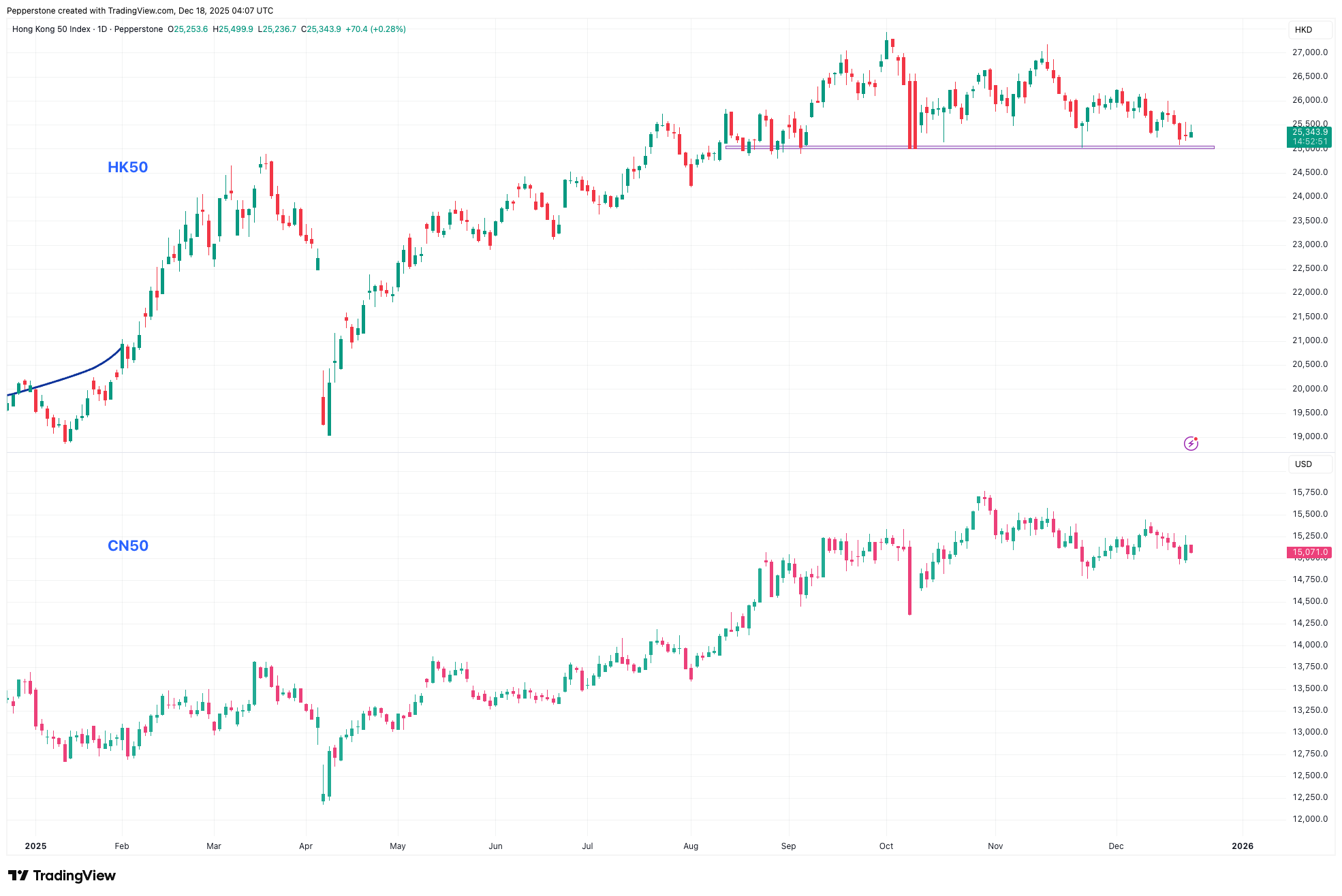
The market’s upward momentum has mainly been concentrated in technology-related sectors. The explosive growth of the AI industry, combined with improved policy expectations, has driven Chinese risk assets higher. However, weak domestic demand, ongoing softness in the property sector, and lingering price pressures mean that fundamental improvements remain uneven.
Looking ahead to 2026, traders face key questions: How will authorities prioritize policy focus? Which sectors might receive resource allocation? And how should one approach trading China?
2025 Economic Characteristics: Resilience Amid Imbalances
In retrospect, China’s growth in 2025 did not stall, but it clearly relied on a few key sectors to maintain balance.
GDP grew roughly 5.2% year-on-year in the first three quarters, with the full-year 5% growth target likely achieved. In an environment of softening global demand and frequent external shocks, this reflects the economy’s capacity to withstand disruptions. Exports continued to play a pivotal role, with high-end manufacturing and technology-related products maintaining resilience and acting as core drivers of overall growth.
However, policy stimulus showed limited marginal impact. Despite continued expansion of broad money supply and a fiscal deficit increase from 3% to 4%, funds largely remained within the financial system, failing to translate effectively into sustained consumer spending and corporate investment.
Consumer activity was particularly weak. Even with support from CNY 300 billion in ultra-long-term special government bonds and trade-in policies, household consumption growth slowed, while savings rates remained high, reflecting insufficient recovery in income expectations and confidence. Weak demand was also visible in prices, with CPI staying low and PPI remaining negative for months, leaving deflationary pressures largely unresolved.
Corporate sectors were similarly under pressure. Profit margins continued to shrink, especially in manufacturing and small-to-medium enterprises, and emerging industries were not yet enough to offset declines in traditional sectors. Investment appetite weakened, with slower fixed asset investment, particularly in real estate, extending inventory cycles and pressuring capital returns.
Overall, China’s 2025 growth relied on export resilience and proactive fiscal measures, while weak domestic demand, declining investment, and deflationary pressures were not fully resolved. Growth depended more on the combination of “external demand support + fiscal backing” than on a broad recovery of domestic momentum.
2026 Policy Logic: Domestic Demand at the Core
The Central Economic Work Conference at the end of 2025 clarified that 2026 policies will focus on domestic demand to create a full economic policy loop.
Compared with 2025’s neutral stance emphasizing alignment with economic trends, the 2026 guidance is more proactive, stressing that “promoting stable economic growth and reasonable price recovery” will be an important consideration for monetary policy. This signals that the central bank will no longer merely follow the economic rhythm but will actively use liquidity management and interest rate tools to stimulate growth.
Asset policies in 2026 aim to support both markets and prices, especially in real estate, with clear guidance to purchase existing housing for affordable housing purposes to prevent uncontrolled price declines. Investment strategies will be more precise, with central budget investment and special bonds prioritized for high-quality projects, leveraging state guidance to attract private capital.
Moreover, the “involution” phenomenon has been evident in recent years, with aggressive price wars eroding corporate profits. Industrial policy in 2026 emphasizes reducing unnecessary competition and improving corporate profitability. This not only protects businesses but also supports wage and household income growth, directly linked to domestic demand recovery.
The ultimate goal of the policy loop is income distribution. Authorities plan to implement urban and rural household income enhancement programs to ensure that monetary, asset, and industrial policies translate into real consumer spending, completing the policy cycle.
Under this logic, the government is clear: it will not rely solely on monetary easing or short-term fiscal stimulus but will create a sustainable cycle of money, assets, industry, and income.
External Environment and Structural Constraints: Risks Remain
Despite clear policy objectives, implementation faces multiple challenges.
Globally, 2026 is expected to continue a pattern of “weak recovery and high divergence.” Slower growth in developed economies and uneven recovery in emerging markets may limit China’s external support. As interest rate cuts approach an end, divergent global monetary policies could trigger RMB volatility and affect cross-border capital flows.
Trade uncertainty persists. Even if temporary US-China agreements hold, tariff policies may still fluctuate, impacting export growth. Expansion into non-US markets may face protectionist pressures from the EU, India, Brazil, and others. Any further tariff escalation would pressure exports, making the 5% GDP target harder to achieve.
Domestic structural constraints are also evident. Local governments face limited fiscal space, declining land sale revenues, and slower fixed asset investment. High household savings and weak consumption create self-reinforcing demand gaps, with deflationary pressures still present. Credit growth may remain restrained by bank spreads and exchange rate stability.
Thus, while policy loops can smooth economic operations, they are unlikely to fully eliminate these constraints in the short term.
Trading China in 2026: Selective Opportunities Over Broad Bull Markets
Overall, the core policy goal in 2026 remains stable growth and domestic demand support, while continuing to back technology development. Under the combined influence of policies, structural opportunities, and external risks, China’s market is expected to be “selective and differentiated” rather than a broad bull market.
Traders can focus on sector allocation. Traditional industries such as real estate and heavy industries remain under pressure, with recovery dependent on policy support. Steel and solar sectors may benefit from anti-involution policies, improving concentration and profitability, but still face short-term capacity adjustments and slower investment growth.
By contrast, emerging technology, high-end manufacturing, and new energy sectors benefit from policy guidance, with clear potential for profit improvement—especially AI, industrial robots, and electric vehicles. China’s position in global supply chains remains strong, with AI server and semiconductor material exports expected to grow over 40%, and EV global market share continuing to expand.
In the 15th Five-Year Plan, “technology” appears 46 times, reflecting authorities’ emphasis on boosting original innovation and core technological breakthroughs. Policy support may channel capital from high-valued US stocks into selected Chinese assets. Nevertheless, despite potential upside in tech, achieving broad-based gains remains challenging.
Against this backdrop, Hong Kong and Mainland stocks may perform differently. Hong Kong equities are sensitive to overseas capital flows and RMB fluctuations, with volatility likely higher, though high-dividend, export-oriented defensive stocks remain attractive. CN50 and other indices benefit from policy guidance and sector momentum but may follow the pace of policy implementation and corporate profit improvements.
Consumer sector opportunities are also selective, with high-end consumption and subsidized lower-end consumption showing potential. Monitoring policy execution and household income growth is key. By tracking external capital flows and policy rhythms, market participants may capture tactical gains.
In short, China’s 2026 market is expected to be a policy-driven “selective market,” where traders focusing on strong sectors can maintain an edge amid volatility.
The material provided here has not been prepared in accordance with legal requirements designed to promote the independence of investment research and as such is considered to be a marketing communication. Whilst it is not subject to any prohibition on dealing ahead of the dissemination of investment research we will not seek to take any advantage before providing it to our clients.
Pepperstone doesn’t represent that the material provided here is accurate, current or complete, and therefore shouldn’t be relied upon as such. The information, whether from a third party or not, isn’t to be considered as a recommendation; or an offer to buy or sell; or the solicitation of an offer to buy or sell any security, financial product or instrument; or to participate in any particular trading strategy. It does not take into account readers’ financial situation or investment objectives. We advise any readers of this content to seek their own advice. Without the approval of Pepperstone, reproduction or redistribution of this information isn’t permitted.