- English
- عربي


Gold Outlook: Geopolitics and Rate Expectations Drive Price Action, $4,660 as Key Pivot
.jpg?height=93&quality=100)
Over the past week, gold surged before pulling back, leaving the market without a clear directional trend.
Persistent geopolitical tensions have kept energy prices elevated, pushing up inflation expectations. At the same time, strong U.S. nonfarm payrolls have reinforced the market’s pricing for the Fed to delay rate cut discussions. Together, these factors have limited gold’s upside.
However, as geopolitical tensions begin to impact the real economy, the market’s demand for a safe haven amid potential recession scenarios continues to support gold, limiting the extent of any pullback.
This week, traders will focus on developments in the Middle East, while the FOMC minutes and March CPI data may act as key catalysts influencing rate expectations and providing signals for gold’s short-term direction.
Technical Observation: Gold’s Direction Remains Unclear, $4,660 as a Short-Term Pivot
Looking at the XAUUSD daily chart, gold climbed for four consecutive days, briefly breaking above $4,800, before pulling back to retest key support.
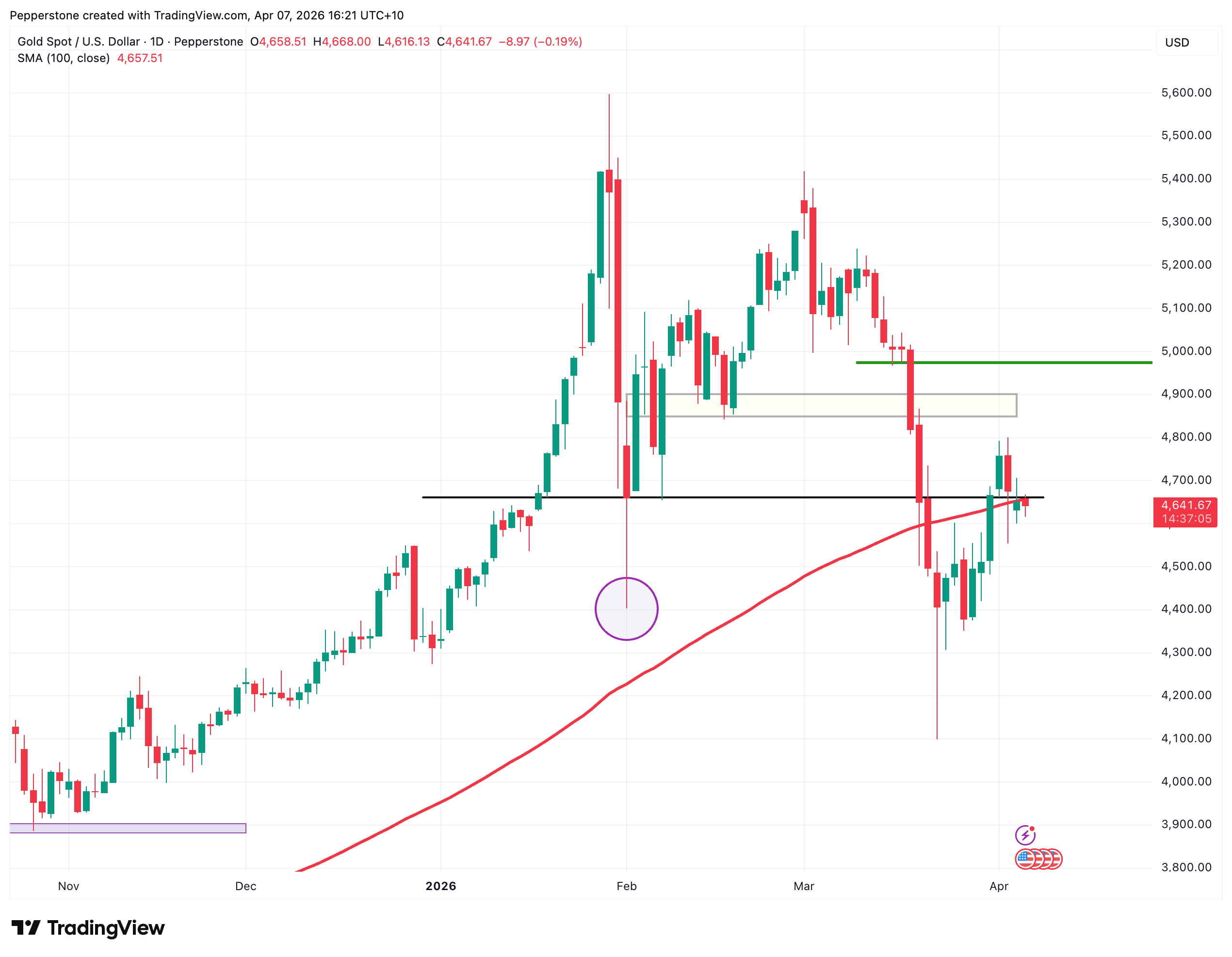
On Tuesday, prices hovered around $4,660 (the 100-day moving average), making this level a focal point for short-term bullish and bearish positioning.
If prices hold above this level, bullish momentum could continue, with upside targets near $4,800 and the $4,850–$4,900 range. Conversely, a breakdown below $4,660 could pave the way toward $4,550 or even $4,380.
Rising Inflation and Hawkish Rate Path Pressure Gold Bulls
The main factor currently influencing gold remains the transmission of geopolitical developments into inflation expectations.
With the “ultimatum” approaching, U.S.-Iran divisions remain pronounced. Trump continues a strategy of “negotiating while applying pressure,” signaling potential progress while threatening strikes on Iranian energy facilities to ensure the reopening of the Strait of Hormuz.
Iran has rejected the U.S. ceasefire proposal, demanding sanctions relief, security guarantees, and transit fees for the Strait, signaling a hardline stance. Negotiations remain deadlocked, and no substantive breakthrough is expected in the near term.
In the absence of a resolution, energy prices remain prone to upward pressure, and inflation risks continue to build, as reflected in the data. While the U.S. ISM services index softened slightly in March, the prices-paid component rose sharply, hitting the highest level since October 2022, showing clear cost pressures.
Meanwhile, the U.S. labor market remains robust. March nonfarm payrolls rose by 178,000, well above the 60,000 forecast, with the unemployment rate falling slightly to 4.3%. With inflation risks and employment resilience coexisting, market expectations for rate cuts within the year have eased significantly.
As a non-yielding asset, gold’s relative appeal has declined. Combined with short-term safe-haven flows favoring the USD and Treasuries, this has further constrained gold’s upward momentum.
Economic Shocks Unfold, Safe-Haven Case Remains Intact
As geopolitical tensions continue to escalate, the market’s focus is gradually shifting from “news-driven” to “real economic impact.” If high energy prices significantly weigh on economic growth or trigger a recession, gold’s safe-haven role could reassert itself, supporting prices on pullbacks.
At the same time, the recent improvement in U.S. employment data is not entirely robust. The March payroll rebound was largely driven by the end of strikes and seasonal adjustments, while February data was revised lower, indicating structural weakness in the labor market.
From a longer-term perspective, gold’s core support logic remains unchanged — central banks continue to purchase gold, the de-dollarization trend persists, and geopolitical risk remains a structural factor. Price corrections are therefore more likely to be temporary pullbacks, with support at lower levels still intact.
Focus on Geopolitical Tensions and Key Data
Overall, gold experienced a dip before rebounding last week, remaining in a trading range. Geopolitical tensions have boosted inflation expectations, reinforcing a hawkish Fed path and pressuring gold prices.
Meanwhile, pricing in economic slowdown or recession, along with medium- and long-term structural support, provides a floor. Amid this tug-of-war between inflation and safe-haven demand, gold is likely to remain range-bound in the short term.
Looking ahead to this week, a cluster of risk events could amplify market volatility.
Geopolitically, the “final ultimatum” deadline is approaching (10 a.m. AEST Wednesday), with significant uncertainty over the outcome. If the conflict persists or escalates, energy prices may rise further, reinforcing a hawkish rate path and pressuring gold. Conversely, any progress in negotiations could ease supply concerns and inflation pressures, potentially stabilizing market volatility and providing temporary support for gold.
On the macro side, the Fed minutes and March CPI will be another focal point. If the minutes signal “no rush to cut rates,” combined with rising inflation (market expectations of overall CPI at 3.4%, core at 2.7%), the Fed’s wait-and-see stance may be further reinforced, limiting gold’s upside.
The market remains highly uncertain, with fragile sentiment and price sensitivity to news flow. For traders, monitoring price reactions to key events and maintaining risk management is more critical than taking aggressive directional bets.
The material provided here has not been prepared in accordance with legal requirements designed to promote the independence of investment research and as such is considered to be a marketing communication. Whilst it is not subject to any prohibition on dealing ahead of the dissemination of investment research we will not seek to take any advantage before providing it to our clients.
Pepperstone doesn’t represent that the material provided here is accurate, current or complete, and therefore shouldn’t be relied upon as such. The information, whether from a third party or not, isn’t to be considered as a recommendation; or an offer to buy or sell; or the solicitation of an offer to buy or sell any security, financial product or instrument; or to participate in any particular trading strategy. It does not take into account readers’ financial situation or investment objectives. We advise any readers of this content to seek their own advice. Without the approval of Pepperstone, reproduction or redistribution of this information isn’t permitted.