- English
- عربي


Gold Outlook: Bulls Break $5,100 as Tariffs and Geopolitical Risks Continue to Drive
.jpg?height=93&quality=100)
Gold showed a clear uptrend last week, successfully breaking the key $5,100 resistance and establishing a solid short-term bullish structure. The combination of repeated tariff concerns and rising geopolitical tensions has been the main driver behind this move. How these factors unfold in the coming days will be crucial for determining whether buying momentum can sustain.
Technical Observation: Gold Breaks $5,100, Bullish Structure Strengthens
On the XAUUSD daily chart, gold has posted gains for three consecutive sessions. Last Friday, prices rose nearly 2.2%, closing above $5,100 once again. This indicates that the previous key resistance has now become a short-term support, opening up further upside potential.
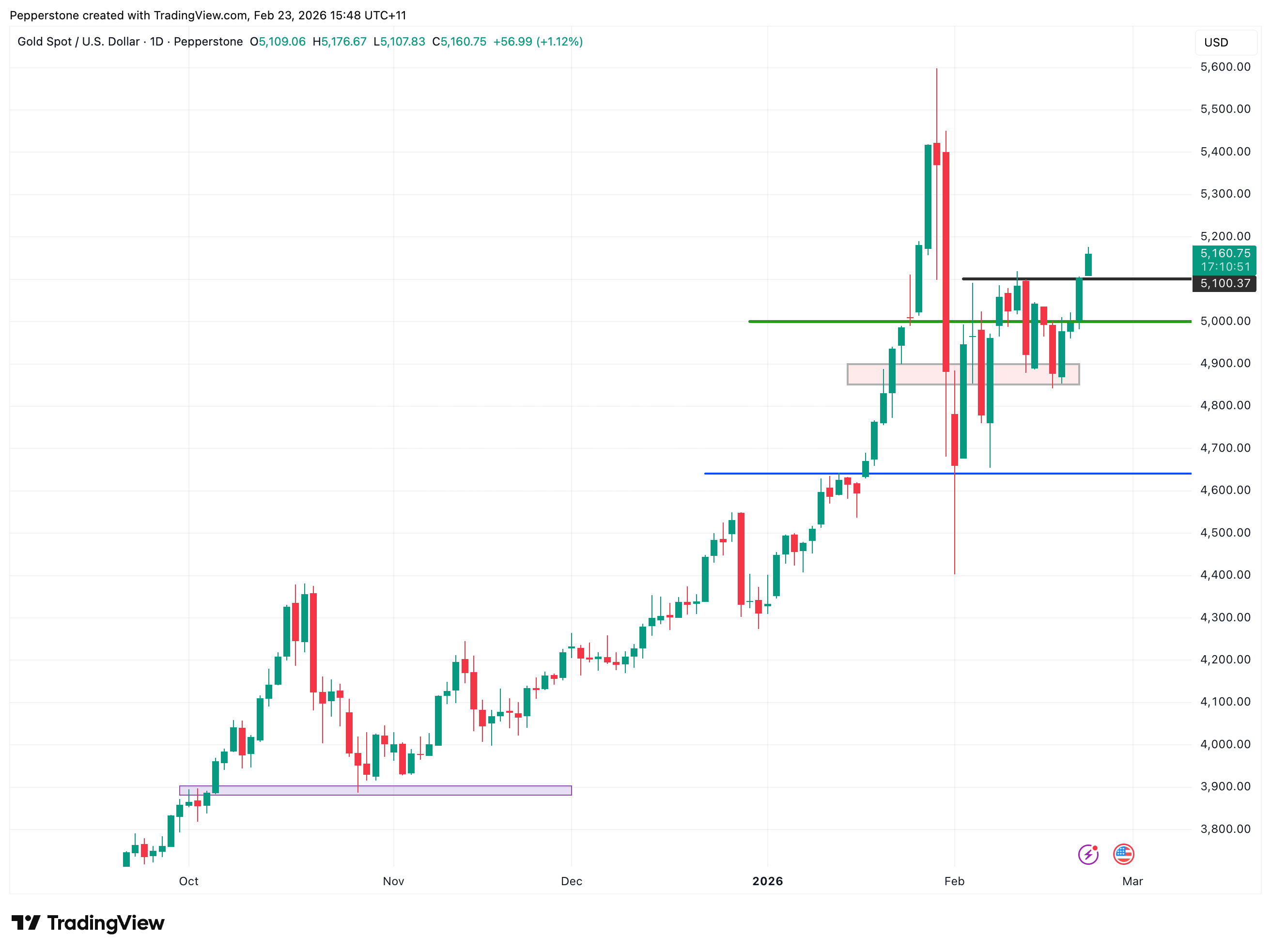
Currently, gold is trading above $5,150. If buying pressure persists, resistance may be encountered near $5,200. On the downside, $5,100 and $5,000 are critical support levels.
Overall, the bullish advantage is clear, though traders should remain alert to short-term volatility.
Tariffs and Geopolitical Risks: Core Drivers of the Rally
The primary catalyst for gold’s recent surge has been the increased uncertainty surrounding U.S. tariff policy and the potential escalation in U.S.–Iran relations.
Although the U.S. Supreme Court ruled on Friday that Trump’s tariffs were invalid, causing gold to briefly dip below $5,000, policy in practice remains largely unchanged.
Trump quickly invoked Section 122 of the 1974 Trade Act, raising the global 10% tariff closer to the 15% “agreement rate” applied to multiple countries. Meanwhile, tariffs under Sections 232, 201, and 301 remain in effect, keeping the overall level largely intact.
The market recognized that this is not a reset of trade rules but a shift in legal implementation. Coupled with ongoing uncertainties regarding substantial tariff refunds under the IEEPA framework, the opaque policy outlook has reinforced gold buying.
Geopolitically, the U.S. continues to pressure Iran while strengthening military deployments in the Middle East. Trump has mentioned a “limited strike” option, and markets have priced in a higher probability of a direct confrontation, further highlighting gold’s safe-haven appeal.
Amid these overlapping tariff and geopolitical risks, gold effectively serves as a direct vehicle for uncertainty premiums.
U.S. “Stagflation” Concerns Remain Secondary
Beyond tariffs and geopolitical tensions, some traders have attributed gold’s gains to concerns over U.S. “stagflation.” However, I think U.S. GDP and PCE data are unlikely to drive gold in the near term and should be viewed more as market noise than bullish signals.
Specifically, Q4 U.S. GDP growth slowed to 1.4% annualized, well below expectations and the prior quarter, but this largely reflects a one-off drag from government shutdown-related spending cuts. Meanwhile, December core PCE inflation came in at 3%, but as an outdated indicator, it offers limited forward-looking insight.
Consequently, these figures have not altered market expectations for the Fed’s rate path. Short-term gold movements remain driven largely by tariff developments and geopolitical headlines rather than economic data or interest-rate signals.
Looking Ahead: Tariffs and Geopolitics Remain Key
Overall, gold bulls strengthened last week, driven mainly by persistent tariff uncertainty and rising geopolitical tensions. In a volatile market environment, buying on dips remains a commonly favored approach, though traders should manage positions carefully rather than heavily betting on directional moves.
For the rest of the week, aside from monitoring Fed speeches for clues on the rate cut path, the focus remains on developments in tariffs and geopolitical tensions.
Under Section 122, tariffs are set for a 150-day period with a maximum rate of 15%, and extending them requires Congressional approval. Given lawmakers’ cautious stance, an extension seems unlikely.
As a result, Trump may accelerate 301 and 232 reviews, which have no fixed duration or rate cap, to reinstate tariffs on select countries and products. New tariff developments could emerge irregularly, each potentially serving as a fresh catalyst for gold.
Geopolitically, considering the midterm election backdrop, the likelihood of a full-scale U.S.–Iran conflict remains relatively low. Nevertheless, until a clear de-escalation emerges from negotiations, tensions continue to support gold. Should progress be made in talks, gold prices could face notable downward pressure.
The material provided here has not been prepared in accordance with legal requirements designed to promote the independence of investment research and as such is considered to be a marketing communication. Whilst it is not subject to any prohibition on dealing ahead of the dissemination of investment research we will not seek to take any advantage before providing it to our clients.
Pepperstone doesn’t represent that the material provided here is accurate, current or complete, and therefore shouldn’t be relied upon as such. The information, whether from a third party or not, isn’t to be considered as a recommendation; or an offer to buy or sell; or the solicitation of an offer to buy or sell any security, financial product or instrument; or to participate in any particular trading strategy. It does not take into account readers’ financial situation or investment objectives. We advise any readers of this content to seek their own advice. Without the approval of Pepperstone, reproduction or redistribution of this information isn’t permitted.