- English
- عربي


Bitcoin Falls Below $60K: Buyers Step Back — Three Variables to Watch
.jpg?height=93&quality=100)
On June 24, Bitcoin broke below $60,000 for the third time this year, touching its lowest level since October 2024. From its all-time high of nearly $126,000 last October, the price has shed roughly half its value in just eight months.
While traders continue to search for the proximate cause of the selloff, the more pressing question is whether $60,000 marks a floor for a potential rebound — or merely a waystation on the way lower. What factors might shape Bitcoin's next move?
A Hawkish Fed Turns Up the Headwinds
Pinning this decline on any single event would be an oversimplification. More accurately, a deteriorating macro backdrop and weakening capital flows within the crypto market have converged to drive Bitcoin's retreat.
From a macro standpoint, Bitcoin currently lacks a clear bullish catalyst. One notable data point: the 10-day rolling correlation between gold and Bitcoin has risen to its highest level in nearly two years. This suggests that the same macro forces dragging gold below $4,000 may be exerting similar pressure on Bitcoin.
.png)
The Fed's hawkish shift is the central driver. Despite some easing of geopolitical tensions, sticky inflation has prompted markets to reassess the path of interest rates. The latest dot plot showed nine of eighteen Fed officials projecting at least one rate hike before year-end — a stark reversal from March, when most officials were still penciling in cuts.
Higher rates raise the opportunity cost of holding non-yielding assets, dealing an ironic blow to Bitcoin's "digital gold" narrative. A US dollar index at a 13-month high adds further headwinds for the dollar-denominated asset.
Strategy Trims Its Holdings; ETF Outflows Continue
Beyond the macro picture, the reliability of institutional buying is being reassessed.
Strategy, the world's largest corporate Bitcoin holder, has long anchored market confidence through its founder Michael Saylor's public commitment to never sell. The company has continuously issued equity and preferred securities to fund Bitcoin purchases, effectively serving as the market's buyer of last resort.
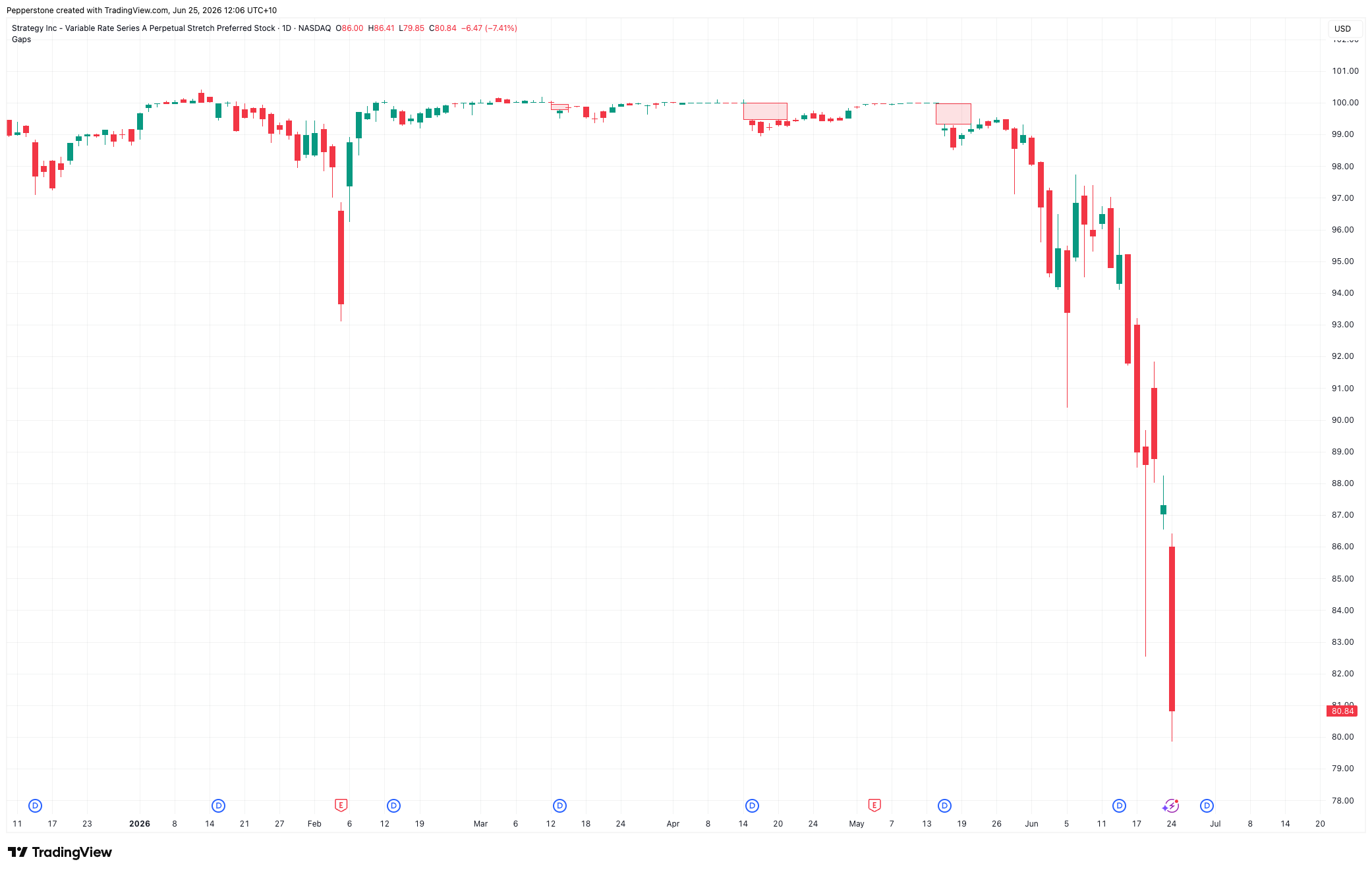
In late May, however, Strategy made a rare and public sale of Bitcoin. The size was negligible in absolute terms, but it was enough to crack a promise that had been repeated many times over. Its preferred shares, STRC, subsequently fell to an all-time low intraday on Wednesday. The market has begun to question the sustainability of this financing model.
A critical question now hangs over the market: as external financing costs rise, can Strategy maintain its historical pace of Bitcoin accumulation? And if that marginal buying slows, who steps in to fill the structural demand gap?
Capital reallocation is also underway across the broader investor base. In previous downturns, retail traders served as an important source of marginal buying. Today, that capital appears to be chasing higher-momentum opportunities — AI-related assets, hot IPOs, and prediction markets.
The data tells the story clearly. Since its April launch, the Roundhill Memory ETF (DRAM) has seen net inflows exceeding $17.4 billion. Spot Bitcoin ETFs, by contrast, are on track to record a seventh consecutive week of net outflows, with cumulative redemptions of approximately $5 billion since May. Total assets under management have declined from a peak of roughly $113 billion to around $77.5 billion.
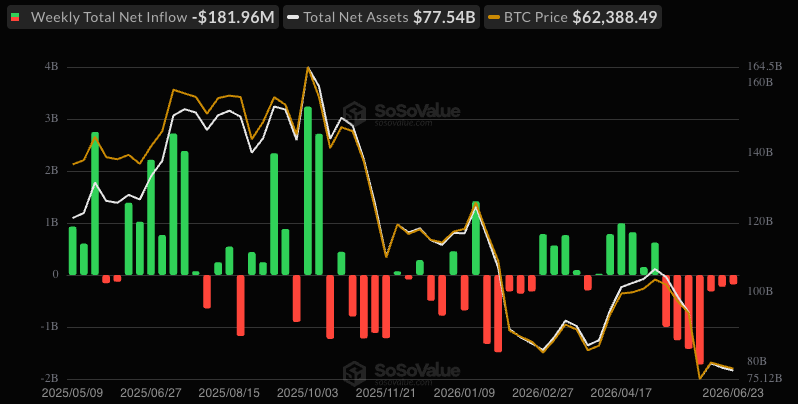
Weakness in Bitcoin ETF flows reflects not only capital reallocation, but also the weight of overhead supply from investors who bought at higher prices. Against this backdrop, concentrated leveraged positions are amplifying every breakdown. Dense clusters of long liquidation orders sit near $60,000 — once triggered, they risk setting off a cascade of forced selling that deepens the move.
Approximately $800 million in long positions were liquidated across the market in the past 24 hours. With roughly $10 billion in Bitcoin options set to expire on Friday, the window for a natural stabilization may narrow further.
$60,000: Rebound Support or the Next Leg Down?
The market has now broken below $60,000 three times this year. Each breach has meant another round of leveraged liquidations and a reset of psychological support levels. The technical picture remains unfavorable.
The Crypto Fear & Greed Index stands at just 12, deep in "Extreme Fear" territory — a condition that has persisted for weeks rather than emerging as a one-off sentiment shock. The daily RSI has yet to enter oversold territory, but momentum is clearly skewed to the downside.
The 200-week moving average — a closely watched long-term reference — sits near $62,400, and Bitcoin is now trading below it, a warning signal that has historically demanded attention.
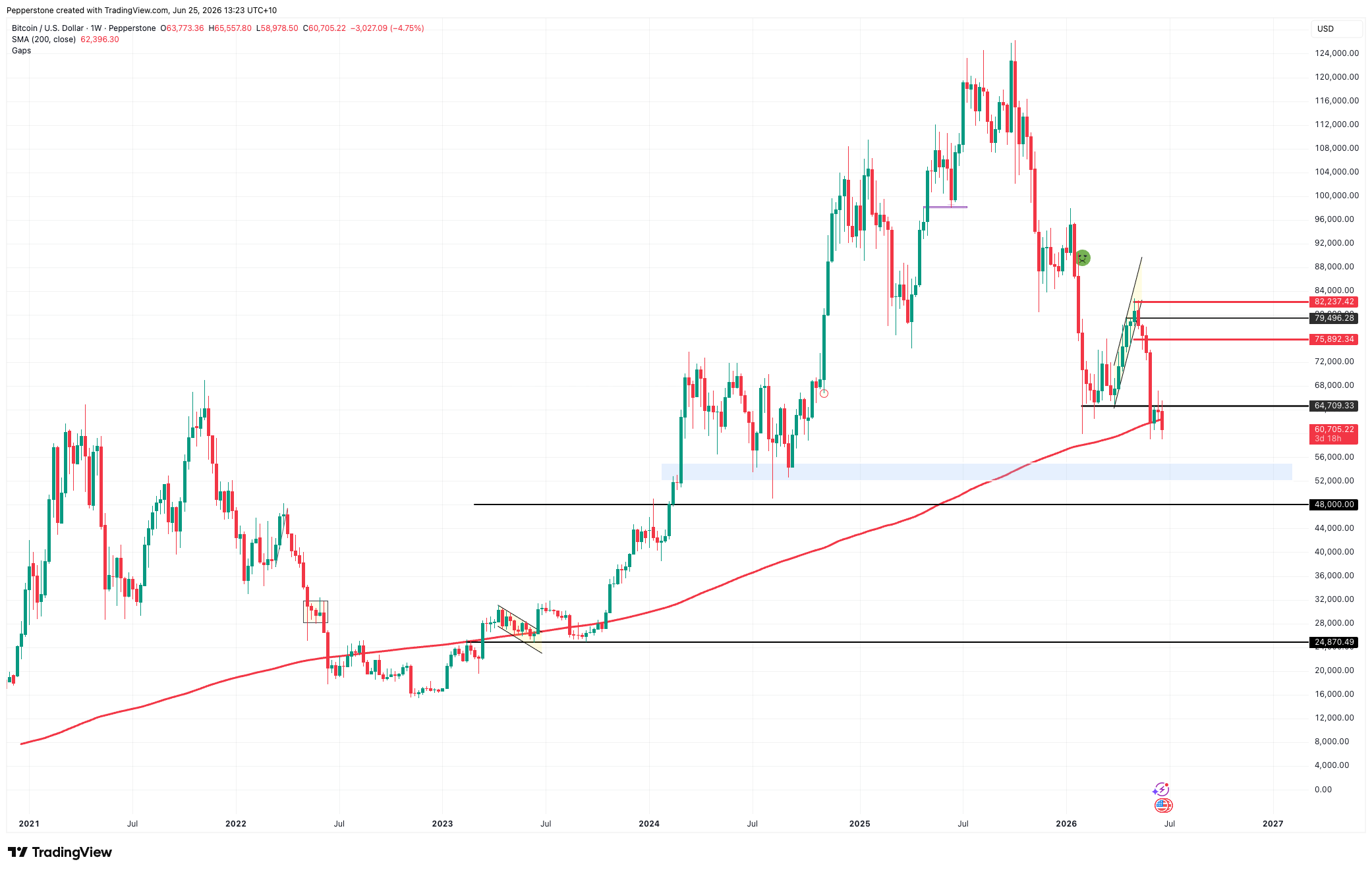
Should Bitcoin fail to reclaim $60,000 on a weekly closing basis, the next area of technical reference lies in the $52,000–$55,000 range, with a more extreme scenario potentially testing the $48,000 zone. Rebuilding a bullish market structure would require a high-volume reclaim of the $64,700–$65,000 area at minimum.
That said, as institutional investors account for a growing share of the market, their tendency toward orderly position adjustment rather than panic-driven liquidation provides some degree of downside cushion — and may contribute to a gradual reduction in Bitcoin's overall volatility.
Three Variables That Could Shift the Outlook
Taken together, Bitcoin breaking below $60,000 is both a technical breakdown and a narrative reassessment. It challenges not just a price level, but the durability of the institutional case for holding Bitcoin in a high-rate environment where capital is actively rotating into AI-driven assets.
In the near term, three variables may determine whether Bitcoin can stabilize or reverse:
First, oil prices and inflation expectations. The US-Iran situation continues to ease, and Brent crude has fallen roughly 40% from its late-April highs. If energy prices weaken further and pull US inflation and real rates lower with them, the Fed's policy constraints could ease at the margin — creating a more favorable macro environment for liquidity-sensitive assets.
Second, the direction of capital flows. If Strategy continues to demonstrate both the willingness and capacity to act as Bitcoin's buyer of last resort, a marginal improvement in ETF flows could serve as a leading indicator of a market turn. Conversely, if Strategy's financing model fails to hold up under scrutiny, it could trigger a fresh round of repricing across Bitcoin's supply-demand structure.
Third, the CLARITY Act's legislative window. As the key market structure bill that would provide a clear regulatory framework for crypto assets, the pace of its progress before Congress breaks for summer recess will directly influence institutional appetite. A missed window and a delay until autumn would deal a marginal blow to institutional confidence. Meaningful legislative progress, on the other hand, would lay the groundwork for renewed institutional capital formation.
Until these variables show clear directional movement, defining risk parameters and managing position size remain the most important decisions a trader can make.
The material provided here has not been prepared in accordance with legal requirements designed to promote the independence of investment research and as such is considered to be a marketing communication. Whilst it is not subject to any prohibition on dealing ahead of the dissemination of investment research we will not seek to take any advantage before providing it to our clients.
Pepperstone doesn’t represent that the material provided here is accurate, current or complete, and therefore shouldn’t be relied upon as such. The information, whether from a third party or not, isn’t to be considered as a recommendation; or an offer to buy or sell; or the solicitation of an offer to buy or sell any security, financial product or instrument; or to participate in any particular trading strategy. It does not take into account readers’ financial situation or investment objectives. We advise any readers of this content to seek their own advice. Without the approval of Pepperstone, reproduction or redistribution of this information isn’t permitted.