- English
- Italiano
- Español
- Français


US Midterms 2026: What the Election Means for Bitcoin, Crypto and Tokenised Markets

Bitcoin remains a macro trade, while altcoins are a regulation and innovation trade
Investors shouldn't assume a favourable regulatory outcome automatically translates into higher Bitcoin prices.
BTCUSD increasingly trades as both a scarcity asset, often described as digital gold, and a high-beta expression of global liquidity and risk appetite. Moves in the NAS100, US Treasury yields and the US dollar could easily overwhelm election-related optimism.
Altcoins are a different proposition. Ethereum, Solana and DeFi tokens are more sensitive to regulatory decisions governing token classification, staking, institutional access and decentralised trading. One can also add the favourable tailwinds from the rapid rise in tokenised markets, and perpetual futures.
Greater regulatory clarity could encourage capital flows into these markets, while tighter restrictions could disproportionately weigh on smaller, more speculative tokens.
The CLARITY Act: Why congressional control matters
The CLARITY Act's failure to advance through the Senate in September exposed the political divisions surrounding digital-asset regulation.
The legislation sought to clarify SEC and CFTC responsibilities, potentially reducing uncertainty for exchanges, DeFi platforms and institutional investors.
Republican control of Congress could revive negotiations, while Democratic gains could bring greater emphasis on consumer protection, market integrity, illicit finance and oversight of crypto-related conflicts of interest.
But neither outcome guarantees legislation.
Even unified Republican control would face Senate procedural hurdles, with most legislation requiring 60 votes to overcome a filibuster. Democratic control would not automatically prevent bipartisan reform.
The critical distinction is between legislation that delivers lasting regulatory certainty and agency-led initiatives that future administrations could potentially reverse.
The regulators are driving the next phase of adoption
For me, the most compelling opportunity isn't simply whether crypto rallies after election night.
It's the structural transformation of financial markets through blockchain infrastructure, faster settlement, improved collateral mobility and potentially 24/7 trading.
The SEC's tokenisation initiatives and CFTC work on digital-asset derivatives are progressing despite the congressional setback, with implications extending well beyond cryptocurrencies:
- - Tokenised real-world assets (RWAs), particularly equities: Faster settlement, more efficient ownership transfers and improved collateral mobility.
- - Perpetual futures: Continuous exposure to traditional and digital assets without conventional contract expiries.
- - Stablecoins: Faster movement of capital across trading venues, payment systems and settlement networks.
- - Decentralised finance (DeFi): Greater integration between traditional markets and on-chain liquidity, trading and lending.
This is crypto adoption in a fundamentally different form. Not necessarily as an investment asset, but as the infrastructure powering the next evolution of financial markets.
Investors may increasingly trade, transfer ownership and settle transactions through blockchain networks without consciously choosing to own Ethereum, Solana or another cryptocurrency.
Major banks and custodians are also developing private blockchain infrastructure, meaning greater tokenisation doesn't automatically translate into higher demand for ETH or SOL.
Political changes could influence the pace of approvals and introduce additional safeguards. But I doubt they reverse the commercial incentives driving this transformation.
For investors, the bigger question is which blockchain networks ultimately capture the transaction activity, fees and economic value.
Three US midterm election scenarios for crypto traders
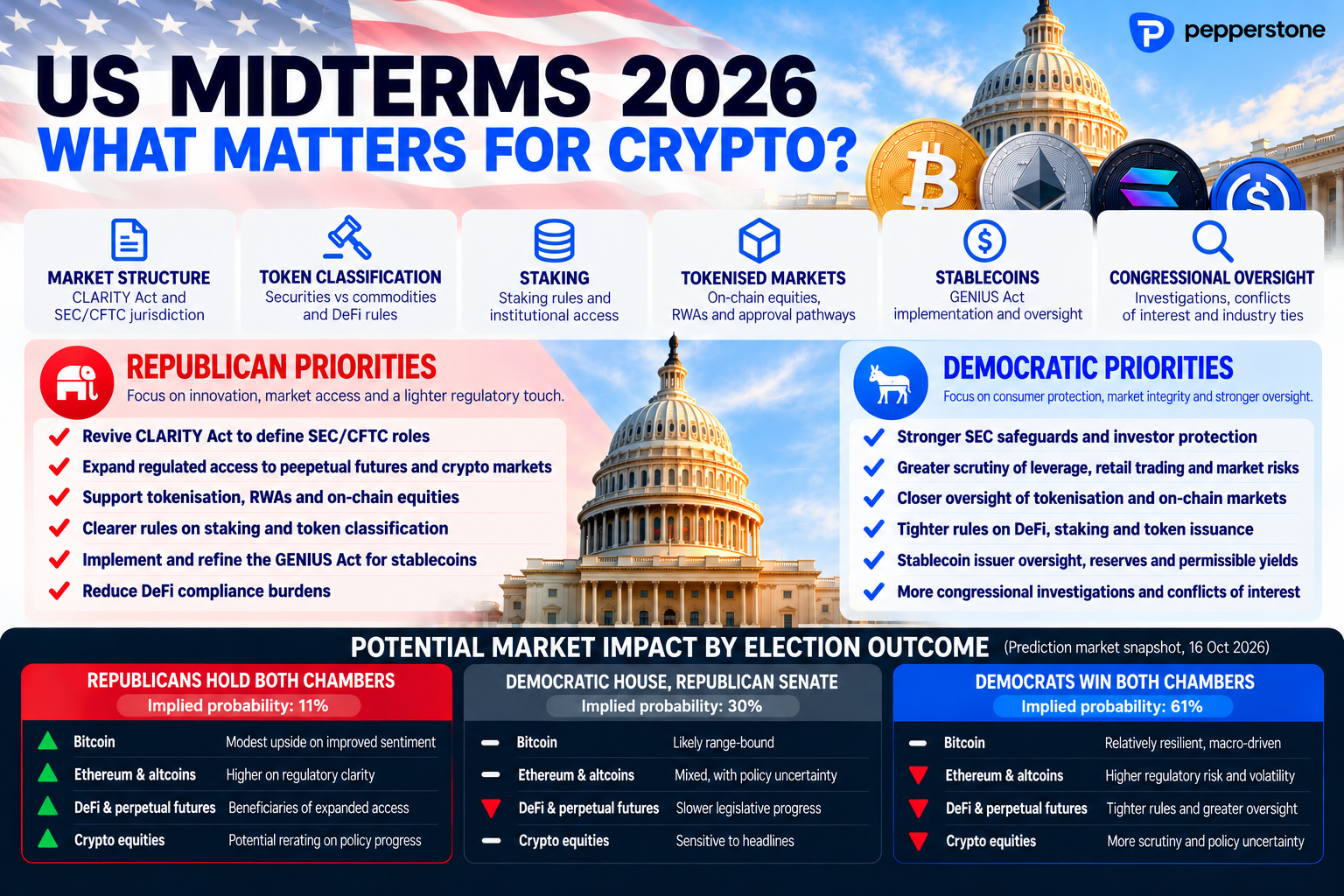
The following probabilities are indicative prediction-market snapshots, not election forecasts.
- Democrats win both chambers (60% implied): Greater uncertainty around market-structure legislation could weigh more heavily on regulatory-sensitive altcoins, DeFi and crypto equities than on Bitcoin. Existing agency initiatives would not automatically disappear.
- Democratic House, Republican Senate (29% implied): Legislative progress could slow, with greater oversight and scrutiny. If broadly anticipated, the immediate market reaction may be relatively contained.
- Republicans retain both chambers (10% implied): Renewed expectations for market-structure legislation could support ETH, SOL, DeFi tokens and crypto-linked equities. An unexpected result could trigger an aggressive initial rally.
Bitcoin and Ether may prove relatively resilient given their more established regulatory treatment, while smaller tokens face greater uncertainty around classification and institutional access.
The bottom line: Trade the price action, not the politics
The crypto industry has invested heavily in bipartisan political support, recognising that durable legislation requires cooperation across Washington.
For traders, positioning could be the immediate catalyst. Crowded leverage, elevated funding rates and concentrated open interest can turn modest political surprises into aggressive liquidations.
The scale of the congressional majority matters. So does the gap between expectations and reality.
The election may determine how quickly crypto regulation evolves and which digital assets attract capital. It is far less likely to determine whether financial markets continue moving on-chain.
The material provided here has not been prepared in accordance with legal requirements designed to promote the independence of investment research and as such is considered to be a marketing communication. Whilst it is not subject to any prohibition on dealing ahead of the dissemination of investment research we will not seek to take any advantage before providing it to our clients.
Pepperstone doesn’t represent that the material provided here is accurate, current or complete, and therefore shouldn’t be relied upon as such. The information, whether from a third party or not, isn’t to be considered as a recommendation; or an offer to buy or sell; or the solicitation of an offer to buy or sell any security, financial product or instrument; or to participate in any particular trading strategy. It does not take into account readers’ financial situation or investment objectives. We advise any readers of this content to seek their own advice. Without the approval of Pepperstone, reproduction or redistribution of this information isn’t permitted.