- English
- Italiano
- Español
- Français


Nikkei 225 Hits All-Time High: Can AI, Yen Weakness, and Earnings Sustain the Rally?
.jpg?height=93&quality=100)
This week, the Nikkei 225 broke through the 72,000 mark, repeatedly setting fresh all-time highs. What makes this rally particularly notable is that it is not unfolding during a period of monetary easing — it is happening against a backdrop of the Bank of Japan raising its policy rate to 1%, the highest level in 31 years, and the Fed maintaining a hawkish stance.
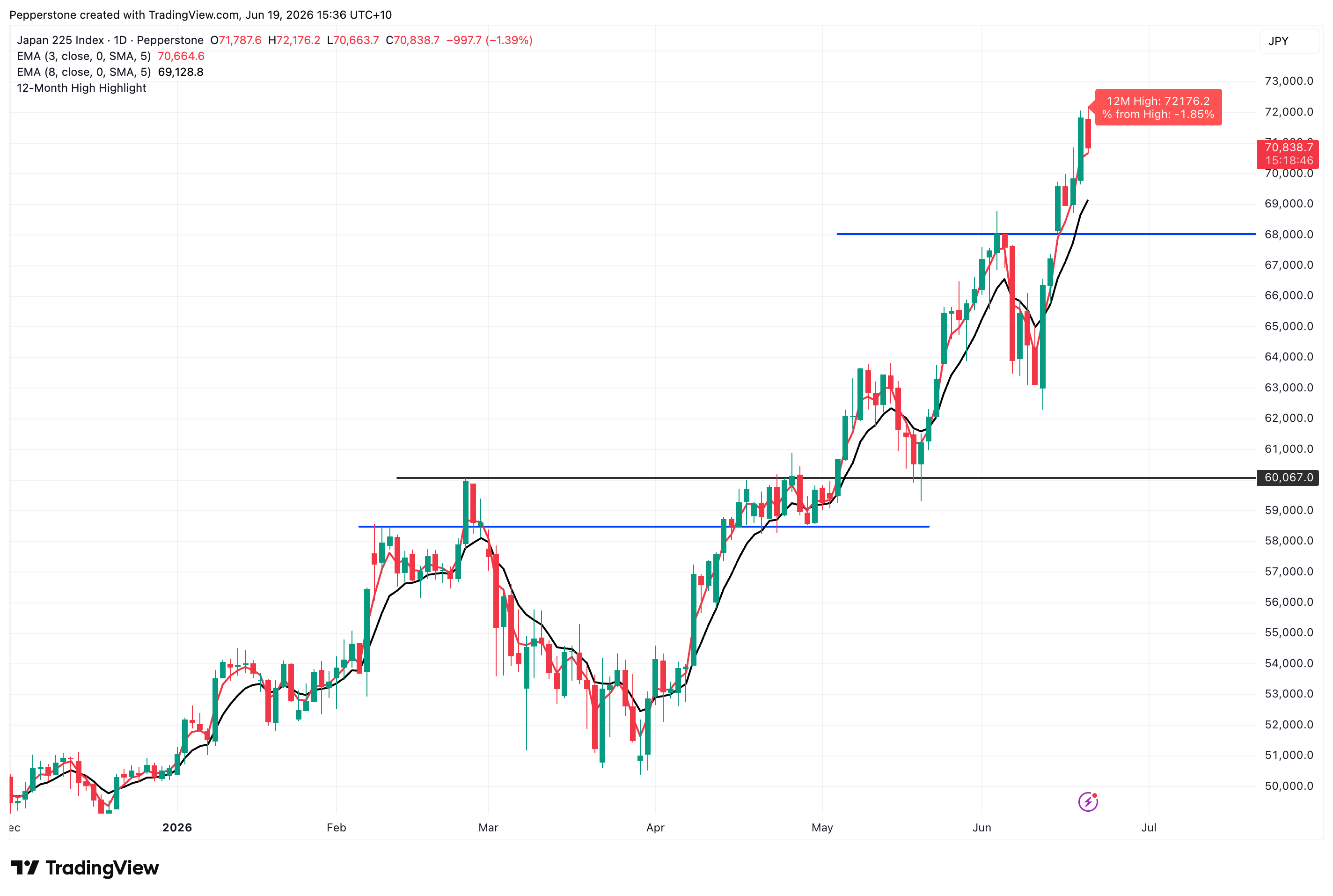
By conventional logic, rising interest rates tend to act as a headwind for risk assets. But the market's behavior makes a clear statement: trader focus has gradually shifted away from liquidity conditions and toward earnings capacity and structural opportunity.
For traders, all-time highs are worth acknowledging — but the more important questions are whether the thesis driving Japanese equities still holds, and what could derail this uptrend.
Three Forces Behind the All-Time High
Looking at the current market structure, this rally is not the product of any single factor. It reflects the convergence of several medium-to-long-term trends.
The first is the valuation re-rating driven by improved global risk appetite. The US–Iran agreement, alongside declining energy prices, has helped take some of the pressure off global inflation and growth concerns.
As an economy that is heavily dependent on energy imports, Japan's corporate sector is particularly sensitive to energy cost fluctuations. As cost pressures have eased, expectations for corporate earnings have improved in kind.
The second is the continued expansion of the AI and semiconductor cycle. Japan holds a globally competitive position in semiconductor equipment, precision manufacturing, and industrial automation — making it a meaningful beneficiary of the AI capex supercycle. Sustained capital flows into leading names within these sectors have been a meaningful driver behind the index's push to new highs.
The third is the profit amplification effect of a persistently weak yen. Despite the Bank of Japan's ongoing rate-hiking cycle, its current policy rate of 1% remains well below the Fed's 3.5%–3.75% range, leaving the interest rate differential between the two countries still firmly intact.
With USDJPY continuing to trade above 160, the weak yen keeps boosting the overseas earnings of Japanese exporters, providing clear tailwinds for automakers, industrial equipment manufacturers, and electronics producers.
Together, these three forces suggest that the current Nikkei rally looks more like an earnings-driven bull market than a liquidity-fueled valuation expansion. In the near term, the underlying thesis for higher prices remains intact — but the associated risks cannot be overlooked.
What Will Markets Trade Next?
If the past few months have largely been about trading the "good news" — declining geopolitical risk premiums, steady growth in AI capital expenditure, and a structurally weak yen — then what comes next requires close attention to three distinct risks.
First, markets will need to watch the actual pace at which the Strait of Hormuz returns to normal operations. While markets have already priced in the benefits of easing geopolitical tensions, "reopening" is not the same as an immediate return to supply chain normalcy. Tanker scheduling, port operations, insurance pricing, and capacity restoration all take time.
This means the optimism already baked into prices will need to be validated by tangible supply recovery. If that recovery falls short of expectations, some of the prevailing bullishness could unwind.
Second, central bank policy will remain a significant market variable. The Fed has recently sent clearer hawkish signals. If the dollar continues to strengthen and the global liquidity environment tightens, the room for further valuation expansion in risk assets may become constrained.
On the other hand, if the Bank of Japan accelerates its pace of rate hikes, yen carry trades could face unwinding pressure. If that kind of capital flow reversal materializes, the effects may extend well beyond Japanese equities to risk assets across Asia more broadly.
Third — and perhaps most worth watching — is corporate earnings. As the index continues to make new highs, markets will increasingly scrutinize whether earnings growth can keep pace with valuation expansion.
Within Japanese equities, the semiconductor and AI supply chain, export-oriented companies, and the financial sector will be the key areas to monitor. If global AI capex continues to grow, equipment makers and automation companies stand to keep benefiting.
If USDJPY stays elevated, the earnings advantage for exporters remains in place. And as Japan's monetary policy gradually tightens, improving net interest margins for banks and insurers may provide a new source of support for the financial sector.
The Thesis Holds — but the Verification Phase Has Begun
In summary, the Nikkei 225's all-time highs are not the product of any one driver — they reflect the combined effect of improving global risk appetite, the AI capex cycle, a weak yen environment, and ongoing corporate governance reform.
As long as the global AI investment wave continues, the Bank of Japan stays on a gradual normalization path, and the US economy avoids a significant recession, the long-term trend for Japanese equities is likely to remain constructive.
That said, as the index pushes to ever-higher ground, markets are gradually shifting from "trading expectations" to "trading confirmation." For traders, the Fed’s policy shifts, yen volatility, and whether corporate earnings actually deliver may well prove more consequential than the record highs themselves.
The material provided here has not been prepared in accordance with legal requirements designed to promote the independence of investment research and as such is considered to be a marketing communication. Whilst it is not subject to any prohibition on dealing ahead of the dissemination of investment research we will not seek to take any advantage before providing it to our clients.
Pepperstone doesn’t represent that the material provided here is accurate, current or complete, and therefore shouldn’t be relied upon as such. The information, whether from a third party or not, isn’t to be considered as a recommendation; or an offer to buy or sell; or the solicitation of an offer to buy or sell any security, financial product or instrument; or to participate in any particular trading strategy. It does not take into account readers’ financial situation or investment objectives. We advise any readers of this content to seek their own advice. Without the approval of Pepperstone, reproduction or redistribution of this information isn’t permitted.