- English
- Italiano
- Español
- Français


Microsoft Q4 FY2026 Earnings Preview: AI Spending, Free Cash Flow, Guidance and the Key Levels That Could Move MSFT

AI spending in the spotlight as investors demand evidence on the ROI
Following Alphabet's decision to materially lift its AI investment plans, investors now want Microsoft to prove that every additional dollar invested into AI infrastructure is translating into faster Azure growth, improving monetisation through Copilot, resilient margins and ultimately stronger free cash flow.
This quarter is less about what Microsoft earned over the past three months, and far more about what management says regarding Q12027 and FY2027.
Consensus expectations call for revenue of $87.7bn and adjusted EPS of $4.24, implying another quarter of double-digit growth. Bloomberg consensus also expects revenue to continue accelerating through FY2027, reaching almost $95bn by the December quarter.
The numbers that matter most to investors
1. Capex and free cash flow guidance
This is likely to be the single most important discussion point on the earnings call.
Markets have become increasingly sensitive to AI infrastructure spending after several hyperscalers significantly increased investment budgets. Investors are now trying to determine whether AI capex is approaching peak intensity, or whether another investment cycle is only just beginning.
Current expectations are for:
- •FY2026 Capex: $116bn
- •FY2027 Capex: $185bn
The market will be asking three questions:
- •Is FY2027 capex materially above or below expectations?
- •Does management provide confidence that Azure capacity constraints ease throughout FY2027?
- •Is management increasingly talking about returns on invested capital rather than simply building AI capacity?
Ironically, another large increase in capex may not necessarily be bearish if Microsoft convincingly demonstrates accelerating Azure demand and improving monetisation.
Investors are increasingly willing to tolerate elevated investment provided there is evidence that revenue growth is beginning to accelerate alongside it.
2. Free Cash Flow
Free cash flow has become one of Microsoft's most scrutinised metrics.
Historically Microsoft generated enormous cash conversion, however AI infrastructure investment has materially reduced free cash flow conversion over recent quarters.
Investors will therefore focus on:
- •quarterly free cash flow
- •free cash flow margin
- •commentary on when conversion begins improving
- •whether FY2027 represents the trough in free cash flow generation
If management suggests free cash flow begins recovering during FY2027 while AI revenues continue accelerating, that would likely be viewed very positively.
3. Margins
Margins remain one of the key battlegrounds.
Cloud AI remains an incredibly attractive business, but GPUs, networking equipment and data centre depreciation continue to pressure gross margins.
Markets will focus on:
- •Gross Margin
- •Operating Margin
- •Commercial Cloud Margin
- •Outlook for FY2027 operating margins
The ideal outcome would be evidence that operating leverage from Azure and Copilot begins offsetting higher depreciation and AI infrastructure costs.
4. FY2027 guidance
Ultimately this is likely to determine whether Microsoft rallies or sells off.
The market wants answers on:
- •Azure growth trajectory
- •Copilot adoption
- •AI monetisation
- •Revenue acceleration
- •Margin outlook
- •Capital allocation A strong quarter combined with confident FY2027 guidance would likely reinforce Microsoft's position as one of the highest-quality AI beneficiaries.
What the analysts expect (consensus numbers):
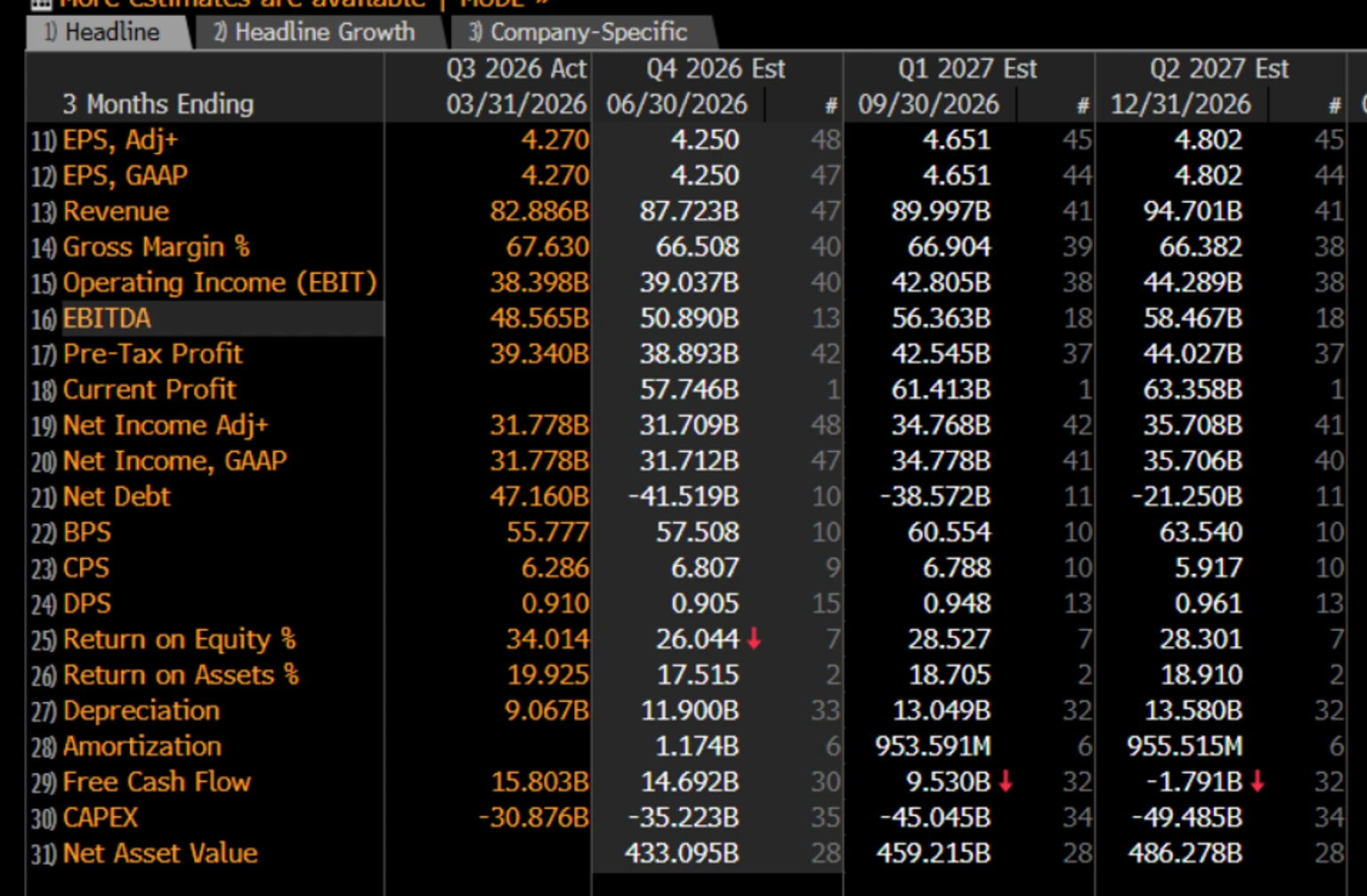
(Source: Bloomberg)
Consensus expectations for the reporting quarter (Q426):
- •Q4 Revenue: $87.72bn +14.8% (Azure: $8.85bn)
- •Q4 Adjusted EPS: $4.25
- •Q4 Gross Margin: 66.5%
- •Q4 Operating Income: $39.1bn
- •Q4 CAPEX: $35.22bn
Expectations for guidance (Q127):
- •Q1 FY2027 revenue: $89.99bn (Azure:
- •Q1 FY2027 gross margins: 66.90%
- •Q1 FY2027 EPS $4.65.
Consensus forecasts continue to imply strong revenue acceleration into FY2027, although investors will ultimately judge whether management believes these expectations remain achievable.
Options market pricing elevated volatility
The options market is currently implying a move of approximately ±6.5% following the earnings release.
That equates to one of Microsoft's larger implied earnings moves in recent years and reflects just how important this result has become for the broader AI investment narrative. Historically Microsoft has averaged a one-day post-earnings move closer to 3.8%, highlighting that traders are expecting substantially larger-than-normal volatility this quarter.
Technical levels to watch (Pepperstone 24-Hour CFD)
Microsoft has spent much of July attempting to stabilise following the sharp June decline and is now trading just below its falling 50-day moving average.
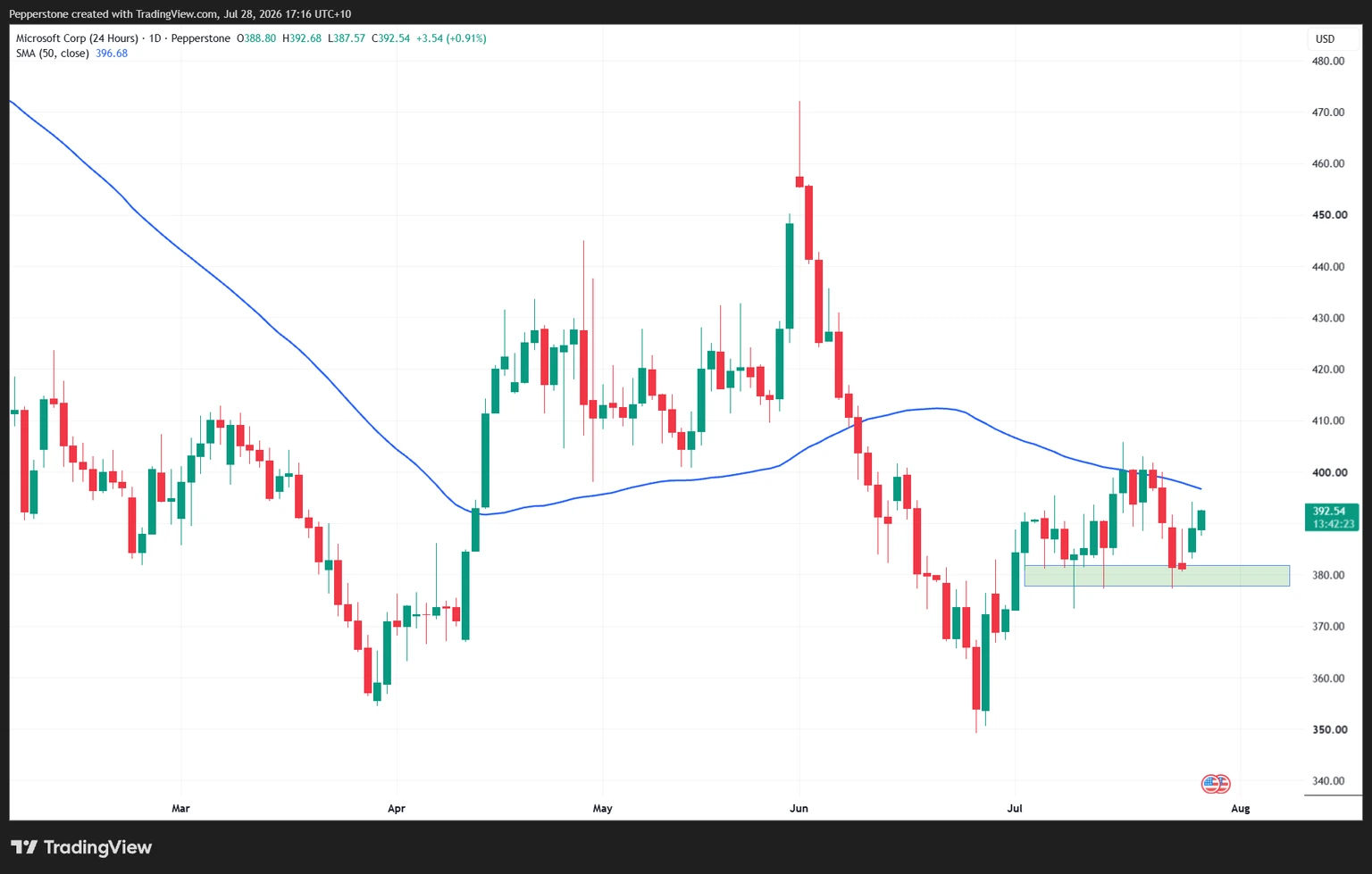
Resistance
- •$396.68 - 50-day SMA
- •$400/$405 - psychological resistance and the July swing highs
- •$430 – Supply zone seen in April and May & 200-day SMA
- •$472 – 1 June highs
A close above the 50-day average following earnings would suggest momentum is beginning to shift back towards buyers.
Support
- •$380 – demand zone seen throughout July
- •$350 – 52-week lows
Given the implied ±6.5% options move, traders should be prepared for price action extending well beyond these initial levels immediately after the release.
Bottom line
Microsoft's Q4 results will almost certainly be viewed through one lens: is AI investment beginning to generate the returns investors have been waiting for?
Headline beats on revenue and earnings are increasingly expected. The larger share price reaction is likely to depend on four variables:
- •FY2027 capex guidance
- •Free cash flow trajectory
- •Margin outlook
- •Azure and Copilot guidance
If management can convince investors that Azure growth is accelerating, Copilot adoption continues gathering momentum, margins remain resilient and free cash flow begins recovering despite elevated AI investment, Microsoft's earnings could become the catalyst that restores confidence across the AI complex.
Conversely, another step-up in capex without a corresponding improvement in monetisation or free cash flow would likely reinforce the market's growing concern that AI infrastructure spending is running ahead of near-term returns.
The material provided here has not been prepared in accordance with legal requirements designed to promote the independence of investment research and as such is considered to be a marketing communication. Whilst it is not subject to any prohibition on dealing ahead of the dissemination of investment research we will not seek to take any advantage before providing it to our clients.
Pepperstone doesn’t represent that the material provided here is accurate, current or complete, and therefore shouldn’t be relied upon as such. The information, whether from a third party or not, isn’t to be considered as a recommendation; or an offer to buy or sell; or the solicitation of an offer to buy or sell any security, financial product or instrument; or to participate in any particular trading strategy. It does not take into account readers’ financial situation or investment objectives. We advise any readers of this content to seek their own advice. Without the approval of Pepperstone, reproduction or redistribution of this information isn’t permitted.