- English
- Italiano
- Español
- Français


Gold Outlook: Geopolitical Tailwinds Fading, Nonfarm Payrolls Could Be the Deciding Factor
.jpg?height=93&quality=100)
Over the past week, gold found support during its pullback and stabilized before re-entering a consolidation range. Two themes continue to dominate: geopolitical developments and the Federal Reserve's potential rate trajectory.
Heading into this week, beyond the Middle East situation, traders will focus on key U.S. data releases — namely the ISM Services PMI and nonfarm payrolls — which could serve as the catalyst that breaks gold out of its current ranging pattern.
Technical Observation: Bulls and Bears Clash at $4,600 — $4,660 Key Resistance
Looking at the XAUUSD daily chart, gold extended its pullback from mid-April during the first half of last week, but found swift support after touching $4,500. Although price subsequently recovered above $4,600, the overall bias remains soft and directionless.
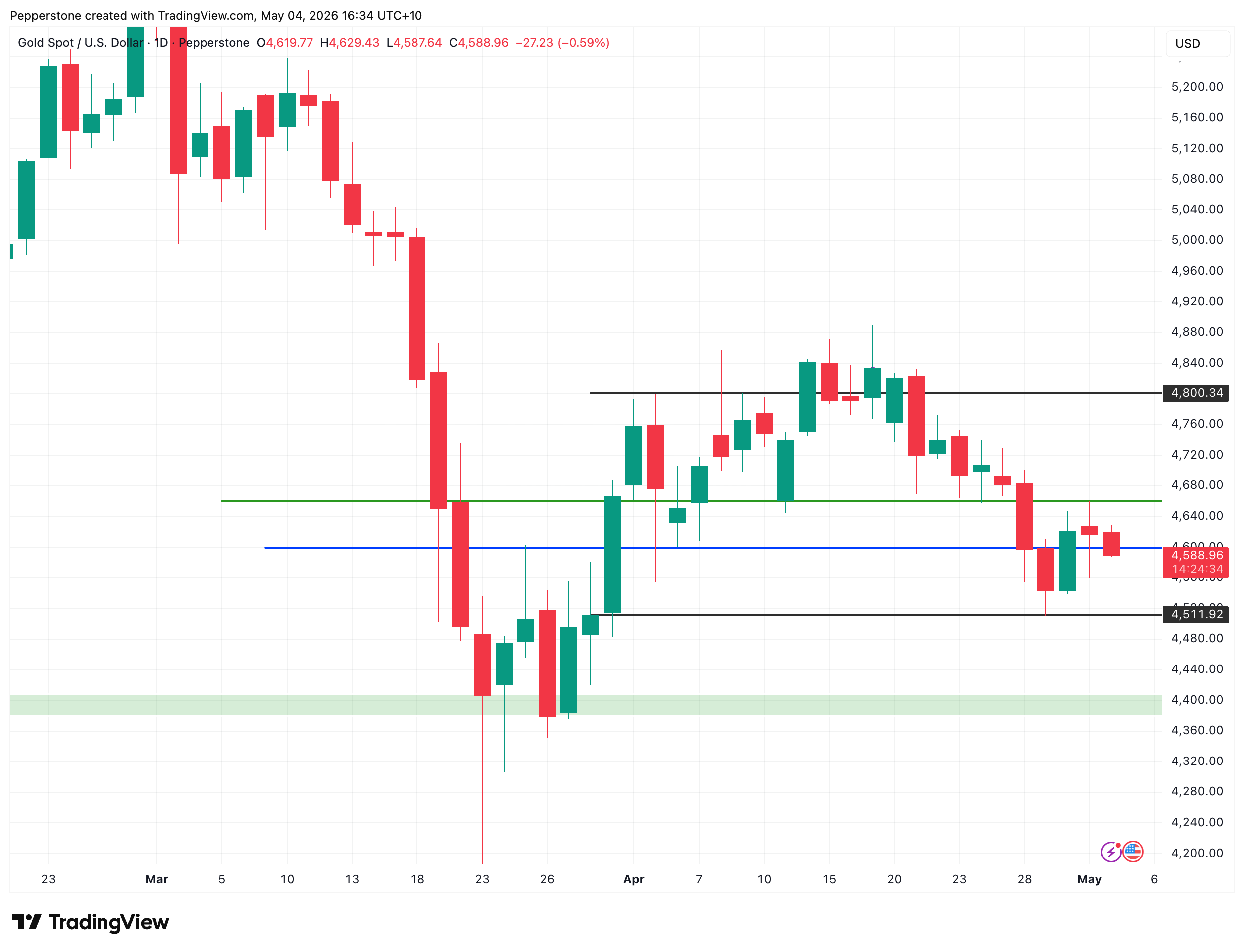
In the near term, $4,600 has emerged as the critical battleground between buyers and sellers. A sustained close above this level would help confirm a short-term base structure. Should price then push through $4,660, it would signal a gradual shift from bearish dominance toward equilibrium — potentially opening the door toward $4,800.
Conversely, a renewed break below $4,600 would bring $4,540 and then the $4,500 zone back into play as initial support.
It is worth noting that Chinese market participation has been reduced during the May Day Golden Week holiday (May 1–5). With a key market participant temporarily sidelined and headline noise elevated, gold faces two-way risks, and short-term volatility may be amplified.
Strait Shipping May Resume: Gold Markets Cautiously Optimistic
Since the outbreak of military conflict in the Middle East in March, geopolitical developments have been a significant driver of gold. However, markets have recently grown noticeably less responsive to geopolitical tailwinds.
Last Friday, Iran submitted its latest response to the United States via Pakistan, proposing to advance nuclear discussions through a technical committee — briefly lifting expectations for a resumption of shipping through the Strait of Hormuz. President Trump also signaled on social media that negotiations were "productive" and announced the launch of an escort operation.
Despite this, gold failed to sustain gains after a brief test of $4,660 on Friday, instead pulling back to close lower. This reflects an important shift: market sensitivity to geopolitical good news is fading.
On one hand, the details of U.S.-Iran talks remain vague, and Trump himself stated he was "not satisfied" with Iran's proposal. NATO allies have also shown persistent reluctance to send warships in response to U.S. calls for assistance. In the absence of tangible progress, the market's willingness to price in diplomatic noise has cooled considerably.
On the other hand, even if tensions were to ease, a full resumption of shipping, insurance repricing, and supply chain normalization would all take time — limiting the near-term relief to oil prices and inflation.
As a result, gold traders maintain a cautiously optimistic stance on geopolitical news. Compared to the mild tailwind from easing inflation, the factors most likely to drive gold out of its range are demand-shock-driven growth fears and the extreme safe-haven sentiment they could trigger.
Warsh to Succeed Powell: Rate Constraints Remain in Place
Following Powell's final press conference as Fed Chair last week, Warsh is set to take over. His relatively dovish policy leanings briefly raised hopes among gold bulls given the metal's non-yielding nature. However, with inflation remaining persistently elevated, the pivot toward easing still appears to be some way off.
Meanwhile, Powell's retention as a Governor means that within the seven-member Board, the Trump camp holds only three seats (Bowman, Waller, and Milan) — insufficient to form a controlling majority and push policy meaningfully in a dovish direction. The "higher for longer" theme remains firmly in place and will continue to weigh on gold from the rates side.
That said, a more significant shift is emerging from a medium-term perspective. Warsh tends to favor reducing forward guidance, communicating less publicly, and downplaying the role of the dot plot. This suggests the Fed's policy framework may become less transparent and more discretionary.
Against this backdrop, markets will gradually transition from "trading the rate path" to "trading uncertainty." A more opaque policy function combined with elevated market volatility could strengthen gold's safe-haven appeal over the medium term, making it more sensitive to "expectation surprises" than to "policy direction" per se.
Ongoing Geopolitical Noise; U.S. Economic Data in Focus
On balance, gold remains caught between "incrementally easing geopolitical tensions" and "unyielding rate constraints," leaving the price action rangebound and modestly bearish.
Geopolitical headlines will continue to drive sentiment in the week ahead. But absent meaningful progress — such as a durable reopening of the Strait or a breakthrough on core issues between the parties involved — their impact on gold is likely to remain largely emotional rather than structural, with limited follow-through.
By contrast, U.S. macroeconomic data is taking on greater significance. April's ISM Services PMI is expected to remain in expansion territory. Beyond the headline figure, the "Prices Paid" sub-index deserves particular attention — it hit a near three-and-a-half-year high in March, and if it stays elevated, it could reinforce sticky inflation expectations, bolstering the Fed's wait-and-see stance and weighing on gold.
On the labor market front, markets expect April nonfarm payrolls to come in around 62,000 — a sharp slowdown from March's 178,000 — with the unemployment rate projected to hold at 4.3%.
If payrolls prove relatively resilient — say, 60,000–80,000 new jobs with unemployment at 4.3% — signs of economic durability could cap gold's upside.
If the data disappoints — closer to zero net job gains or unemployment rising to 4.4% or above — the Fed would face a harder balancing act between supporting employment and containing inflation. Gold might find some support in that scenario, but with inflation still far from cooling meaningfully, market pricing for rates remaining elevated over the next twelve months would be unlikely to reverse quickly.
Related articles

The material provided here has not been prepared in accordance with legal requirements designed to promote the independence of investment research and as such is considered to be a marketing communication. Whilst it is not subject to any prohibition on dealing ahead of the dissemination of investment research we will not seek to take any advantage before providing it to our clients.
Pepperstone doesn’t represent that the material provided here is accurate, current or complete, and therefore shouldn’t be relied upon as such. The information, whether from a third party or not, isn’t to be considered as a recommendation; or an offer to buy or sell; or the solicitation of an offer to buy or sell any security, financial product or instrument; or to participate in any particular trading strategy. It does not take into account readers’ financial situation or investment objectives. We advise any readers of this content to seek their own advice. Without the approval of Pepperstone, reproduction or redistribution of this information isn’t permitted.