- English
- Italiano
- Español
- Français


Gold Outlook: Ceasefire Collapses, $4,000 in Sight, CPI and Warsh Testimony in Focus
.jpg?height=93&quality=100)
Gold came back under pressure last week. The escalation in U.S.-Iran tensions drove oil prices higher and revived concerns about a second inflation wave, eroding the momentum from the prior week's bounce. That said, the Strait of Hormuz has remained open to traffic, with no material disruption to energy supply yet — a factor that has kept a floor under gold and limited the downside.
Heading into this week, beyond any further geopolitical developments, the market's attention is squarely on Tuesday's double-barreled event: the U.S. June CPI release and Warsh's testimony before the House Financial Services Committee. A combination of sticky inflation and a hawkish tone from Warsh could accelerate gold's decline.
Technical Observation: Rangebound and Tilted Lower — $4,000 Is the Line to Hold
On the XAUUSD daily chart, gold continues to trade in a soft, directionless pattern. Having failed to push through $4,200 resistance, prices pulled back and ran into selling again near $4,135 — roughly where the 20-day moving average sits — a sign that buyers still lack the conviction to drive a sustained recovery.
Gold opened Monday down 1.2% and is currently trading below $4,100. Short-term selling pressure remains dominant, though whether this tips into a new downtrend depends on how key support levels hold up.
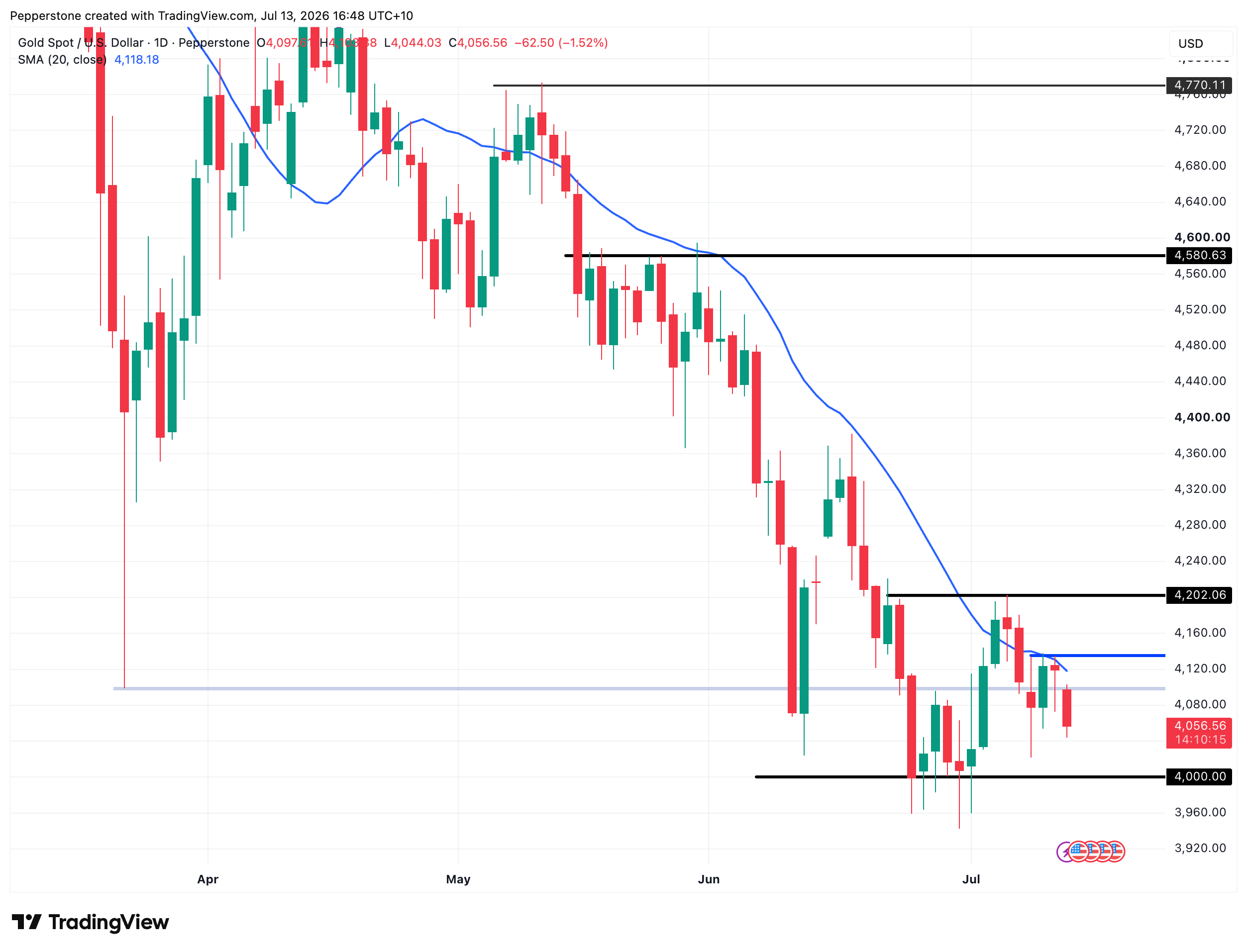
$4,000 is the critical near-term line in the sand. A decisive break lower on volume would strengthen the bear case and open the door toward $3,940–$3,960. On the upside, if prices stage a recovery, watch how gold behaves between $4,096 and $4,115 — a sustained hold above that zone would bring $4,200 resistance back into focus.
Ceasefire Breakdown Fans Inflation Fears — Gold Pulls Back
The renewed geopolitical escalation was the direct trigger for gold's pullback.
The collapse of the U.S.-Iran ceasefire pushed oil prices higher and reignited fears of a fresh inflation flare-up. As a result, market pricing for a Fed rate hike in September climbed from around 57% to above 67%, with hawkish rate expectations emerging as a meaningful headwind for gold.
The trade logic that has dominated since the conflict erupted in late February has reasserted itself: higher inflation risk → more hawkish Fed → higher opportunity cost of holding gold → downward pressure on prices.
At the same time, in an environment of rising rate expectations, safe-haven flows have tended to favor the dollar over gold. As a non-yielding dollar-denominated asset, gold typically faces additional headwinds when the greenback firms.
That said, gold's reaction to this latest flare-up has been relatively contained compared to the early days of the conflict. Data indicates that around 20 oil tankers successfully transited the Strait of Hormuz under escort on Sunday — a signal that markets are focused on whether supply is actually being disrupted, not just on the political rhetoric.
If the Strait were to face a full closure and oil prices surged back toward conflict-era highs, gold would likely come under significantly greater pressure. But absent a further loss of control, geopolitical risk remains more of a short-term source of volatility than a driver capable of setting a new directional trend on its own.
Watching U.S. CPI and the Warsh Testimony
With geopolitical risk premium back in the picture, the near-term bias for gold is tilted to the downside. Beyond monitoring Strait of Hormuz shipping conditions, Tuesday's CPI print and Warsh's testimony are the events most likely to guide gold's next move. Until then, the market is likely to stay cautious and range-bound.
Consensus expects headline CPI to ease from 4.2% to 3.9% year-over-year, with core CPI stays at 2.8%. If inflation comes in as expected or softer, September rate-hike bets could ease, pulling Treasury yields and the dollar lower and giving gold some room to breathe. If the data surprises to the upside, a stronger dollar and rising yields could push gold toward a test of $4,000.
Warsh's House testimony begins roughly 90 minutes after the CPI release. With the Fed having moved away from forward guidance and toward a more data-driven approach, markets will be watching closely to see how Warsh navigates the tension between rising inflation risks and a softening labor market.
The latest geopolitical developments and their impact on oil add another layer of complexity to Tuesday's risk setup. If the "backward-looking" CPI data and the "real-time" signals from Warsh's testimony point in different directions, gold may continue to chop between $4,000 and $4,200 — with the real trend call potentially waiting for data that more fully captures the conflict's impact on both inflation and employment.
The material provided here has not been prepared in accordance with legal requirements designed to promote the independence of investment research and as such is considered to be a marketing communication. Whilst it is not subject to any prohibition on dealing ahead of the dissemination of investment research we will not seek to take any advantage before providing it to our clients.
Pepperstone doesn’t represent that the material provided here is accurate, current or complete, and therefore shouldn’t be relied upon as such. The information, whether from a third party or not, isn’t to be considered as a recommendation; or an offer to buy or sell; or the solicitation of an offer to buy or sell any security, financial product or instrument; or to participate in any particular trading strategy. It does not take into account readers’ financial situation or investment objectives. We advise any readers of this content to seek their own advice. Without the approval of Pepperstone, reproduction or redistribution of this information isn’t permitted.