CFDs are complex instruments and come with a high risk of losing money rapidly due to leverage. 72.2% of retail investor accounts lose money when trading CFDs with this provider. You should consider whether you understand how CFDs work and whether you can afford to take the high risk of losing your money.
- English
- Italiano
- Español
- Français


Gold Outlook: Bulls Rally on Rate Cut Bets, Dip Buying Back in Favor
.jpg?height=93&quality=100)
Over the past week, precious metals broadly advanced, with gold bulls standing out. The rally is mainly driven by a sharp repricing of U.S. interest rate expectations: Fed officials have delivered consecutive dovish signals, December rate cut odds surged, and markets anticipate the next Fed chair may lean even more toward easing, all boosting bullish sentiment.
With the Thanksgiving holiday behind us, the market will return to a “data-driven” rhythm this week. Traders will focus on key U.S. economic releases, including ISM Services PMI, ADP employment data, and core PCE inflation. With the Fed entering a blackout period, even marginal data changes could trigger outsized market reactions.
Technical Outlook: Bulls Back in Control, $4,250 Key
Looking at the XAUUSD daily chart, gold buying regained momentum last week, with a nearly 3.8% weekly gain. While markets expected thin holiday trading, Friday’s strong push broke that assumption, allowing gold to comfortably surpass $4,200.
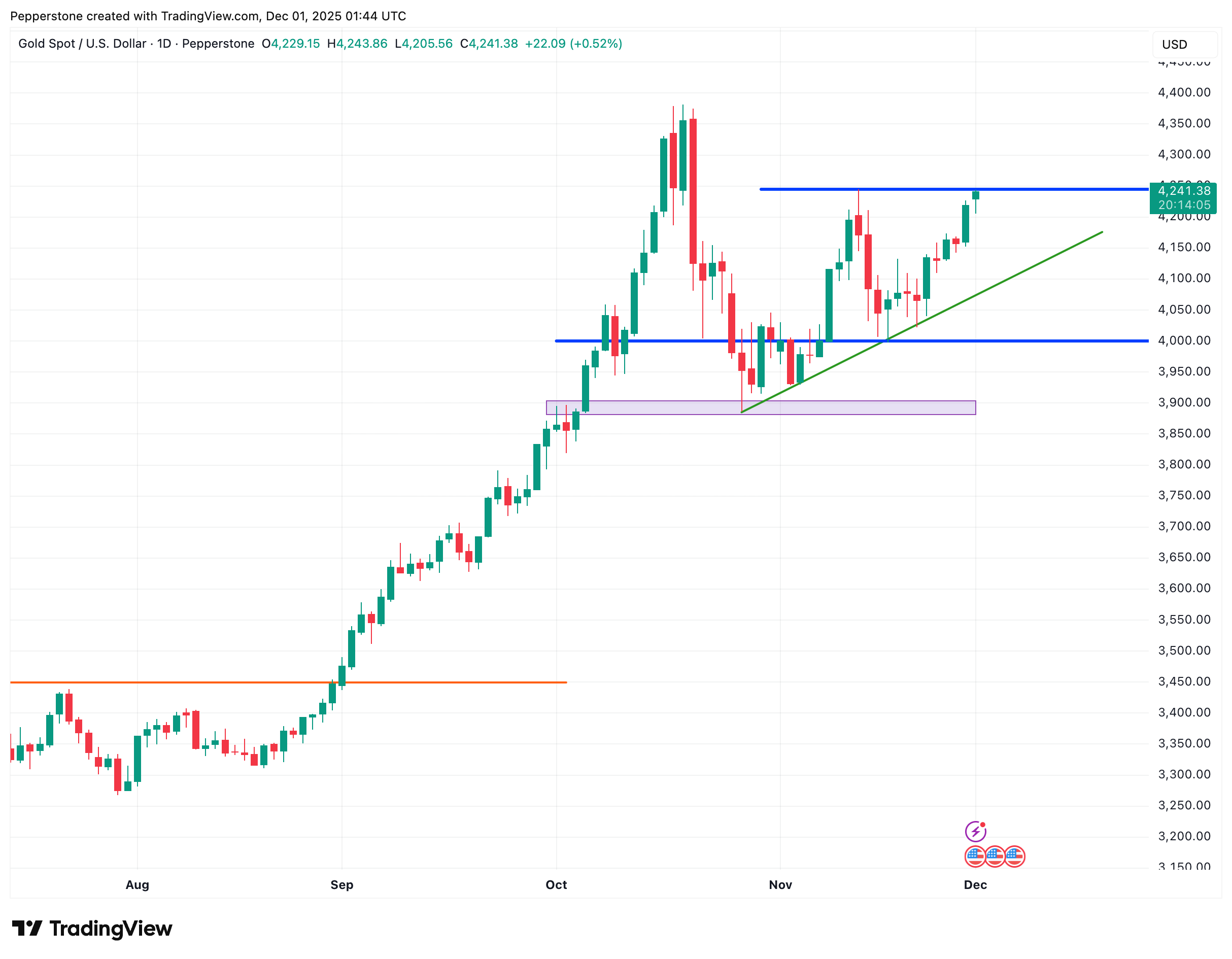
With the holiday over and CME’s earlier technical issues resolved, price discovery should be more robust this week. Gold is currently challenging its mid-November high of $4,250. A close above this level would open the door for a push toward $4,300 and potentially revisit the all-time high of $4,381.
On the downside, profit-taking at elevated levels could find support around $4,200 and further down at $4,130. Overall, technicals remain bullish, though the strength of the breakout and market sentiment will need confirmation from this week’s data.
Fed Rate Cut Odds Surge, Supporting Gold Bulls
The recent acceleration in gold is mainly fueled by a shift in Fed policy expectations. Dovish tones are now clear—both Fed Governor Waller and NY Fed President Williams have publicly backed a December rate cut, altering the market’s baseline expectations.
Economic data also support this trend. U.S. retail sales slowed in September, consumer confidence fell to 88.7 in November—the lowest since April—and the Fed’s Beige Book showed cooling hiring, reduced hours, and even some layoffs, with consumer spending easing. Overall, U.S. economic momentum is weakening, while inflation, though moderating, remains sticky.
Against this backdrop, bets on a December Fed rate cut have surged, currently priced near 90%. Stronger rate cut expectations imply lower real rates, the key logic supporting a rise in non-yielding assets like gold.
Dollar performance reflects this shift. As the U.S. interest rate advantage fades, the dollar index has come under pressure. Meanwhile, policy shifts in Japan add to dollar weakness.
Sanae Takahashi’s aggressive fiscal stance has raised concerns over the continuation of Abenomics, while Ueda hinted at a possible December rate hike (current odds above 60%), increasing the potential for a yen rebound. If realized, this would further weaken the dollar and provide additional support for gold.
Hassett Poised to Lead, Dovish Tilt Boosts Gold
Treasury Secretary Janet Yellen indicated that President Trump may announce the next Fed chair before Christmas. Current NEC Director Hassett, a long-time proponent of Trump-style monetary easing, is the frontrunner, with betting markets pricing his nomination at roughly 64%.
Markets expect that if Hassett takes the helm, his stance will be more dovish, likely keeping rates lower than under Powell. This expectation has pushed traders to increase bets on future rate cuts and raises questions about Fed independence, naturally benefiting non-yielding, safe-haven gold.
Moreover, concerns over aggressive rate cuts heighten attention to U.S. debt expansion, while central bank gold buying provides a solid floor. Together, these factors make it difficult to break gold’s upward path in the near term.
Final Week Before the Rate Decision: Can Gold Keep Rising?
In short, gold bulls have surged recently, driven by higher December rate cut bets, a softer dollar, and expectations of a more dovish next Fed chair. Central banks continue to accumulate gold, and geopolitical risks remain, offering additional support.
In a low-rate, uncertain U.S. economic environment, gold’s path of least resistance remains upward, with dip buying still the prevailing strategy. Any short-term pullbacks are likely to be limited.
This week marks the final week before the December Fed meeting. Fed officials will enter a blackout period, amplifying the market impact of economic data. Key releases include Wednesday’s November ADP private payrolls and ISM Services PMI, and Friday’s delayed September core PCE.
Consensus is for ADP jobs to rise 10k, below 42k previously, while core PCE is expected to fall from 2.9% YoY to 2.8%. If results align, showing a soft labor market with controlled inflation, they could reinforce December rate cut bets, pressuring the dollar and modestly lifting gold. Even if employment improves slightly and inflation remains sticky, it’s unlikely to change market pricing for cuts, leaving gold in a narrow trading range.
Additionally, as major central banks diverge in policy paths—especially the RBA, RBNZ, and BoJ returning to a rate hike trajectory—traders should monitor yield differentials for both risk and opportunity when trading gold.
The material provided here has not been prepared in accordance with legal requirements designed to promote the independence of investment research and as such is considered to be a marketing communication. Whilst it is not subject to any prohibition on dealing ahead of the dissemination of investment research we will not seek to take any advantage before providing it to our clients.
Pepperstone doesn’t represent that the material provided here is accurate, current or complete, and therefore shouldn’t be relied upon as such. The information, whether from a third party or not, isn’t to be considered as a recommendation; or an offer to buy or sell; or the solicitation of an offer to buy or sell any security, financial product or instrument; or to participate in any particular trading strategy. It does not take into account readers’ financial situation or investment objectives. We advise any readers of this content to seek their own advice. Without the approval of Pepperstone, reproduction or redistribution of this information isn’t permitted.