- English
- Italiano
- Español
- Français


China Lowers 2026 GDP Target: Policy Focus Shifts to Structural Upgrades and Market Repricing
.jpg?height=93&quality=100)
Following the release of the government work report at the National People’s Congress (NPC), one of the most closely watched figures by the market is China’s 2026 GDP growth target, set at a range of 4.5%–5%, down from the previous 5% level.
Some traders interpret this adjustment as a sign that China’s economic momentum is slowing. The Hang Seng Index responded with a notable intraday drop, while the CN50 ended lower.
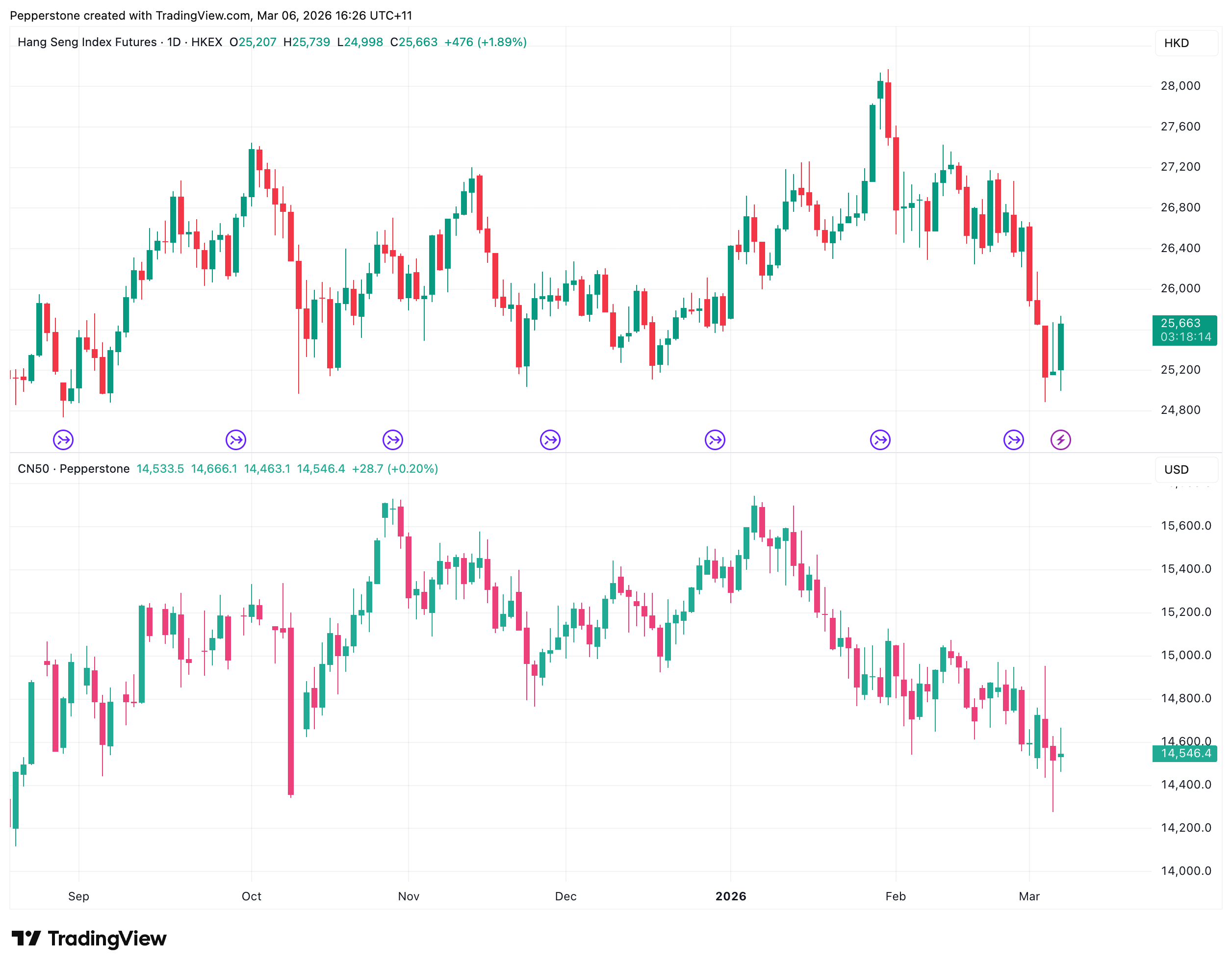
However, from the perspective of policy logic and the current macro environment, this appears more like a proactive policy recalibration—reserving space for economic structural transformation and the development of new growth engines amid complex domestic and external conditions.
For the market, the key point is not the number itself, but how policy direction is shifting and how capital markets will reprice these signals.
Lower GDP Target: A Sign of Pragmatic Policy
Historically, China’s GDP growth targets have often been viewed by the market as a “policy floor,” implying that the government will use policy tools to ensure the economy reaches at least this growth level. However, the newly announced 4.5%–5% range sends a clearer policy signal: authorities are willing to accept moderate economic growth in exchange for time to advance structural transformation.
This target aligns with China’s current economic reality. The property market remains in an adjustment phase, population aging pressures persist, deflationary risks remain, and external uncertainty is still high.
Against this backdrop, Beijing is attempting to transition the economy from the previous “dual-speed growth” model—driven by industrial production and exports—toward a new growth structure focused on technological innovation and domestic demand.
It is worth noting that the government work report emphasizes striving for “better results” in implementation, implying that the actual growth outcome may lean toward the upper end of the 5% range, leaving room for cautious optimism.
Policy Mix: Balancing Growth Stabilization and Structural Upgrades
While the GDP target provides a directional signal, the specific policy mix illustrates the likely trajectory for economic operations.
First, on the macro policy front, the report maintains a “more proactive fiscal policy + moderately accommodative monetary policy” stance. The fiscal deficit remains at 4% of GDP, with the central government planning to issue 1.3 trillion yuan in ultra-long special treasury bonds to expand domestic demand and support industrial upgrades. Local government special bond quotas total around 6 trillion yuan, roughly in line with last year.
Additionally, the report proposes approximately 800 billion yuan in new policy financial instruments to support infrastructure investment, leaving room for further policy support if needed.
Second, technological innovation and industrial upgrading remain core policy priorities. The report indicates that future technology spending will maintain roughly 10% YoY growth, focusing on AI, high-end manufacturing, and emerging industries. This further strengthens the concentration of policy resources on technology and innovation.
A third notable policy emphasis is inflation management and domestic demand circulation. While the CPI target remains at 2%, the report unusually includes “promoting prices from negative to positive” in the annual task list, signaling a desire to use moderate price recovery to improve economic circulation.
On the consumption side, the NPC announced 250 billion yuan in consumption subsidies, slightly lower than last year, along with an additional 100 billion yuan in government funds to boost domestic demand. Policy priorities focus on raising household income, supporting service consumption, and optimizing the consumption tax structure to sustain domestic demand.
Overall, this policy mix reflects a clear path: stabilize growth in the short term, promote structural transformation in the medium term, and cultivate new growth drivers in the long term.
Market Reaction: Sentiment-Driven More Than Fundamentals
During the NPC, market capital flows also showed notable patterns.
On the opening day of the NPC, southbound capital saw net outflows of nearly HKD 13 billion, marking the largest single-day outflow since August of last year. This triggered discussions about the outlook for Hong Kong stocks and Chinese assets more broadly.
However, looking at the capital structure, this outflow largely reflects short-term trading rhythm and shifts in risk appetite rather than fundamental pessimism.
First, amid heightened geopolitical tensions and increased global market volatility, traders are generally more cautious. The NPC itself is a sensitive window where policy signals intersect with market expectations, leading to temporary reductions in positions.
Second, at the individual stock level, the market did not experience broad-based sell-offs. For example, Tencent and some structurally supported sectors still saw net inflows, indicating traders are actively seeking policy-driven and structural opportunities.
From an asset allocation perspective, the moderate GDP target reduces expectations of large-scale stimulus, which could limit short-term upside for cyclical sectors. At the same time, policy resources are more concentrated in tech, innovation, and consumption-driven areas, reinforcing market attention on structural growth sectors.
For China’s broader market, with cautious overall inflows, a pragmatic growth target lowers the tail risk of “policy disappointment,” implying a higher probability of range-bound trading instead of sustained declines.
Key Variables to Watch Going Forward
Overall, the signals from the 2026 government work report are not pessimistic but indicate a more pragmatic and mature policy approach. By setting a more stable growth range, China is creating space for economic structural transformation while guiding resources toward technology and domestic demand.
For traders, market performance will depend on several key variables:
- Policy implementation.The GDP target itself is directional; the critical question is whether fiscal, industrial, and consumption-stimulating policies are consistently executed. Weak policy follow-through could dampen market sentiment. At the same time, achieving an average annual growth of 4.2% to meet China’s 2035 commitment to reach middle-developed economy levels will be challenging.
- Property market adjustment.Real estate remains in a deleveraging and structural adjustment phase. Although policymakers can stabilize the sector with non-budget tools such as relending programs, the sector could still weigh on overall economic growth until the next growth engine emerges.
- External environment.Geopolitical conflicts and U.S.-China trade frictions may impact market sentiment. A significant drop in export demand or limits on tech imports could slow the emergence of AI and advanced manufacturing as new growth drivers, affecting the pace of structural transformation.
In a world of high uncertainty, short-term market volatility is inevitable. However, over the medium to long term, as policy resources continue to tilt toward technology and domestic demand, China’s investment logic is gradually shifting from cyclical-driven to structure-driven, making structural opportunities in the market worth attention.
The material provided here has not been prepared in accordance with legal requirements designed to promote the independence of investment research and as such is considered to be a marketing communication. Whilst it is not subject to any prohibition on dealing ahead of the dissemination of investment research we will not seek to take any advantage before providing it to our clients.
Pepperstone doesn’t represent that the material provided here is accurate, current or complete, and therefore shouldn’t be relied upon as such. The information, whether from a third party or not, isn’t to be considered as a recommendation; or an offer to buy or sell; or the solicitation of an offer to buy or sell any security, financial product or instrument; or to participate in any particular trading strategy. It does not take into account readers’ financial situation or investment objectives. We advise any readers of this content to seek their own advice. Without the approval of Pepperstone, reproduction or redistribution of this information isn’t permitted.