- English
- Italiano
- Español
- Français


2026 US Midterm Elections: Who Wins Congress and Why Markets Care

What are the US midterm elections, and why do they matter?
On Tuesday 3 November 2026, Americans head to the polls to elect all 435 members of the House of Representatives and 35 of the 100 Senate seats.
The elections arrive halfway through Trump's second presidential term, making them a crucial referendum on his administration's performance and a potential turning point for US economic policy.
Republicans currently control both chambers, giving the administration greater scope to advance its legislative agenda.
Should Democrats capture one or both chambers, the balance of power in Washington changes materially.
A divided Congress could constrain new tax legislation, government spending and regulatory reforms. However, Trump would retain considerable executive authority over tariffs, sanctions, foreign policy and aspects of regulation.
For markets, the question isn't simply who wins. It's what the result means for growth, inflation, interest rates and corporate earnings.
Who currently controls Congress, and how many seats are being contested?
Republicans enter the midterms defending narrow majorities in both chambers, although the electoral arithmetic differs considerably between the House and Senate.
In the House of Representatives, the early-October composition stands at approximately 218 Republicans, 214 Democrats, one independent and two vacancies. All 435 seats are up for election, with 218 required for a majority in a fully occupied chamber. Democrats therefore need only a modest net gain to wrest control from Republicans.
The Senate presents a more challenging path. Republicans hold 53 seats, while Democrats hold 45, alongside two independents who caucus with them, giving Republicans an effective 53–47 majority. Of the 35 seats being contested, 22 are Republican-held and 13 Democratic-held. Democrats need a net gain of four seats to reach 51, assuming they retain their existing seats and the independents continue caucusing with them.
However, it's not simply which party wins, but the magnitude of that victory that matters for markets. A Democratic House majority exceeding 235 seats would provide greater leverage over legislation, spending negotiations and oversight of the Trump administration. Winning the Senate as well would strengthen Democrats' ability to block Republican legislation and appointments, potentially creating more sustained political gridlock. The size and composition of any majority would therefore shape expectations for fiscal policy, regulation and the administration's ability to advance its agenda.
This distinction is central to understanding why prediction markets assign different probabilities to Democratic control of the House and Senate, and why the final seat count could matter as much as the headline result.
What are prediction markets telling us?
With less than a month until polling day, prediction markets are signalling a meaningful shift in political power.
According to Kalshi probabilities displayed on Bloomberg on 8 October:
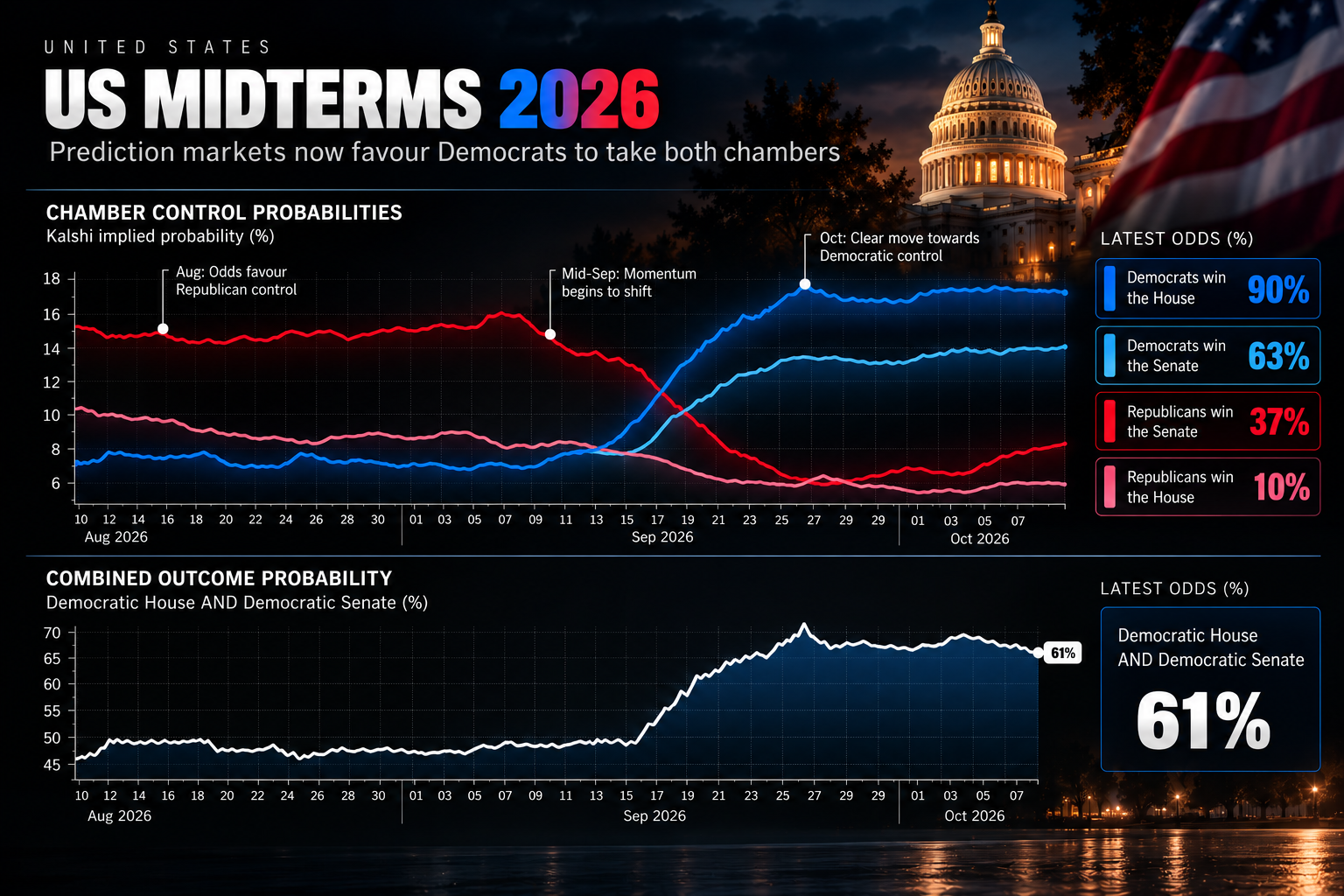
(Source: Kalshi, Bloomberg)
These are implied probabilities on exchange, not election results or guarantees.
What interests me is the distribution of expectations. A Democratic House victory is already heavily anticipated, while the Senate represents the more significant uncertainty.
A Republican hold of the Senate could therefore generate a more meaningful market repricing than a widely expected Democratic House victory.
What are the key policies being fought over?
Affordability is arguably the defining issue of this election.
Despite solid pockets of US economic growth and substantial AI investment, many households remain frustrated by elevated housing costs, energy prices, healthcare expenses and borrowing rates.
Trump's job approval stands at low 38.4%, against disapproval of 59.5%, while 63.2% disapprove of his handling of the economy, according to the Bloomberg data.
The principal policy battlegrounds include:
- Cost of living and taxes: Republicans are campaigning on growth, tax relief and investment, while Democrats are emphasising household affordability and the distribution of economic gains. The rise in data centres sits at the heart of the debate.
- Healthcare: Medicaid funding, insurance affordability and healthcare coverage remain major dividing lines, with potentially important implications for hospitals and insurers.
- Immigration: Border security and immigration enforcement remain central Republican themes, while Democrats are challenging the administration's approach and economic consequences.
- Tariffs and trade: Trump's trade agenda remains contentious, particularly where import costs affect businesses, farmers and consumers.
- Energy and foreign policy: Domestic energy production, the Iran conflict, fuel prices and America's international commitments have become increasingly important electoral issues.
- AI and regulation: The expansion of data centres, electricity costs, AI oversight and technology investment are emerging policy questions with direct implications for corporate America.
For investors, the policy mix matters because legislation can change the outlook for government borrowing, corporate profitability, inflation and sector valuations.
The Senate battlegrounds that could decide everything
The Senate contest could come down to a handful of states.
Maine, Iowa and Texas deserve particular attention. Kalshi currently prices Democratic victories in these Senate races at 58%, 45% and 66%, respectively.
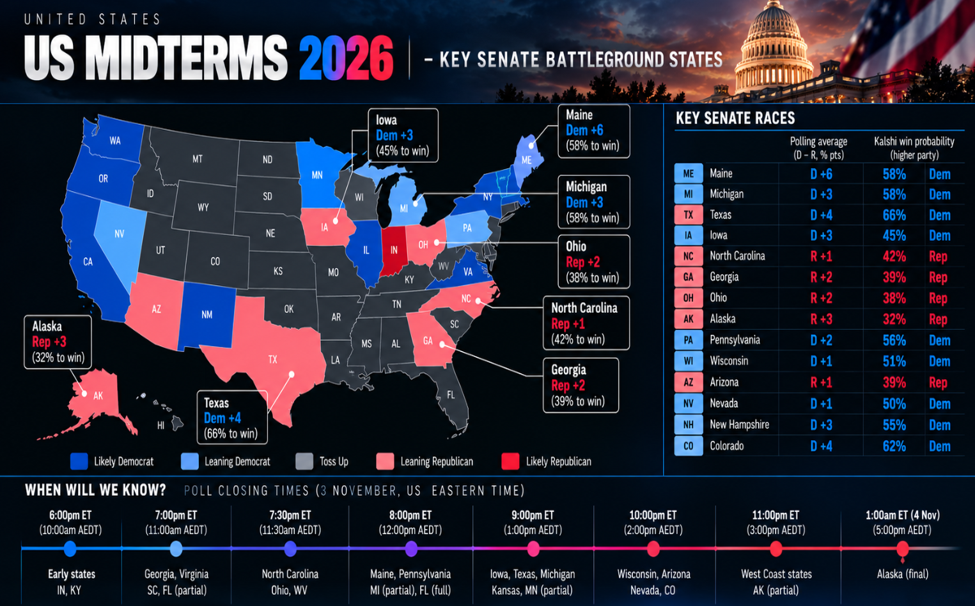
Texas is especially intriguing. A Democratic victory in this traditionally Republican state would signal a substantial political shift.
Maine offers Democrats a potential pickup opportunity, while Iowa has become more competitive amid pressure on household and agricultural costs.
North Carolina, Ohio and Alaska are also important Republican-held battlegrounds. Meanwhile, Michigan represents a crucial Democratic-held seat that Republicans could potentially capture.
These contests will help determine whether Democrats merely win the House or achieve the more consequential sweep of Congress.
For traders, individual state odds may provide an early indication of whether the national result is tracking expectations.
Three possible election outcomes and what they mean
Scenario one: Democratic sweep, 61% probability
Democrats win both the House and Senate, creating substantial congressional opposition to Trump's legislative agenda.
Markets could price greater constraints on fiscal expansion and deregulation, alongside increased political oversight.
Healthcare and renewable energy could benefit, while parts of financial services and traditional energy may face greater regulatory uncertainty.
Scenario two: Divided Congress, 29% probability
Democrats win the House, but Republicans retain the Senate.
This would produce legislative gridlock, reducing the probability of major new policy initiatives.
Historically, markets have sometimes welcomed gridlock as it reduces the risk of sweeping legislative changes. However, executive policy risks would remain.
Scenario three: Republicans retain Congress, 10% probability
The least likely outcome according to prediction markets, but potentially the biggest political surprise.
Republican control would preserve Trump's legislative flexibility, supporting expectations of deregulation and policy continuity.
However, investors could also revisit concerns about fiscal deficits, Treasury issuance and inflation.
What would the midterms mean for the 2028 presidential election?
The 2026 result will help shape the political landscape heading into the 2028 presidential election.
A Democratic sweep would provide the party with momentum, stronger congressional leadership and a platform to challenge the administration's policies over the final two years of Trump's term.
It could also strengthen the profiles of potential Democratic presidential contenders.
For Republicans, retaining Congress would validate Trump's political agenda and give prospective 2028 candidates a stronger platform.
Trump cannot be elected to a third presidential term under the Constitution's 22nd Amendment, making the question of who inherits his political coalition especially important.
However, the midterms do not determine the 2028 presidential winner. Candidate selection, the economy and events over the following two years could substantially change the political landscape.
When will we know the results? Key election-night times
For international traders, the election unfolds during the Asian trading session on Wednesday 4 November, with potentially significant implications for European market openings.
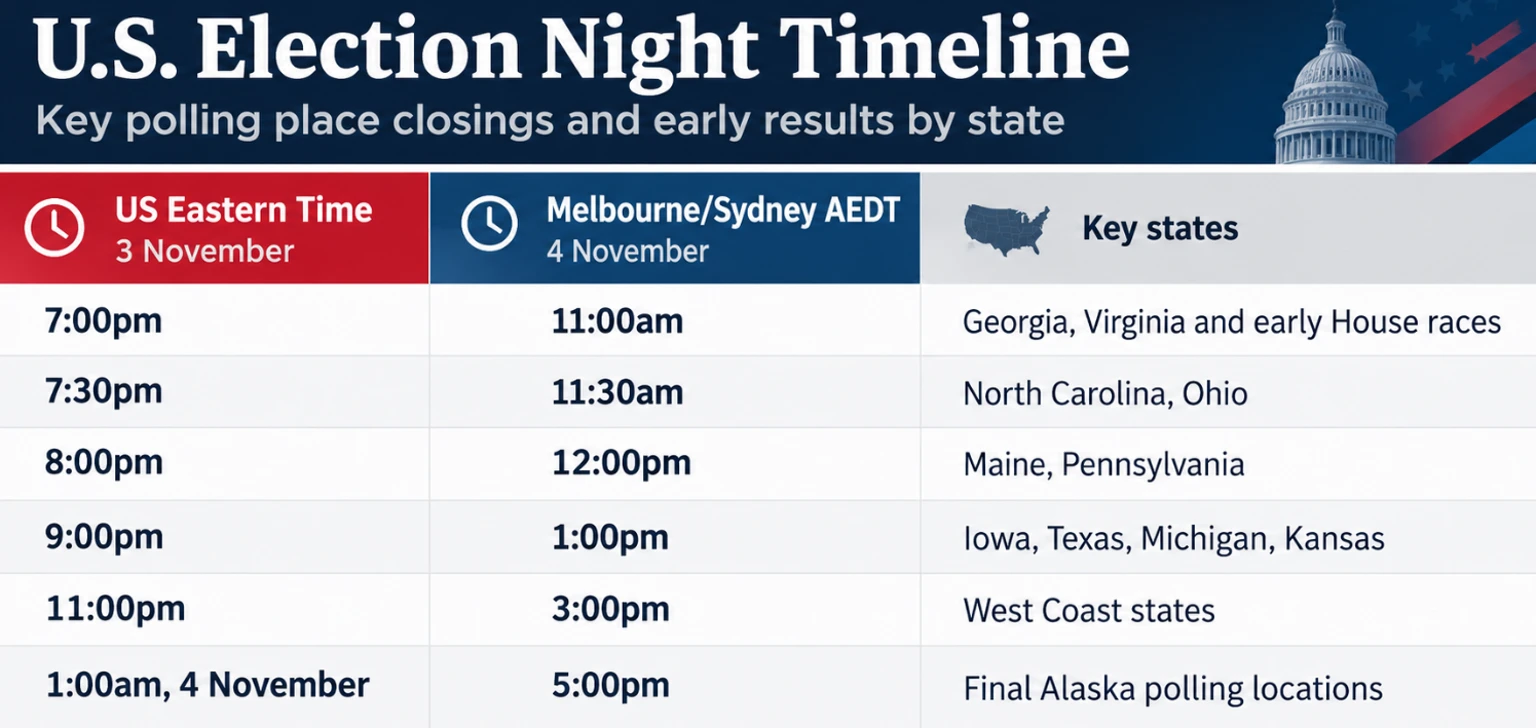
These are scheduled poll-closing times, not guaranteed result announcements.
A clear House majority could become apparent during the US evening. However, closely contested Senate races, postal votes and recounts could mean the final composition of Congress remains uncertain for hours or even days.
Why should traders outside the US care?
US political decisions rarely stay confined to America.
The US Treasury market influences global borrowing costs. Changes in US fiscal expectations can affect the dollar, which in turn influences EURUSD, GBPUSD, AUDUSD and USDJPY.
Gold responds to real yields, the dollar and geopolitical uncertainty. The S&P 500 and Nasdaq 100 influence global equity sentiment, while US energy policy can affect Brent and WTI crude.
For traders in Australia, Asia and Europe, the election also creates a potentially attractive timing dynamic. Major political developments could unfold while US cash equities are closed but FX, gold and equity futures are trading.
That combination can generate sharp moves, price gaps and changing liquidity conditions.
The opportunity is not simply to predict the political result, but to understand how the outcome alters expectations for interest rates, inflation, fiscal policy and corporate earnings.
Summary: The result matters, but the surprise matters more
The US midterms represent a potentially important market catalyst, but traders should distinguish between the political outcome and the financial market reaction.
A Democratic sweep is already substantially priced into prediction markets. What could generate the biggest moves is a result that challenges those expectations, changes the outlook for US fiscal policy or alters the trajectory of Treasury yields and the dollar.
For international CFD traders, the opportunity lies in understanding the probabilities, following the critical Senate races and being prepared for markets to reprice as the political picture becomes clearer.
The material provided here has not been prepared in accordance with legal requirements designed to promote the independence of investment research and as such is considered to be a marketing communication. Whilst it is not subject to any prohibition on dealing ahead of the dissemination of investment research we will not seek to take any advantage before providing it to our clients.
Pepperstone doesn’t represent that the material provided here is accurate, current or complete, and therefore shouldn’t be relied upon as such. The information, whether from a third party or not, isn’t to be considered as a recommendation; or an offer to buy or sell; or the solicitation of an offer to buy or sell any security, financial product or instrument; or to participate in any particular trading strategy. It does not take into account readers’ financial situation or investment objectives. We advise any readers of this content to seek their own advice. Without the approval of Pepperstone, reproduction or redistribution of this information isn’t permitted.