- English
- 中文版


Oil consolidates at highs: Escalation concerns give way to time premium pricing
.jpg?height=93&quality=100)
Entering late April, oil remains range-bound at elevated levels, with SpotBrent trading roughly between $93–$103.5 and showing limited directional bias.
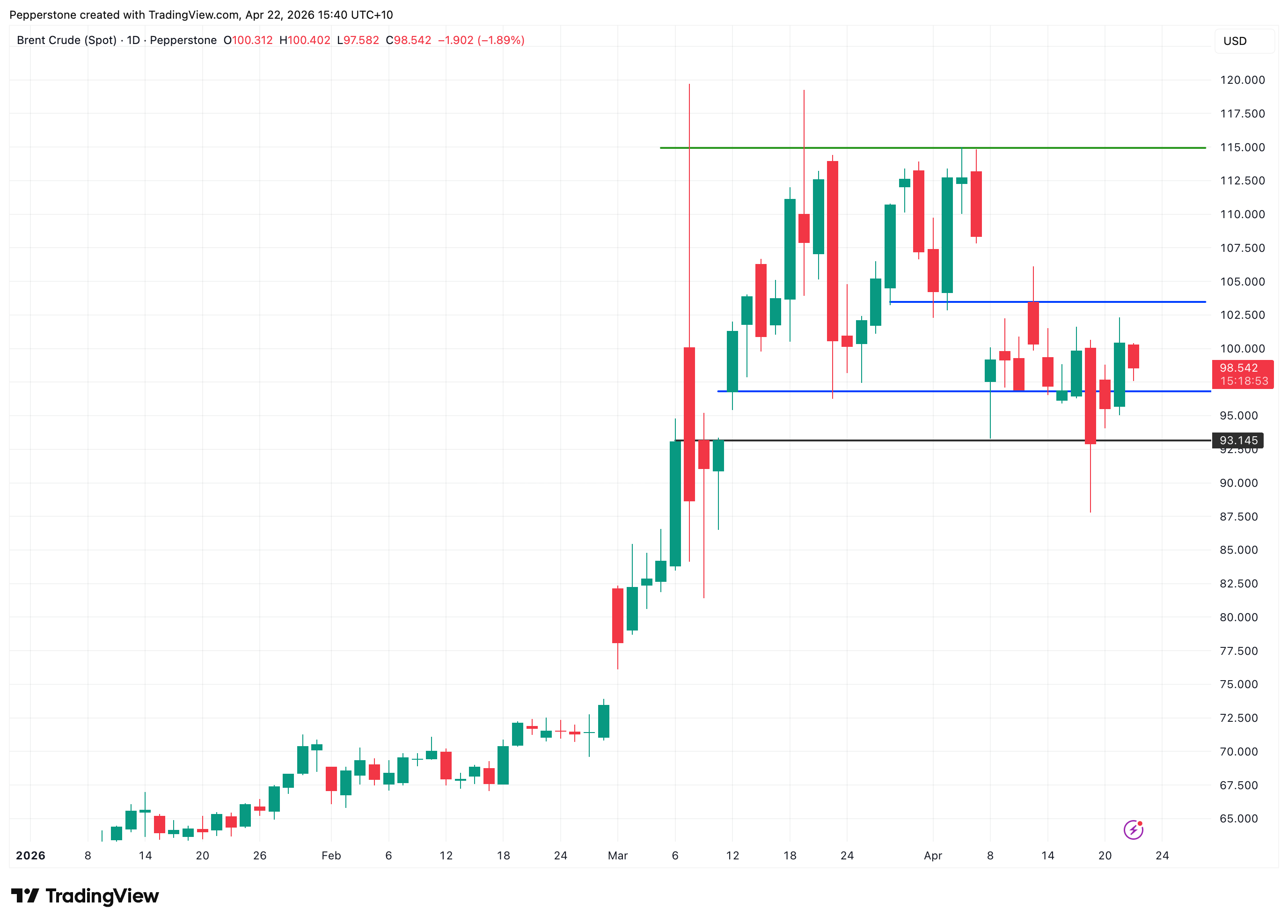
Behind the consolidation, the underlying pricing logic is gradually shifting—from escalation concerns to a more forward-looking assessment of how long uncertainty persists.
In this environment, headline volatility, incremental supply adjustments, and softening demand are collectively shaping a choppy but contained trading structure.
Shift in Trading Logic: From “Risk Premium” to “Time Premium”
The evolution of the oil market since the onset of geopolitical tensions can broadly be divided into two phases.
In the initial stage, prices were driven by extreme tail outcomes, including prolonged conflict, regional supply disruptions, and broader escalation risks. This rapidly expanded the risk premium embedded in crude.
However, as we move into April, the market focus has shifted away from whether tensions will escalate, toward how long this prolonged state of uncertainty will last under repeated negotiation cycles. In other words, the key driver has transitioned from the conflict itself to its duration.
As a result, oil’s reaction to headlines has become increasingly muted.
Markets now largely assume that both sides will continue to use negotiations as leverage, with no immediate resolution to long-standing structural issues such as nuclear negotiations and disputes over strategic shipping lanes. These are deeply entrenched disagreements that are unlikely to be resolved in the near term.
With much of the initial “peace optimism” already priced in, attention is shifting toward a more important variable: whether prolonged price elevation eventually forces a supply–demand adjustment that begins to dominate pricing.
US Crude: Export Surge ≠ Structural Supply Relief
Geopolitical disruptions have constrained Middle Eastern shipping flows, limiting the speed at which supply expectations can normalize. Against this backdrop, rising US crude exports have been viewed as a potential offset.
Recent US data shows net crude imports falling to around 66,000 barrels per day—the lowest since 2001—while exports climbed to roughly 5.2 million barrels per day, a seven-month high. While this has been interpreted by some as easing supply tightness, the structural picture is more constrained.
First, scale remains a key limitation. Prior to the conflict, flows through the Strait of Hormuz accounted for roughly 15–20 million barrels per day, while US production at around 13 million barrels per day is not sufficient to fully replace that volume. Even with higher output, export infrastructure is already operating close to capacity constraints.
Second, higher exports do not equate to incremental global supply. What is effectively occurring is a reallocation of domestic barrels rather than a net increase in supply to the system.
EIA data also shows that as of the week ending April 10, both crude and gasoline inventories declined significantly. Sustained exports supported by inventory drawdowns may further tighten domestic balances, potentially lifting local energy costs and indirectly weighing on consumption.
Overall, US crude is unlikely to act as a durable substitute for disrupted Middle Eastern flows, limiting its ability to meaningfully cap prices from the supply side.
Marginal Demand Weakness: Uncertainty Weighs on Growth Outlook
On the demand side, uncertainty is beginning to weigh on growth expectations. The IEA has sharply revised down its 2026 demand outlook to -80 kb/d, from +730 kb/d previously, with Asia emerging as the main drag due to weaker industrial activity and constrained feedstock supply impacting refinery utilisation.
Beyond industry, elevated oil prices are also starting to filter into transportation and aviation demand, where early signs of consumption fatigue are emerging.
Once demand begins to act as a counterforce, the upside elasticity of oil prices becomes structurally capped, limiting the likelihood of sustained upside continuation.
Tail Scenarios May Drive Breakout, but Direction Remains Uncertain
From the current structure, the base case remains continued consolidation at elevated levels. Market focus is gradually shifting from whether risk materialises to how and when the embedded risk premium will unwind.
Upside breakout risks remain tied to geopolitical escalation. If tensions in the Middle East intensify again—particularly through heightened military activity or further disruptions to key shipping routes such as the Bab el-Mandeb Strait—oil prices could see sharp, sentiment-driven spikes in the short term.
However, unless such developments evolve into sustained, system-wide supply shock, these moves are likely to remain temporary rather than directional, with prices eventually reverting back into the prevailing trading range.
On the downside, two key forces are in play. The first is progress toward a durable de-escalation and gradual normalisation of shipping flows through key chokepoints. The second is a broader macro slowdown driven by persistently elevated energy prices.
If visibility on supply recovery improves, or if demand data weakens more materially, oil could face a more pronounced corrective phase.
Overall, no single factor is strong enough to establish a sustained trend at this stage. However, the market remains highly sensitive to shifts in timing, risk perception, and headline flow. Risk management remains central for traders.
The material provided here has not been prepared in accordance with legal requirements designed to promote the independence of investment research and as such is considered to be a marketing communication. Whilst it is not subject to any prohibition on dealing ahead of the dissemination of investment research we will not seek to take any advantage before providing it to our clients.
Pepperstone doesn’t represent that the material provided here is accurate, current or complete, and therefore shouldn’t be relied upon as such. The information, whether from a third party or not, isn’t to be considered as a recommendation; or an offer to buy or sell; or the solicitation of an offer to buy or sell any security, financial product or instrument; or to participate in any particular trading strategy. It does not take into account readers’ financial situation or investment objectives. We advise any readers of this content to seek their own advice. Without the approval of Pepperstone, reproduction or redistribution of this information isn’t permitted.