
Summary
• Gold rejected multiple times at 5,100 and has pulled back to 4,941, showing signs of consolidation with a mild downside bias.
• Falling global inflation expectations and stable growth have reduced urgency to be in expressions of debasement trades.
• Higher real yields and improved fiscal optics in the US and Japan are removing key pillars of gold’s recent rally.
Gold Technical Outlook: Supply Wall at 5,100
Gold repeatedly hit a strong wall of supply at $5,100 throughout February before retreating to a low of $4,941. The failure to break higher suggests that upside momentum has stalled, at least in the near term.
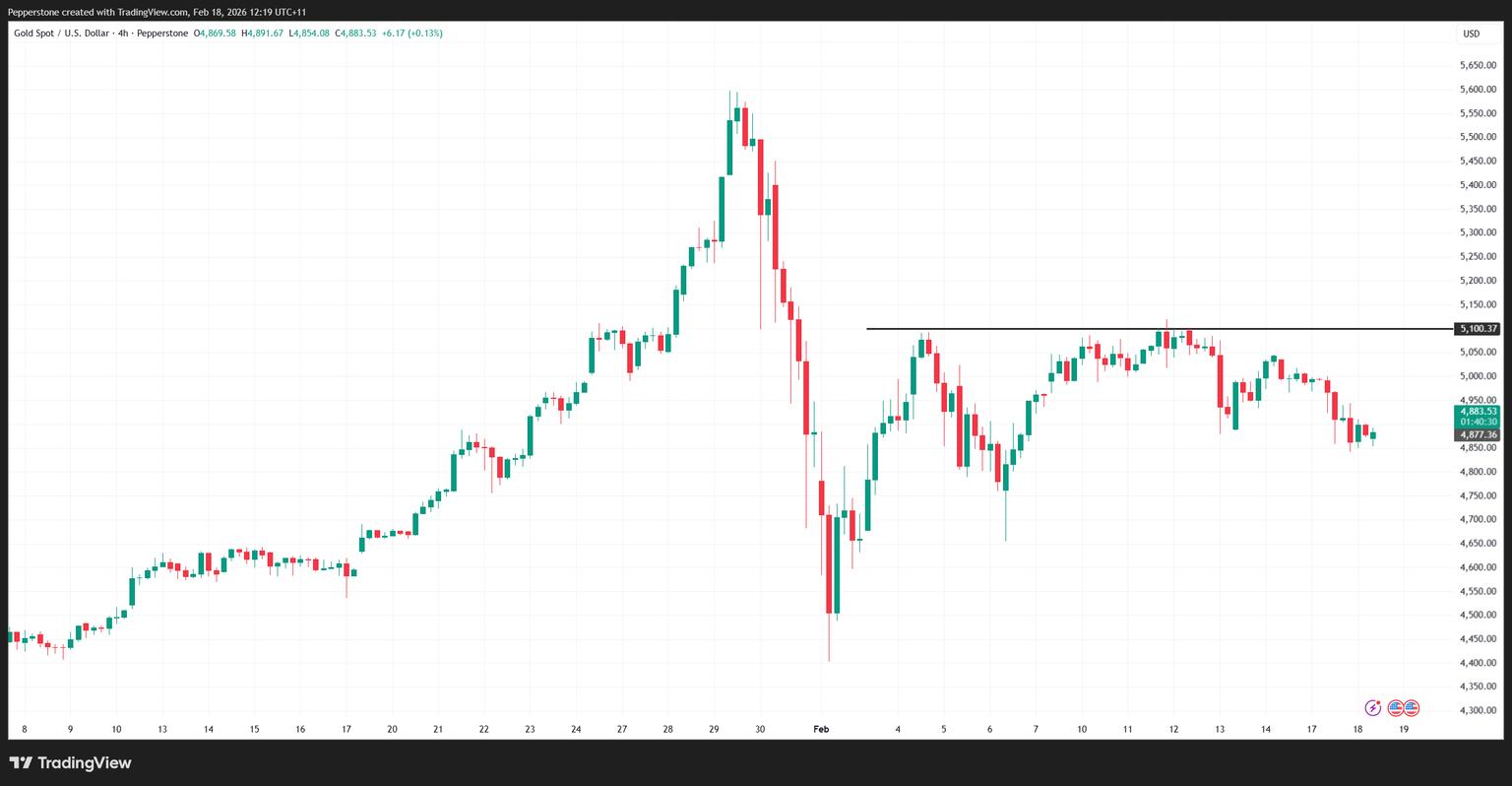
While sellers are currently exerting control, price action is not yet trending decisively lower. Instead, the market appears to be transitioning into a range-trading environment, where traders may look to trade defined levels rather than chase momentum.
Importantly, positioning data across various gold products still shows an extensive long bias. In the absence of a fresh bullish catalyst, that positioning overhang increases the risk of further consolidation or shallow pullbacks.
The Debasement Trades Lose Momentum
A core driver of gold’s rally has been the “debasement trade” - the idea that expansive fiscal policy, rising deficits, and persistent inflation would erode fiat currency value.
For now, that narrative has cooled.
Falling US Inflation Expectations
Market-based inflation expectations have declined meaningfully through February:
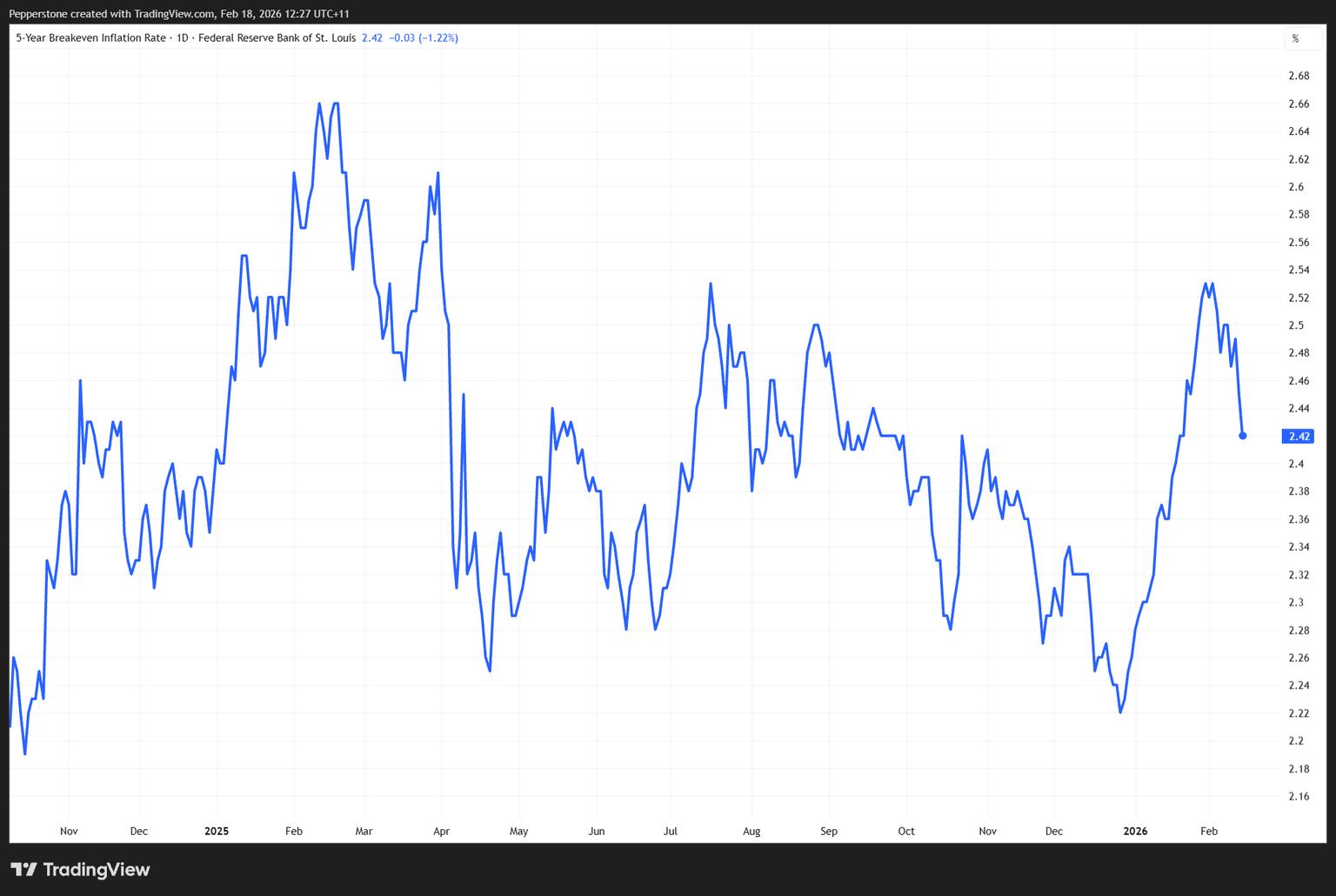
• US 5-year breakeven inflation have fallen from 2.59% to 2.42% (see chart above) - now comfortably within the Federal Reserve’s 2–3% inflation target range.
• US 2-year inflation swaps imply inflation of 2.35% two years forward, down from 2.63% on 29 January.
The move is not isolated to the US. Market-implied inflation expectations have also fallen across Japan, Europe, the UK, and Australia. That synchronised moderation reduces urgency for inflation hedges such as gold.
Rising Real Yields: A Possible Headwind Ahead for Gold
With inflation expectations declining and US Treasury yields not far from 12-month lows, real yields may begin to rise.
Historically, gold has shown sensitivity to movements in US real yields. While the correlation has weakened at times, structurally higher real returns on US Treasuries represent a symbolic and practical pullback from debasement-style trades.
If US real yields continue to firm, gold may struggle to regain upside momentum without a new macro catalyst.
Fiscal Optics: US Deficit Improvement Eases Concerns
Fiscal anxiety has also moderated.
The US deficit-to-GDP ratio has improved from 7.2% in January 2025 to 5.3% in 2026. While this remains elevated by historical standards, the improvement, partly supported by tariff revenues, has reduced immediate concerns about fiscal deterioration.
Additionally, commentary from Supreme Court Justice Brown Jackson suggests that even if the Court were to rule certain IEEPA tariffs unlawful, previously collected funds may not need to be reimbursed. This has reduced market fears of sudden fiscal disruption.
Lower perceived fiscal stress weakens one of gold’s key structural supports.
Japan: Relief Buying in Japan's Bond Market
Following Japan’s recent election and a market-friendly speech by PM Takaichi, concerns around aggressive fiscal expansion have eased.
This shift has been reflected in Japanese government bond markets, with 30-year JGB yields falling sharply from 3.87% to 3.39% on relief buying.
Reduced fears of fiscal blowout in Japan further diminish the global debasement narrative that had supported gold and silver.
Geopolitics and Fed Credibility
Geopolitical risk remains a variable factor for gold, but recent developments have been comparatively constructive around Iran and Ukraine–Russia.
Meanwhile, the announcement of Kevin Walsh as Fed Chair has reduced concerns about potential erosion of Federal Reserve independence. For investors who had bought gold as a hedge against Fed credibility risk, that thesis may now be less compelling.
Global Growth: Steady, Not Stalling
Global growth dynamics also matter:
• US growth remains solid.
• European growth is improving, albeit from low levels.
• Asian growth remains resilient.
With inflation moderating gradually and growth holding up, the Federal Reserve may lean toward holding rates steady rather than increasing the number of cuts. If markets reprice toward fewer cuts (for example, two instead of three), that would represent a modest headwind for gold.
Gold Outlook: Consolidation With a Downside Bias
Gold’s powerful rally toward 5,600 has stalled, and the market is now consolidating below major resistance at 5,100. The debasement trade, a key pillar of the advance, appears to have been shelved for now.
Absent a renewed inflation shock, fiscal deterioration, geopolitical escalation, or a sharp downturn in growth, gold may remain range-bound with a slight downside bias in the near term.
Which way it ultimately breaks will depend on the next macro catalyst. For now, traders may be better served focusing on defined ranges rather than assuming a continuation of the prior bullish trend.
Good luck to all.